
The Zushi Stalker Murder: Rie Miyoshi, the Disclosure of Her Address and Gaps in the Law
On November 6, 2012, 33-year-old Rie Miyoshi was killed at her home in Zushi, Kanagawa Prefecture, by a former partner who then died by suicide. She had reported threats and repeated emails, and had sought measures to keep her address confidential. Information was disclosed through both police procedures and a later municipal data leak. Because the perpetrator died, no murder trial was held. The case contributed to the 2013 amendment that brought repeated emails within the Stalker Regulation Act.
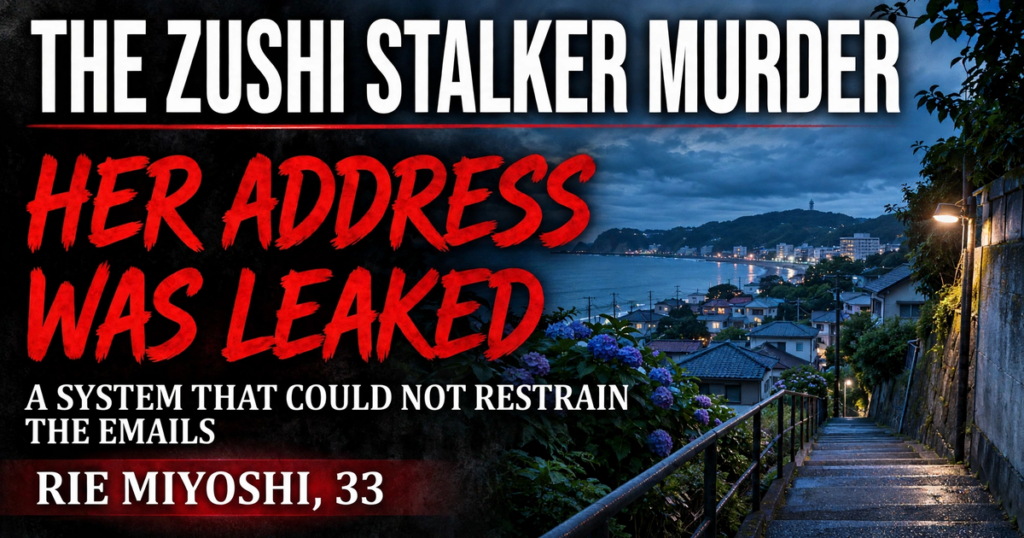
A former partner continued to contact Rie Miyoshi after their relationship ended
Rie Miyoshi, aged 33, had previously been in a relationship with Hideto Kozutsumi. After the relationship ended, he continued to contact her and sent threatening messages. Miyoshi married another man and moved to Zushi, Kanagawa Prefecture, seeking to keep her new surname and address from her former partner. She reported the threats to police. The case later showed that the danger did not end when the relationship ended or when the victim moved. It also exposed how information held by police and local government can become a safety issue when it reaches the person making threats.
A 2011 prosecution did not end the unwanted contact
In 2011, Miyoshi consulted the police about threatening emails. Kozutsumi was arrested for intimidation and was sentenced on September 20, 2011 to one year in prison, suspended for three years. The court also imposed probation-related conditions restricting contact with the victim. Miyoshi had asked that her married surname and new location not be disclosed to him. During the arrest procedure, however, officers read aloud information in the arrest warrant that included her married surname and part of her address. Police later acknowledged that the handling of the information should have been more carefully considered.
The victim's address was protected under a municipal support measure
On June 10, 2011, Miyoshi applied through Zushi Police Station for a domestic-violence and similar victim support measure that restricted access to her resident-registration information. She renewed the measure on June 28, 2012 after receiving further large numbers of emails. The measure was designed to make it harder for a stalker or other threatening person to discover a victim's location through official records. The existence of this protection was important: the city knew that the address was sensitive and that disclosure could expose Miyoshi to physical danger.
A municipal employee disclosed the address on November 5, 2012
On November 5, 2012, a person connected with an investigation company telephoned Zushi City and pretended to be Miyoshi's husband. The caller claimed to be checking a tax-related document and asked for her address. A municipal employee disclosed the address without adequately confirming the caller's identity or authority. The information was passed through the investigation company and reached Kozutsumi. A later civil judgment found that the employee's disclosure violated the protected privacy interest of a person covered by the support measure. The city subsequently acknowledged the leak and apologised to Miyoshi's family.
Miyoshi was killed the following day
On November 6, 2012, Kozutsumi went to Miyoshi's home in Zushi and killed her. He then died at the scene by suicide. Miyoshi was 33. The sequence made clear why address confidentiality was not a routine administrative matter: the information was being protected because the person seeking it had a history of threats and stalking. The murder was investigated by police, but Kozutsumi had died. He could not be prosecuted as a living defendant, and there was no criminal trial in which a court entered a conviction for the 2012 killing.
The earlier intimidation conviction is separate from the murder
Kozutsumi's 2011 conviction for intimidation remained a separate criminal case. It resulted in a one-year sentence suspended for three years. The later murder was not the subject of a trial because of his death. It is therefore inaccurate to say that a court convicted him of the 2012 murder or imposed a sentence for it. The facts of the killing were examined through the police investigation, municipal review and subsequent civil proceedings. Keeping the two legal stages separate is important when describing the case.
The civil court found that the city's disclosure was unlawful
In a civil action brought by Miyoshi's husband, the Yokohama District Court's Yokosuka Branch found that the municipal employee had disclosed protected address information without taking the required steps to verify the caller's identity and authority. The court ordered Zushi City to pay 1.1 million yen, including compensation and legal costs. The judgment treated the address as information requiring special care because the victim had requested a support measure to protect her from a former partner. The civil ruling concerned the city's unlawful disclosure; it was not a criminal conviction of the employee for murder or a finding that the employee intended the killing.
Zushi City changed its information-security procedures
After the incident, Zushi City apologised to the victim's family and strengthened its handling of resident information. The city introduced or improved warning displays for people covered by the support measure, biometric authentication using finger-vein patterns, stricter telephone and counter-service identity checks, and staff training. These changes were designed to reduce the risk of impersonation and unauthorised access. The city's own public explanation acknowledges that a staff member disclosed the information and that the incident led to stronger information-security controls.
The 2013 amendment added repeated emails to the law
At the time of the murder, the Stalker Regulation Act covered certain repeated telephone calls, faxes and other listed conduct, but repeated emails were not expressly included in the same way. The 2013 amendment was enacted on June 26 and promulgated on July 3. The provision covering repeated emails took effect on July 23, 2013; the remaining main provisions came into force on October 3. The amendment was a response to gaps exposed by cases including Zushi and the West-Saikai stalking murders. It should not be described as a law that applied retroactively to Kozutsumi's conduct.
The case involved two different failures of information protection
The Zushi case is often discussed in relation to both police procedures and municipal information management. During the 2011 arrest, police read out details that helped identify Miyoshi's married surname and area of residence. Separately, on November 5, 2012, a municipal employee disclosed her registered address to a caller posing as her husband. The two disclosures occurred in different procedures and should not be collapsed into a single event. Together they showed that victim protection requires careful handling of information at every stage, from arrest documents to local-government records.
Original Japanese record: 逗子ストーカー殺人事件|三好梨絵さんの住所漏えいと「連続メール」を規制できなかった制度
Last updated:
Related articles
Case record
The Kawasaki Stalking Murder: Nine SOS Calls, a Failed Police Response and a Pending Murder Trial
Case record
The Mitaka Stalking Murder: A Twenty-Two-Year Sentence, a Retrial on Remand and Digital Abuse

Case record
The Tomioka Hachimangu Shrine Murders
Case record