
The Kawasaki Stalking Murder: Nine SOS Calls, a Failed Police Response and a Pending Murder Trial
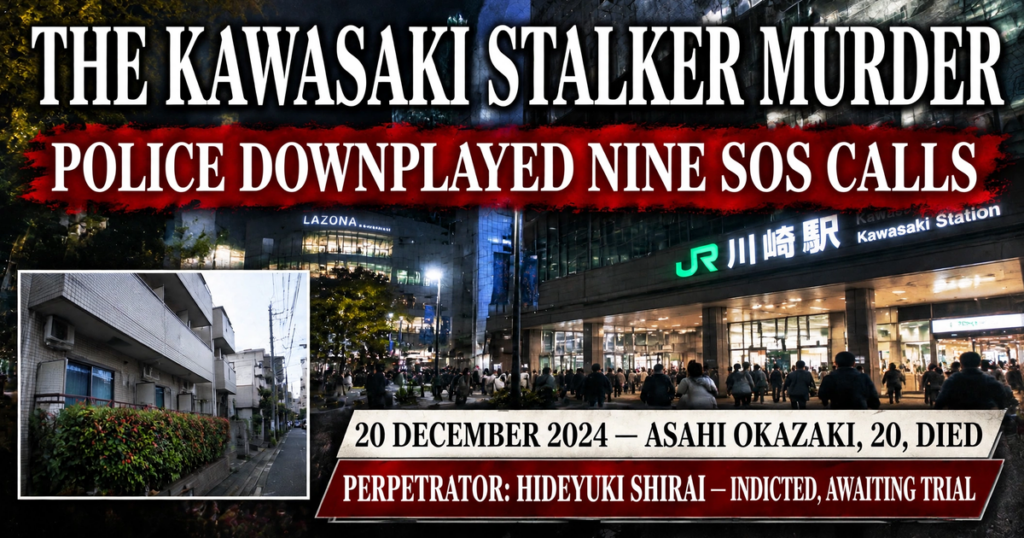
Twenty-year-old Asahi Okazaki disappeared on December 20, 2024, after repeatedly seeking police help about her former partner. Her remains were found under the floor of his home on April 30, 2025. A Kanagawa Prefectural Police review found serious failures in the handling of nine calls. The former partner has been indicted, but no verdict has been reached.
A twenty-year-old woman disappeared after repeated contact with police
Asahi Okazaki, aged twenty, disappeared from Kawasaki City on December 20, 2024. She had been living with her grandmother after separating from her former partner, Hideyuki Shirai, and had repeatedly contacted the Kawasaki Rinko Police Station about his conduct. The police review later established that she had made nine telephone calls between December 9 and December 20. At least three of those calls concerned alleged stalking by Shirai. Her disappearance was not an isolated event without warning: it followed months of reports about violence, unwanted approaches and renewed contact with the former partner.
Earlier reports in June, September and November were treated as separate incidents
The first recorded consultation came on June 13, 2024, when Okazaki reported that an argument with her partner had resulted in her clothing being torn. The police treated that matter as having calmed down after the couple reportedly ended the relationship, and the file was closed on July 5. On September 20, her father contacted police about an assault, and Okazaki submitted a victim complaint. She withdrew it on October 29. Two days later, her sister reported that someone had entered the sister's apartment, apparently the former partner. On November 5, the sister again contacted police after seeing him near the apartment bicycle parking area.
The police closed the second matter after reports of reconciliation
The police considered warning or prohibition measures under the Stalker Regulation Act after the November 5 report. However, the victim's wishes and the procedural steps were not confirmed quickly. Okazaki was temporarily out of contact from November 10 to November 19, and on November 22 she said that she and Shirai had reconciled and resumed living together. The police then treated the matter as resolved and closed the file. The official review later found that the closure decision was made without the required continuing oversight and without advice from the prefectural police headquarters. It also found that an assumption that the relationship problem had been resolved later affected how officers viewed the new calls in December.
Nine calls were made in the twelve days before she disappeared
Between December 9 and December 20, Okazaki called the Rinko Police Station nine times. The official review identified two calls on December 9 and one on December 12 as consultations about stalking by Shirai. A separate call on December 10 concerned Okazaki's own contact with him. The calls were answered by officers on duty. The three officers who handled the December 9, 10 and 12 calls did not create the required records of the calls or the responses. Officers also underestimated the danger and did not report the matter as a new personal-safety case to the station chief or the headquarters unit responsible for such incidents.
The police did not conduct the face-to-face checks required by the risk
The official report found that officers who spoke with Okazaki by telephone did not go to her location to interview her in person, did not sufficiently confirm the facts and did not summon or warn the former partner. On December 16 and 19, Okazaki also reported the theft of her bicycle and said that she believed Shirai was responsible, but the officers who took the reports did not recognize the connection to the stalking matter or share the information with the station's life-safety section. The problem was therefore not limited to a single missed call. Information from different contacts was not brought together into a coherent assessment of the risk.
The missing-person response began with further investigative failures
On December 22, relatives called police after finding a broken window at the grandmother's home and being unable to contact Okazaki. The police attended but did not photograph the damage or collect fingerprints. Officers considered the possibility that the window had been broken from inside and that Okazaki had left voluntarily. Her father filed a missing-person report on December 23. On December 24, she was classified as a special missing person, but the police did not immediately treat the case as one in which a crime might have endangered her life. The official review later found that the initial response lacked basic investigative steps and that important information from the family was not properly escalated.
The investigation did not change course despite warning information
After December 24, police received additional information that should have prompted a reassessment. Shirai admitted that he had been near Okazaki's home and had sent messages saying that he would not forgive her. Other information included the fact that her phone remained switched off, Shirai's suicide attempt on January 7, the deletion of social-media data, reports from his relatives about suspicious behaviour and information that Okazaki had not attended a planned reunion. The police also received a photograph relating to a sighting on December 20. The official review concluded that these warning signs were not combined into a sufficiently urgent investigation.
Her remains were found beneath the floor of Shirai's home
On April 30, 2025, police searched Shirai's home in connection with the stalking investigation and found Okazaki's remains beneath the floor. She had been missing for more than four months. Shirai was arrested on May 3 on suspicion of corpse abandonment. He was later arrested under the Stalker Regulation Act on May 28 and charged with that offence on June 18. On July 12 he was arrested on suspicion of murder, and on August 1 prosecutors indicted him for murder. The prosecution also charged him with corpse damage and abandonment. These are allegations in a criminal case; they are not a conviction.
The prefectural police publicly acknowledged serious failures
On September 4, 2025, Kanagawa Prefectural Police published a detailed review of the handling of the case. It concluded that officers had underestimated the danger, failed to record key calls, did not take appropriate initial action after the disappearance and did not adequately coordinate the life-safety and criminal-investigation departments. The police apologized. The review also identified a structural problem: the relevant units did not have a stable mechanism for sharing information and jointly deciding when a stalking case should be escalated. The police announced organizational changes and disciplinary action involving forty-three personnel.
The criminal case and the police review remain separate
The police review examined how officers handled Okazaki's consultations and disappearance. It did not decide whether Shirai was guilty of murder. That question belongs to the criminal proceedings. As of the Japanese source article's November 17, 2026 update, Shirai had been indicted for murder, corpse damage, corpse abandonment and a violation of the Stalker Regulation Act, but a first-trial date had not been confirmed. The case must therefore be described as pending, with no final verdict. The central public issue is the documented failure to treat repeated requests for help as a continuing safety risk, while the defendant's criminal responsibility remains for the court to determine.
Original Japanese record: 川崎ストーカー殺人事件|9回のSOSを過小評価した警察対応と検証報告書が明らかにした問題
Last updated:
Related articles
Case record
The Zushi Stalker Murder: Rie Miyoshi, the Disclosure of Her Address and Gaps in the Law
Case record
The Shinjuku Tower-Mansion Stabbing
Case record
The Kanagawa Two Robbery Murders: An Acquittal Reversed and a Death Sentence Later Upheld

Case record