
The Mitaka Stalking Murder: A Twenty-Two-Year Sentence, a Retrial on Remand and Digital Abuse
A teenager was murdered by a former partner in Mitaka in 2013. An appellate ruling addressed the use of uncharged conduct in sentencing.
An eighteen-year-old high-school student was killed in Mitaka
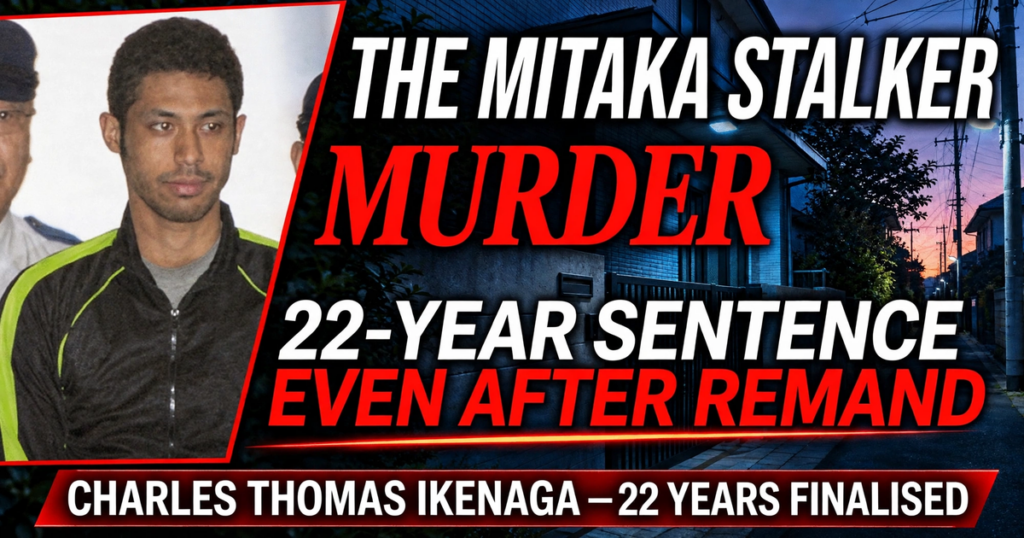
On October 8, 2013, 18-year-old high-school student Saaya Suzuki was killed near her home in Mitaka, Tokyo. The offender was her former partner, Ikenaga Charles Thomas. The relationship had ended, but Ikenaga continued to seek contact and meetings. He also used private images and videos made during the relationship as a means of pressuring her. The murder occurred after a period of stalking and threats. The case became known not only for the killing but also for the online dissemination of private images, which brought wider attention to the overlap between stalking, physical violence and digital abuse.
Suzuki and her father consulted police on the morning of the murder
Suzuki and her father went to Mitaka Police Station on the morning of October 8 to seek help. Her family had already asked Ikenaga to stop contacting her. He continued to demand contact and used the private images as leverage. Later that day, after police had begun responding to the consultation, Ikenaga attacked Suzuki near her home. The timing made the case particularly troubling: the victim and her family had sought help on the very day she was killed. The translation records that consultation and the subsequent attack without claiming that police could certainly have prevented the murder; the available source does not establish that counterfactual conclusion.
Private images were disseminated online around the time of the killing
Ikenaga posted private images and videos of Suzuki online before and around the time of the murder and directed other people to the material. The images were not merely a separate online dispute. They were part of the pressure used after the relationship ended and continued to harm the victim's dignity after her death. This account does not reproduce or describe intimate content. At the time, Japan did not yet have the later special legislation directly addressing the nonconsensual distribution of private sexual images. The case helped bring public attention to the need for a legal response to this form of abuse.
The first trial imposed a twenty-two-year sentence
On August 1, 2014, the Tachikawa Branch of Tokyo District Court sentenced Ikenaga to 22 years in prison. The prosecution had sought life imprisonment. The charges included murder, unlawful entry and firearms or weapons-related offences. The first court also considered the online dissemination of private images as a factor increasing the seriousness of the conduct. However, the image-posting conduct itself had not been separately charged as defamation at that stage. That procedural detail became central to the appeal. The dispute was not whether the image distribution was harmful; it was whether a court could use an uncharged separate offence as though it had been established in order to increase the sentence.
The Tokyo High Court quashed the first judgment and ordered a retrial
On February 6, 2015, the Tokyo High Court set aside the first judgment and remanded the case to the Tachikawa Branch of Tokyo District Court. The High Court reasoned that the first court had allowed the image-posting conduct to play a role in sentencing that went beyond what was properly covered by the charged offences. In effect, the defendant risked being punished for an uncharged defamation offence without having had a proper opportunity to defend against it. The reversal was a procedural ruling. It did not acquit Ikenaga of murder, approve the image distribution or conclude that the original sentence was too long for the murder itself.
The remand proceedings resulted in another twenty-two-year sentence
After remand, the prosecution reorganised the charges and the court held a new lay-judge trial. The proceedings addressed the image-related conduct through the appropriate legal process, rather than using it as an uncharged aggravating factor. In March 2016, the remand court again sentenced Ikenaga to 22 years in prison. The numerical result matched the first sentence, but the legal route was different. The first judgment had been quashed; the second followed a renewed trial in which the relevant conduct was handled through the proper charges and procedures. It is therefore inaccurate to say that the original judgment simply came back into force.
The sentence became final in 2017
Both the prosecution and the defence appealed the judgment after remand. In January 2017, the Tokyo High Court dismissed both appeals. No further appeal was filed, and the 22-year sentence became final in 2017. The final outcome was a conviction and a fixed-term prison sentence, not an acquittal. The procedural history matters because the first 22-year sentence was set aside for a legal error, and the second 22-year sentence followed a new trial. The High Court's 2015 ruling addressed the limits on how a court may use conduct that has not been charged, not the victim's credibility or the seriousness of the murder.
The case contributed to legal reform on nonconsensual image distribution
In 2014, Japan enacted the Act on Prevention of Damage Caused by Provision of Private Sexual Image Records, commonly called the Revenge Porn Prevention Act. The law created criminal penalties for certain forms of nonconsensual distribution and mechanisms to assist with removal of images. The Mitaka case was among the incidents that made the problem visible to the public. It showed that stalking can continue through digital channels and that harm may persist after a victim has been killed. The law was a response to a broader social problem; it should not be described as a law created solely because of this one case.
Original Japanese record: 三鷹ストーカー殺人事件|懲役22年が一度破棄された理由、差し戻し裁判とリベンジポルノ
Last updated:
Related articles
Case record
The Koganei Stalking Attack: A Victim's 110 Call, Police Dispatch Failures and the Limits of the Law
Case record
The Shinjuku Tower-Mansion Stabbing
Case record
The Tomioka Hachimangu Shrine Murders
Case record