
The Tomioka Hachimangu Shrine Murders
On 7 December 2017, chief priest Nagako Tomioka was killed near Tomioka Hachimangu in Tokyo, and her driver was seriously injured. Police said her younger brother and his wife carried out the attack before both died; the suspects were referred to prosecutors after death, and prosecutors declined the case without a trial.
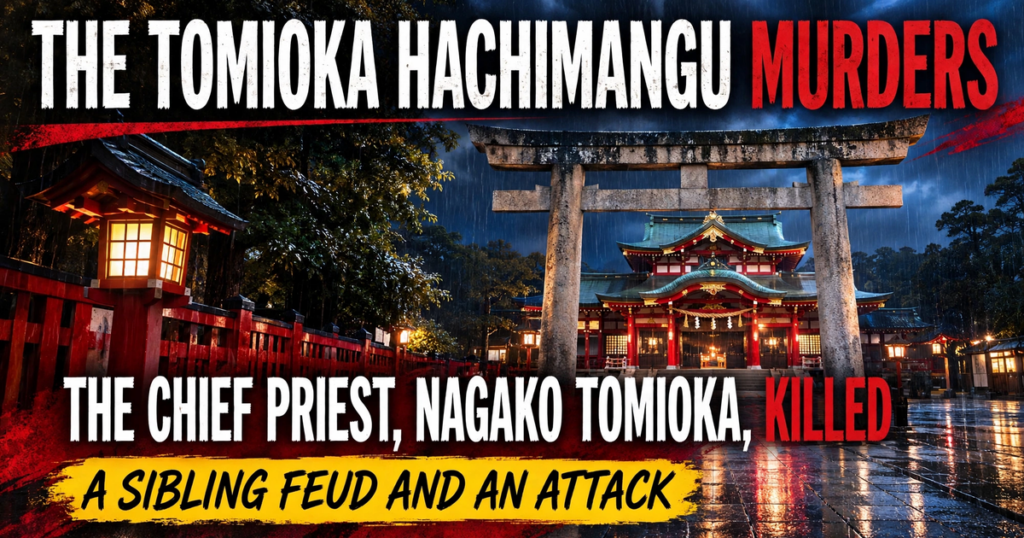
The chief priest was attacked near the shrine on 7 December 2017
At about 8:30 p.m. on 7 December 2017, Nagako Tomioka, the 58-year-old chief priest of Tomioka Hachimangu in Koto Ward, Tokyo, was attacked shortly after getting out of a car near the shrine. The Metropolitan Police Department’s investigation identified her younger brother, Shigenaga Tomioka, then 56 and a former chief priest, as the person who attacked her with a Japanese sword. The driver who had been transporting Nagako, a 33-year-old man, was also attacked by Shigenaga’s wife, Mariko, then 49, and seriously injured. He escaped from the scene.
The police investigation reconstructed a sequence involving three deaths
According to the police account, Mariko attacked the driver as he fled. The investigation further concluded that Shigenaga later stabbed Mariko in the shrine grounds, after which he died from a self-inflicted knife wound to his chest. The result was three deaths—Nagako, Shigenaga and Mariko—and one seriously injured survivor, the driver. Because both suspected perpetrators died, prosecutors did not bring them before a court. The sequence described in public accounts was reconstructed from the scene, surveillance cameras, documents and other investigative material rather than from testimony tested in a criminal trial.
The dispute over the shrine’s leadership had lasted for years
The attack followed a long conflict within the Tomioka family over the position of chief priest and the management of the shrine. Nagako and Shigenaga had been in conflict over succession and the family’s role in the religious institution. In 2002, Nagako reportedly consulted police about problems involving relatives and the priesthood. In 2006, Shigenaga was arrested on suspicion of threatening his sister after sending a postcard containing words to the effect that he would send her to hell. The history therefore extended well beyond the final dispute over the shrine’s relationship with the national religious organisation.
Nagako’s appointment was delayed and the shrine left the national association
From 2010 onward, Tomioka Hachimangu repeatedly asked the Association of Shinto Shrines to appoint Nagako as chief priest. Shrine parishioners and representatives of the shrine’s festival community also submitted petitions supporting her appointment. The association did not approve it, citing family disputes and litigation. In 2017, the shrine proceeded to end its institutional relationship with the association. The Tokyo Metropolitan Government certified the change to its religious-corporation rules on 28 September 2017, and Tomioka Hachimangu became an independent religious corporation, with Nagako serving as chief priest. The attack occurred about two months later.
The separation was part of the background, not a proven single motive
Documents attributed to Shigenaga called for Nagako to be removed, and a letter attributed to Mariko referred to longstanding resentment and a plan to kill her. These materials were part of the police investigation. The shrine’s separation from the Association of Shinto Shrines and Nagako’s appointment were close in time to the killings, but it would be inaccurate to reduce the motive to that one event. The history included the succession dispute, earlier threats, questions about financial support and the management of the shrine. Since neither suspect survived to stand trial, the documents and the police theory were never tested through a public criminal proceeding.
A warning had been sent five months before the attack
After complaints that Shigenaga was making calls to parishioners that disparaged Nagako, the shrine’s lawyer sent him a formal notice dated 10 July 2017. The notice warned that financial support from the family would be stopped if the nuisance behaviour continued. The reported calls had occurred in June and July. The behaviour was said to have stopped for a time after the warning, but the couple had rented a room near the scene and later evidence included multiple bladed weapons and written materials. A temporary reduction in visible contact did not mean that the risk had disappeared.
The driver escaped but was pursued and seriously wounded
The driver left the vehicle and ran after the attack on Nagako. Mariko followed him and cut him with a blade. Reports described a trail of blood extending for approximately ninety metres from the area behind the shrine toward a nearby supermarket, where the driver was found. He survived but suffered serious injuries. Police believed that Shigenaga and Mariko had taken separate roles in attacking Nagako and the driver. The couple’s alleged use of a room near the scene, the preparation of several blades and the division of targets were treated as indications of advance planning. These were investigative conclusions, not findings delivered after a trial.
Both suspects were referred to prosecutors after death
The Metropolitan Police Department referred Shigenaga and Mariko to prosecutors with the suspects deceased, on suspicion of murder, attempted murder and related offences. The referral concerning Shigenaga also included suspicion of killing Mariko at her request, based on the contents of a letter attributed to her. On 28 September 2018, the Tokyo District Public Prosecutors Office decided not to prosecute either of them because they had died. A referral to prosecutors is not an indictment, and a non-prosecution decision after a suspect’s death is not an acquittal. No criminal trial was held, and no court made a final finding of guilt against either person.
The shrine continued its religious activities after the killings
A shrine funeral for Nagako was held on 24 January 2018, with approximately three hundred clergy members and parishioners reported to have attended. A deputy chief priest served as acting chief priest, and the shrine continued its festivals and ordinary religious functions. The case was not only a fatal attack on a serving chief priest by a close family member. It also exposed a long-running conflict over succession, family relationships and institutional control. Because both suspects died, the precise motive and the full details of any agreement between them were never established by a criminal court.
Original Japanese record: 富岡八幡宮殺人事件|宮司の富岡長子さん殺害、姉弟対立と計画的襲撃の経緯
Last updated:
Related articles

Case record
The Ikebukuro Pokémon Center Stabbing
Case record
The Zushi Stalker Murder: Rie Miyoshi, the Disclosure of Her Address and Gaps in the Law
Case record
The Shimane University Student Murder: Miyako Hiraoka's Disappearance, a Deceased Suspect and 57 Images
Case record