
The Yamagata Gym-Mat Death: Divided Juvenile Rulings, Civil Liability, and the Third Compensation Judgment in 2026
Thirteen-year-old Yuhei Kodama was found dead inside a rolled gym mat at a junior high school in Shinjo in January 1993. Juvenile proceedings and civil litigation produced different findings; a 2004 civil judgment holding seven former students jointly liable became final in 2005, and a third damages action against three unpaid defendants became final in July 2026.
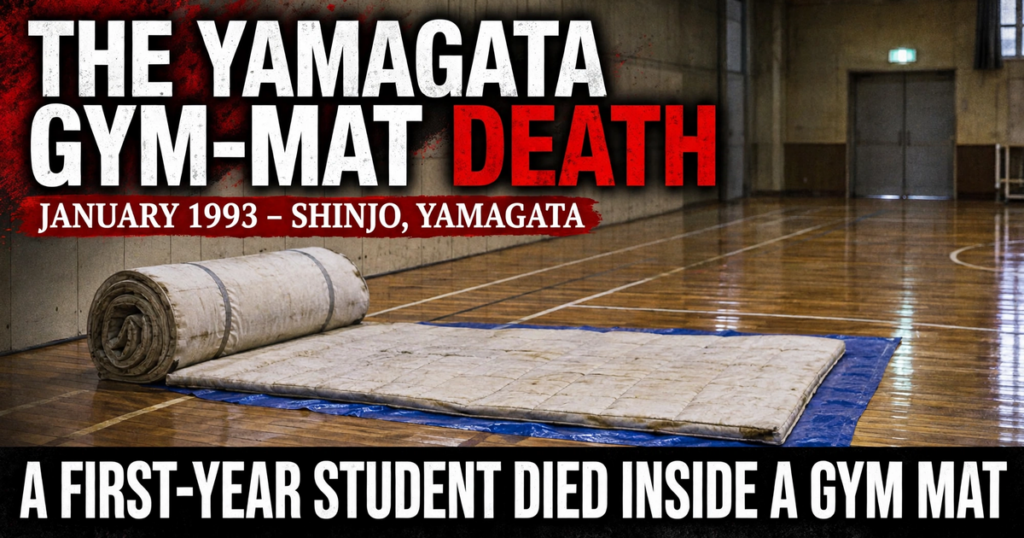
A first-year junior high school student was found dead inside a gym mat
On 13 January 1993, 13-year-old Yuhei Kodama was found dead in the equipment room of the gymnasium at Meirin Junior High School in Shinjo, Yamagata Prefecture. His head was inside the hollow centre of a long gym mat that had been rolled and stored upright. Later findings in civil litigation placed his death at around 7 p.m. that day. The unusual position of the body led investigators to examine whether other students had been involved. The case became known as the Yamagata Gym-Mat Death and developed into a complicated series of juvenile proceedings and civil lawsuits.
Seven students were arrested or otherwise brought into the investigation
Police investigated seven students who had contact with Kodama at school. They were treated as suspects in connection with alleged assault and confinement resulting in death, but the case did not proceed as an ordinary adult criminal trial involving seven adult defendants. Under the juvenile justice system then in force, six students were referred to the family court for juvenile proceedings. The remaining student was dealt with through a child-welfare guidance measure. The different ages and procedural routes matter: it is inaccurate to describe all seven as having been tried and convicted in an adult criminal court.
The family court found no delinquent act by three students
The Yamagata Family Court's juvenile proceedings produced divided results. Three of the six students referred to the court were found to have committed no delinquent act and received non-disposition decisions. In explaining the proceedings to the House of Representatives in 2000, the Ministry of Justice said that the court had rejected the reliability of their investigative statements and accepted their alibis. A juvenile non-disposition is not procedurally identical to an adult criminal acquittal, but it is a formal decision that the court did not establish the alleged delinquent conduct for those individuals.
Three other students received protective measures
The family court found involvement by three of the other students and imposed protective measures under juvenile law. The result was a split within the same juvenile proceedings: three students were found not to have committed the alleged act, while three others were subjected to protective measures. The seventh student had been handled through a child-welfare route rather than the same family-court process. This division later became important because subsequent appellate and civil proceedings addressed the alleged group conduct in ways that did not align neatly with the initial juvenile decisions.
The Sendai High Court's appeal decision referred to the involvement of all seven
The three students who received protective measures appealed, arguing that they had not participated in the incident. In November 1993, the Sendai High Court rejected their appeals. In its reasoning, it regarded the investigative statements as credible and referred to the involvement of all seven students, including the three who had already received non-disposition decisions from the family court. The appellate court did not, however, reopen the separate non-disposition orders and convert those three students into juveniles subject to protective measures. The appeal was concerned with the three protective measures, and the procedural status of the other three remained distinct.
The Supreme Court rejected the further appeals in 1994
The three students who received protective measures appealed. In November 1993, the Sendai High Court dismissed their appeals and treated the investigative statements as credible, referring to the involvement of all seven students, including the three whose non-disposition decisions were already final. It did not reopen those separate orders or impose protective measures on those three; only the three existing protective measures were under appeal. The Supreme Court rejected further appeals in 1994, leaving the measures in place. The case was later discussed in Diet debate about fact-finding in serious juvenile proceedings. The 2000 revision to the Juvenile Act included prosecutor participation in certain serious juvenile cases. None of these steps created an adult criminal conviction of all seven.
The first civil judgment rejected the family's damages claim
Kodama's family brought a civil damages action against the former students and others. On 19 March 2002, the Yamagata District Court rejected the family's claim. It did not find that the seven students had pushed Kodama into the mat, reasoning that the investigative statements were not sufficiently reliable. This civil judgment differed from the juvenile appeal reasoning that had accepted the statements as credible. The civil court was conducting a separate proceeding, with its own evidence and standards, rather than simply applying the earlier juvenile decisions.
The Sendai High Court reversed the civil judgment and found joint liability
On 28 May 2004, the Sendai High Court reversed the first civil judgment. Considering multiple statements, the bullying situation at the school, and the students' conduct before and after the incident, it found in the civil case that seven students had acted jointly, pushed Kodama headfirst into the hollow centre of the mat, and caused his death. The court ordered the seven former students to pay approximately 57.6 million yen in damages jointly and severally. The defendants appealed, but the Supreme Court dismissed their appeals on 6 September 2005. The civil finding of joint tort liability therefore became final.
The 2026 case concerned enforcement of an existing civil judgment, not a new criminal trial
Three former students had not paid the full amount covered by the earlier civil judgment. In November 2025, Kodama's family filed a third damages action against them. A second action had already been brought in 2016 to interrupt limitation and preserve the unpaid claim; the Yamagata District Court's second judgment became final on 23 August 2016. In the third action, the defendants again denied involvement. On 15 July 2026, the Yamagata District Court ordered payment to four family members, including principal amounts and delay damages. Reports described the total as approximately 112.6 million yen. The increase from the approximately 57.6 million yen in the 2004 judgment reflected decades of delay damages, calculated at the applicable annual rate of five percent, with amounts already recovered through enforcement taken into account.
The third judgment became final on 30 July 2026
Neither the plaintiffs nor the defendants appealed the 15 July 2026 judgment, and it became final on 30 July. The court did not retry the events of January 1993 from the beginning. The 2004 civil judgment had already established the basis of the family's damages claim, and the 2026 proceeding dealt with the existing claim, prior payments, limitation, and the remaining amounts. The defendants continued to deny involvement, but the final judgment applied the binding effect of the earlier decision. It did not create a new adult criminal conviction.
Juvenile findings and civil liability must be kept separate
The case has distinct juvenile and civil histories. The family court made non-disposition and protective-measure decisions; the 1993 appeal and 1994 further appeal concerned only three protective measures; the 2002 civil court rejected the claim; and the 2004 civil appellate judgment, final in 2005, established joint liability. The 2016 and 2026 actions preserved and enforced that civil claim. No adult criminal trial convicted all seven.
Original Japanese record: 山形マット死事件|児玉有平さんの死、少年審判の分裂と2026年3度目の賠償判決
Last updated:
Related articles

Case record
The Kyoto Kameoka Runaway Crash: Three Deaths, Seven Injuries and the Limits of the Former Dangerous-Driving Law

Case record
The Tojinbo Cliff Murder

Case record
Police Agency Wide-Area Important Designation Case No. 121: Five Robberies, Three Deaths, and Two Final Death Sentences
Case record