
The Hikari Mother-and-Child Murders: A Death Sentence and the Third Retrial Request's Move to the Supreme Court
On April 14, 1999, 18-year-old Takayuki Otsuki killed 23-year-old Yayoi Motomura and her 11-month-old daughter, Yuka, in Hikari, Yamaguchi Prefecture. His death sentence became final in 2012. In the third retrial request, the High Court rejected an objection on July 8, 2026; September 28 was the date the defence's special appeal to the Supreme Court was reported, not a dismissal date.
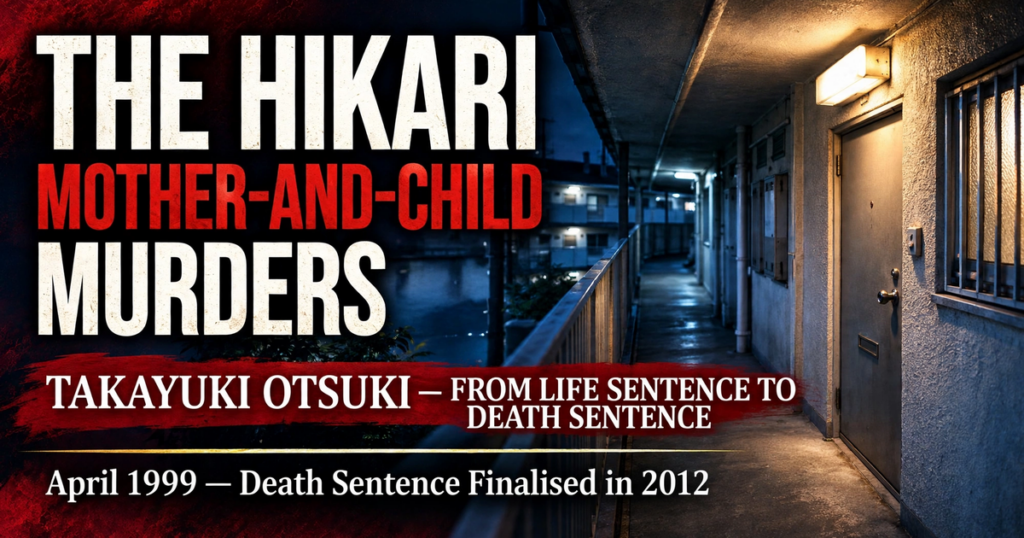
A mother and her infant daughter were killed in their company home
On April 14, 1999, 23-year-old Yayoi Motomura and her 11-month-old daughter, Yuka, were killed in a company apartment in Hikari, Yamaguchi Prefecture. The defendant, Takayuki Otsuki, was 18 years and one month old at the time. He entered the home while pretending to be carrying out an inspection of a water pipe. Prosecutors charged him with murder, rape resulting in death and theft. The case became one of Japan's most closely watched juvenile-offender trials because the defendant had only recently turned 18 and the court had to consider whether the gravity of the offences justified the death penalty under the Juvenile Act then in force.
The defendant's age became a central issue in sentencing
At the time of the crime, Japanese law treated people under 20 as juveniles, but the Juvenile Act prohibited a death sentence only for offenders who were under 18 when the crime was committed. Otsuki had already passed that threshold by about one month. That meant a death sentence was legally available, but it did not make such a sentence automatic. The courts had to consider the seriousness of the offences, the defendant's age, his maturity, his upbringing and the possibility of rehabilitation. The first trial and the first appeal placed substantial weight on his youth and the circumstances of his development. Later proceedings would reach a different conclusion about the balance between those mitigating factors and the harm caused.
The District Court imposed life imprisonment in March 2000
On March 22, 2000, the Yamaguchi District Court sentenced Otsuki to life imprisonment, despite the prosecution's request for the death penalty. The court recognised the gravity of the two deaths and the seriousness of the sexual violence, but it also considered that Otsuki had been only 18 years and one month old. It assessed his psychological immaturity and the possibility of rehabilitation as mitigating circumstances. Prosecutors appealed the sentence. On March 14, 2002, the Hiroshima High Court dismissed the appeal and maintained life imprisonment. The first two judgments did not minimise the victims' deaths; they differed from the later courts in how they weighed youth and the possibility of reform.
The Supreme Court ordered a new sentencing review in 2006
The prosecution appealed to the Supreme Court. On June 20, 2006, the Supreme Court's Third Petty Bench set aside the Hiroshima High Court judgment and remanded the case for further proceedings. It did not directly sentence Otsuki to death at that stage. The Supreme Court held that the High Court had not sufficiently examined whether there were exceptional mitigating circumstances that justified avoiding the death penalty. It considered the nature of the offences, the motive and manner of the crimes, the consequences, the bereaved family's feelings, social impact, the offender's age and his conduct after the crimes. The Court accepted that the killings had not been planned from the outset, but it emphasised that Otsuki decided to kill during the sexual assault to overcome resistance and conceal the crime.
The remand court rejected the revised account and imposed death
During the remand proceedings, the defence presented an account that differed from Otsuki's earlier statements. It challenged the findings of intent to kill and sexual purpose, and argued that the death of Yayoi should be treated as injury resulting in death rather than murder. On April 22, 2008, the Hiroshima High Court rejected the revised account because it was inconsistent with objective evidence and earlier statements. The court found that Otsuki had acted with intent to kill and had committed the sexual offence. It then imposed the death penalty. The High Court considered his age, upbringing, maturity and prospects for rehabilitation, but concluded that those matters did not amount to exceptional mitigation in light of the two deaths and the circumstances of the crimes.
The Supreme Court made the death sentence final in 2012
Otsuki appealed again. On February 20, 2012, the Supreme Court dismissed his final appeal, leaving the death sentence in place. The judgment did not mean that the Supreme Court had imposed the sentence for the first time: the death penalty had been imposed by the Hiroshima High Court on remand in April 2008. The 2012 decision rejected the challenge to that judgment. The death sentence then became final after the related procedural steps were completed. The distinction among the 2006 remand, the 2008 death sentence and the 2012 Supreme Court decision is important because each court performed a different role in the case.
The third retrial request was filed in December 2023
After the death sentence became final, the defence continued to seek a retrial. The third retrial request was filed in December 2023. On February 27, 2026, the Hiroshima High Court rejected the request. The defence then filed an objection within the same High Court process. On July 8, 2026, the High Court dismissed that objection. These were two separate decisions: the February ruling rejected the retrial request, and the July ruling rejected the defence's challenge to that decision. Neither date should be confused with the later special appeal to the Supreme Court.
September 28 was the report of a special appeal, not a dismissal
On September 28, 2026, reporting disclosed that the defence had filed a special appeal with the Supreme Court against the July 8 dismissal of the objection. September 28 is therefore the date on which the filing was reported; it is not the date on which the objection was dismissed. As of November 22, 2026, no Supreme Court decision rejecting that special appeal had been confirmed in the Japanese source record. The death sentence remains final, while the third retrial request is at the special-appeal stage. Filing a special appeal does not itself reopen the case or suspend the conviction. The current procedural description must preserve all three dates: February 27, July 8 and September 28.
Original Japanese record: 光市母子殺害事件|無期懲役を破棄した最高裁判断と第3次再審請求
Last updated:
Related articles
Same case · Feature
The Hikari Mother-and-Child Murders: The Day Life Imprisonment Became a Death Sentence — Thirteen Years of Proceedings Involving an 18-Year-Old Defendant and the Family
Case record
The Hitachi Junior-High-School Girl Abduction-Murder: A Family Acquaintance, a Ransom Demand and Death in Custody
Case record
The Sakahogi Family Triple Murder: A First-Instance Death Sentence Finalized by Withdrawal of Appeal
Case record