
The Kyoto Kameoka Runaway Crash: Three Deaths, Seven Injuries and the Limits of the Former Dangerous-Driving Law
An unlicensed 18-year-old driver fell asleep at the wheel and struck a group of schoolchildren and a guardian in Kameoka, Kyoto Prefecture, on April 23, 2012. Three people died, including two children and a pregnant 26-year-old guardian, and seven children were injured. The dangerous-driving offence was not applied because the court did not find the required lack of driving skill. The driver received an indefinite juvenile sentence of five to nine years.
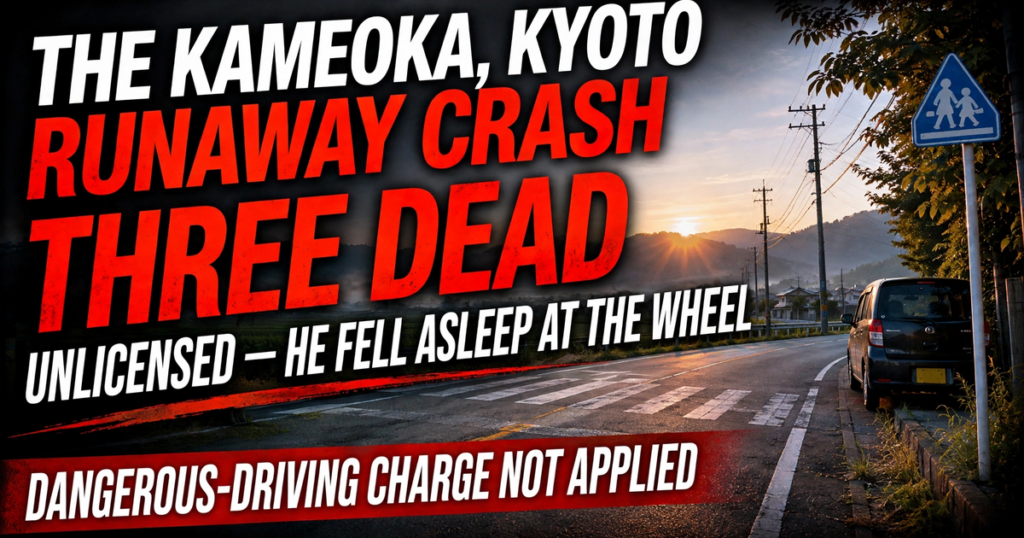
A car struck a group walking to school
At about 8 a.m. on April 23, 2012, a light passenger car drove into a group of elementary schoolchildren and an accompanying adult in Shino-cho, Kameoka City, Kyoto Prefecture. The group was walking along a familiar local route on the way to school. The driver was an 18-year-old who had never obtained a driving licence. He had been driving for a long period after staying out overnight and fell asleep at the wheel. The car left its intended path and struck the people walking ahead. The collision turned an ordinary school morning into a disaster that killed three people and injured seven children.
Three people died, including two children and a pregnant guardian
The people killed were Mao Kotani, aged seven, Nao Yokoyama, aged eight, and Yukihime Matsumura, aged 26, who was accompanying the children and was pregnant. Seven other children were injured. The death of a pregnant adult and two young pupils made the scale of the loss especially difficult for the families and the local community. The accident also raised questions about the protection of school routes and the legal treatment of serious crashes caused by drivers who had no licence and had continued driving despite extreme fatigue.
The driver had no licence but had repeatedly driven cars
The driver had never held a driving licence, but he had experience behind the wheel and had driven repeatedly. Before the collision, he and friends had been travelling during the night and continued driving after becoming severely sleep-deprived. The court found that he had become drowsy and fallen asleep. This distinction mattered under the law then in force. The dangerous-driving causing death or injury offence included a category for driving without the skill to control a vehicle, but being unlicensed did not automatically prove that a person lacked the actual ability to steer and operate a car.
The dangerous-driving offence was not applied
The prosecution considered the dangerous-driving offence, but the court did not find that the driver lacked the driving skill required by the statutory definition. The fact that he had no licence was not enough on its own. The immediate cause of the crash was identified as falling asleep after prolonged driving, and the case proceeded under the offence of negligent driving causing death or injury and related provisions. This outcome created a gap between the seriousness of the result and the range of offences available under the law at that time. A fatal crash did not automatically qualify as dangerous driving merely because the driver had acted recklessly or illegally.
The court imposed an indefinite sentence under juvenile law
The driver was prosecuted as a juvenile and received an indefinite sentence of five to nine years. This was not the same as a fixed sentence of nine years. Under the juvenile system, the sentence had a lower and upper limit, allowing the period of confinement to reflect rehabilitation and the circumstances of the offender. The final sentence was five years to nine years. The legal classification and the sentence should be reported together: the dangerous-driving offence was not applied, and the conviction was based on negligent driving causing death or injury and related offences.
The families challenged the limits of the law
The victims' families called for changes to the law so that serious crashes involving unlicensed driving and other dangerous conduct could be punished more appropriately. They argued that the existing legal categories did not adequately capture the risk created by a driver who had no licence and continued driving while exhausted. Their calls were part of a wider public discussion that included other fatal traffic cases, such as the Kanuma crane-truck accident. The families' advocacy did not change the verdict in the Kameoka case, but it contributed to pressure for a review of the law.
The 2013 driving-offences law expanded the legal framework
In 2013, the Diet enacted the Act on Punishment of Acts Inflicting Death or Injury by Driving Motor Vehicles. The legislation separated dangerous-driving and negligent-driving offences into a dedicated statute, expanded the categories of dangerous driving and introduced additional penalties for certain offences committed while unlicensed. The reform responded to more than one accident and should not be attributed to the Kameoka case alone. However, the case was repeatedly discussed in parliamentary debate as an example of the limits of the previous legal framework when a serious collision did not meet the technical requirements of the dangerous-driving offence.
School-route safety was reviewed alongside criminal law
The response was not limited to changes in criminal penalties. Kameoka City and other local authorities reviewed road conditions and school routes. Across Japan, schools, police and road administrators carried out joint inspections and considered improvements such as sidewalks, protective barriers, road markings and measures to reduce vehicle speeds. The accident showed that children walking to school can be exposed to traffic risks even on routes used every day. Legal reform and physical improvements to the road environment addressed different parts of the problem and were pursued in parallel.
The final record must distinguish the harm from the offence actually applied
The established facts are that the crash occurred on April 23, 2012, killed three people and injured seven children, and involved an 18-year-old unlicensed driver who fell asleep after prolonged driving. The driver received an indefinite juvenile sentence of five to nine years. The dangerous-driving offence was not applied because the statutory requirement concerning lack of driving skill was not established. The 2013 legislation later expanded the law, but it did not change the legal basis of the original conviction. The case remains important because it exposed the difference between public understanding of dangerous conduct and the precise elements required by criminal law.
Original Japanese record: 京都亀岡暴走事故|無免許・居眠りで3人死亡、危険運転罪が適用されなかった理由
Last updated:
Related articles
Case record
The Tojinbo Cliff Murder
Case record
The Yamagata Gym-Mat Death: Divided Juvenile Rulings, Civil Liability, and the Third Compensation Judgment in 2026
Case record
The Kyoto Gion Runaway Van Crash: Seven Pedestrian Deaths, a Driver's Medical History and Changes to Driving-Licence Rules

Case record