
Police Agency Wide-Area Important Designation Case No. 121: Five Robberies, Three Deaths, and Two Final Death Sentences
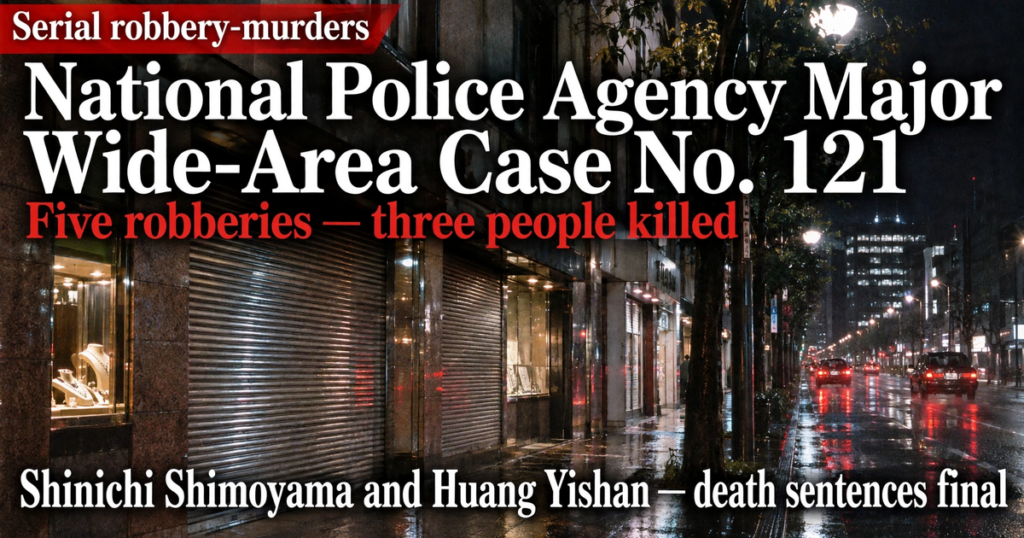
Between October and December 1993, a group of Japanese and Chinese-Malaysian members committed five robberies across Shizuoka, Shiga, Tokyo and Gunma. Three people were killed and another was seriously injured; approximately 26 million yen was taken. Two central defendants, Huang Yishan and Shinichi Shimoyama, later known as Shinichi Matsuzawa, received death sentences that became final on different dates.
A mobile robbery group crossed four prefectures
From October to December 1993, a group of men carried out a series of robberies in Shizuoka, Shiga, Tokyo and Gunma. The police treated the offences as a connected wide-area case because the group moved between prefectures and targeted businesses and people believed to hold cash. The five incidents included robberies and robbery-murders. The group included Japanese members and people of Chinese-Malaysian nationality. The case was assigned Police Agency Wide-Area Important Designation No. 121, a police classification used for serious crimes requiring coordination across prefectural boundaries. The designation was an investigative label, not a separate criminal charge or a judicial finding.
The crimes escalated from robbery to lethal violence
The group targeted places such as pachinko businesses, financial operators and a game café. The offences were not all identical. In one case, a financial operator in Shiga was killed and approximately 14 million yen was taken. In Tokyo, the group attempted another robbery-murder but did not complete its objective. In Takasaki, Gunma Prefecture, a game-café manager was shot and killed, and cash was stolen. In another Tokyo incident, a condominium manager was beaten to death while the group took a safe. The police record describes five robberies, three deaths and another victim who was seriously injured.
The group used weapons and coordinated roles
The offences involved knives and an illegally obtained firearm. Investigators examined not only the person who physically attacked a victim but also the roles of people who arranged vehicles, watched the surroundings, transported members or handled stolen money. The legal question was whether each participant shared the plan and intent required for the offences charged. In a joint crime, Japanese courts can hold a participant responsible even if that person did not personally deliver the fatal blow, but the prosecution must prove the necessary agreement and contribution. The case therefore turned on the relationship between the group's planning, the individual acts and the members' knowledge that violence could be used.
The evidence connected incidents in different prefectures
The police compared witness accounts, vehicles, travel routes, firearms, bullets and cartridge cases. They also examined the movements of members and the way the stolen money was handled. These details linked incidents that might initially have appeared to be unrelated local robberies. The case showed why the National Police Agency's wide-area designation system existed: a group could commit crimes in several prefectures before any one local police force understood the full pattern. The designation allowed police to coordinate investigations, but the criminal courts still had to determine the evidence against each defendant and decide which offences each person had joined.
Huang Yishan received a death sentence that became final in 2004
Huang Yishan was convicted in the Tokyo District Court and sentenced to death on 19 July 1996. The Tokyo High Court dismissed his appeal on 26 March 1998. On 19 April 2004, the Supreme Court rejected his final appeal, leaving the death sentence final. Huang had argued that his role was subordinate and that he did not intend to kill, but the courts assessed the violence, his participation and the evidence of shared responsibility. The Supreme Court's decision was specific to Huang; it should not be treated as the date on which every other defendant's sentence became final.
Shinichi Shimoyama's death sentence became final in 2005
Another central defendant was Shinichi Shimoyama, who later used the name Shinichi Matsuzawa. The Tokyo District Court sentenced him to death on 26 May 1998, and the Tokyo High Court dismissed his appeal on 30 May 2001. The Supreme Court rejected his appeal on 16 September 2005, making the death sentence final. The different finality dates matter: Huang's sentence became final in April 2004, while Shimoyama's became final in September 2005. CrimeInfo's record lists the later name Matsuzawa and identifies Shimoyama as his former name.
Other participants received different sentences
The group did not receive one collective sentence. Other defendants were given life imprisonment or fixed-term prison sentences according to their participation and the offences proved against them. The courts considered whether each person had joined the robberies, knew of the use of weapons, participated in the killings or played a more limited role. A summary that names only the two death-sentenced defendants can obscure the wider case, while a summary that says every member was sentenced to death would be false. The judgments assessed individual responsibility within a group whose members did not necessarily share identical roles or intent.
The designation number should not obscure the victims
The police designation is useful for identifying the case in official and historical records, but it can make the events sound abstract. Five robberies took place across four prefectures; three people died and another was seriously injured. Approximately 26 million yen was taken. The case also raised questions about the legal responsibility of participants in a mobile group, the use of firearms and the way investigators connect crimes across local jurisdictions. The two final death sentences were imposed after separate appeals and became final on separate dates. The most accurate account preserves those distinctions and avoids describing nationality as an explanation for the crimes.
What the record can and cannot establish
The case is documented through court records, the death-row database maintained by CrimeInfo and the Japanese incident archive. The court outcomes establish the convictions and final sentences of the named defendants. They do not justify treating every member of the group as equally responsible, nor do they make the police designation itself a finding of guilt. The two death sentences are final, but execution status should be stated only when confirmed by an official announcement. The careful historical account is a cross-prefectural robbery series, three deaths, one serious injury, a substantial financial loss and separate judicial outcomes for the defendants.
Original Japanese record: 警察庁広域重要指定121号事件|5件の強盗と3人殺害、下山・黄の死刑確定
Last updated:
Related articles
Case record
The Torigoe 2-Chome Murder and Arson: The Killing of an Indian Jewelry Worker and the Search for Diwakar Sethia

Case record
The Four-Prefecture Four-Murder Case: Twelve Years for the First Killing and Death for Three Later Murders
Case record
The Katsuta Kiyotaka Serial Murders: The Reported 22-Victim Confession, Eight Judicially Established Deaths and the Nationwide No. 113 Investigation
Case record