
The North Kanto Child Disappearances and Murders: Five Cases, a Wrongful Conviction and a Possible Connection
Five girls disappeared in neighboring parts of Tochigi and Gunma between 1979 and 1996. Four were found dead; one remains missing. A common perpetrator has not been established.
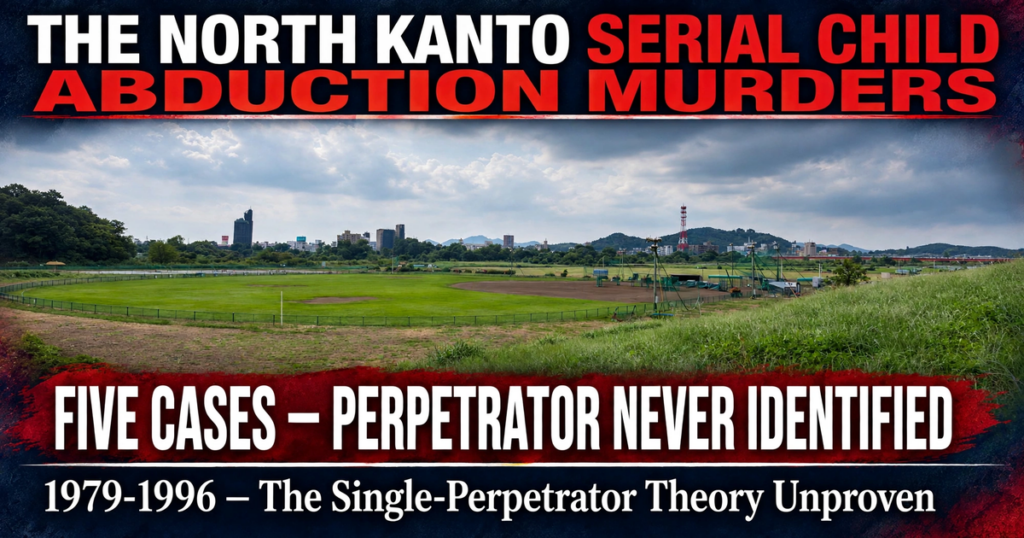
Five girls disappeared in neighbouring parts of Tochigi and Gunma
Between 1979 and 1996, five young girls disappeared in a relatively small area around Ashikaga in Tochigi Prefecture and Ota in Gunma Prefecture. Four were later found dead. The fifth, four-year-old Yukari Yokoyama, disappeared from a pachinko parlour in Ota in 1996 and remains missing. The five cases occurred over seventeen years and were handled by different police jurisdictions. They are often discussed together as the North Kanto Child Abductions and Murders because of the victims' ages, the geographic proximity and similarities in some circumstances.
Fukushima Mami disappeared near a shrine in 1979
The first case occurred on August 3, 1979, when five-year-old Mami Fukushima disappeared near a shrine in Ashikaga. Her body was found six days later, on August 9, on the riverbank of the Watarase River. Publicly available official records about this first incident are limited. The chronology and location are important because they show how the series began, but the identity of the person responsible for the child's death was never established in a criminal judgment.
Hasebe Yumi was found more than a year after she vanished
On November 17, 1984, five-year-old Yumi Hasebe disappeared near a pachinko parlour in Ashikaga. Her remains were not found the following year; police located them in a field in Ashikaga on March 7, 1986, approximately sixteen months after she went missing. Later summaries have sometimes compressed the interval or confused the date of disappearance with the date of discovery. The 2026 National Police Agency account presented to the Diet confirms the two dates separately.
Osawa Tomoko disappeared in Ota in 1987
The third case occurred on September 15, 1987, when eight-year-old Tomoko Osawa disappeared near a park in Ota, Gunma Prefecture. Her body was found on November 27, 1988, on the bank of the Tone River in Ota. The location was across the prefectural boundary from Ashikaga, but the two areas are close to one another. No court identified the person who killed Osawa, and the fact that her body was found near a river does not establish that the other cases had the same perpetrator.
The 1990 Ashikaga case led to a wrongful conviction
On May 12, 1990, four-year-old Mami Matsuda disappeared near a pachinko parlour in Ashikaga. Her body was found the following day on the Watarase River bank. Police arrested Toshikazu Sugaya in 1991. A then-current MCT118 DNA test was interpreted as matching biological material recovered from the victim's clothing, and Sugaya's confession was also used to support the prosecution. He was convicted and received a life sentence, which became final after appeals. Sugaya was not the offender, and the case became a major example of the danger of relying too heavily on an early form of DNA testing and a confession.
A retrial acquitted Sugaya, but it did not identify the killer
New DNA testing showed that Sugaya's DNA profile did not match the biological material attributed to the offender. On March 26, 2010, Utsunomiya District Court acquitted him at retrial. The Supreme Public Prosecutors Office later reviewed the investigation and prosecution, identifying an excessive evaluation of the original DNA result and insufficient scrutiny of the confession as major problems. The acquittal removed the conviction against Sugaya; it did not establish who killed Matsuda. Nor did it prove that the same person was responsible for the other four disappearances.
Yukari Yokoyama disappeared in 1996 and remains missing
On July 7, 1996, four-year-old Yukari Yokoyama disappeared while visiting a pachinko parlour in Ota with her family. She was playing inside the premises when she went missing. Security-camera footage showed a man approaching and speaking to her shortly before her disappearance. Gunma Prefectural Police have continued to seek information about the man, describing him as an important person of interest. The footage does not show the abduction itself, and it does not establish that the man took her. Yukari has not been found, and the authorities have not confirmed her death. The case remains an active missing-child investigation.
The National Police Agency has not ruled out a common offender
In a House of Representatives Legal Affairs Committee hearing on May 8, 2026, the National Police Agency described the five cases and stated that its earlier assessment had not changed: because the victims were young girls and the disappearance locations were close, the possibility that the same offender was responsible could not be ruled out. The agency did not say that a common offender had been identified. It describes a possibility that investigators continue to consider, not a judicial finding that the five cases form one serial crime. The five incidents remain separate legal cases, each with its own chronology and evidentiary record.
The five-case label should not become a claim that one person has been proved responsible
The five incidents share features that justify continued examination: young female victims, locations within a relatively small area, and some similarities in the places where the children disappeared or their bodies were found. The Ashikaga wrongful conviction also changed how investigators and the public understood the 1990 case. But the available record does not establish a single perpetrator across all five incidents. The National Police Agency's position remains that a common offender cannot be ruled out, not that one has been identified. A responsible account must keep the four deaths, Yukari's continuing disappearance, Sugaya's retrial acquittal and the unresolved question of any connection among the five cases distinct.
Original Japanese record: 北関東連続幼女誘拐殺人事件|5件の失踪・殺害と足利事件の再審無罪、2026年も続く捜査
Last updated:
Related articles

Same case · Feature
The North Kanto Series of Abductions and Murders of Young Girls: One Wrongful Conviction Exposed the Gaps in the Investigation — Five Disappearances Re-examined
Case record
The Disappearance of Yuri Yoshikawa: The Unresolved Route Home from School
Case record
The Disappearance of Naoko Nagao: A Commuter Who Vanished in Sapporo in 1981

Case record