
The Disappearance of Yuri Yoshikawa: The Unresolved Route Home from School
Nine-year-old Yuri Yoshikawa disappeared while walking home in Kumatori, Osaka, on May 20, 2003. Her whereabouts remain unknown and police continue to seek information.
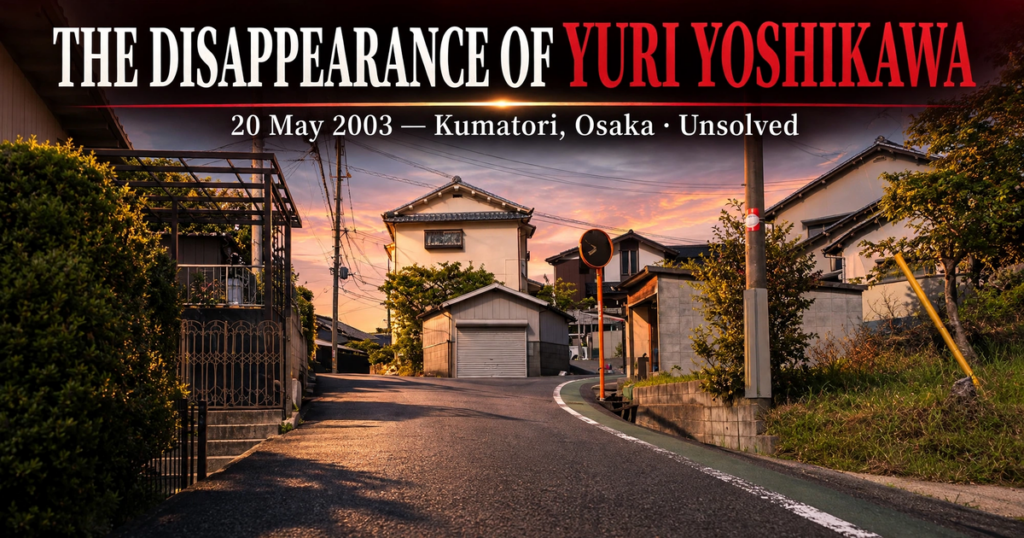
A nine-year-old did not complete the walk home
Yuri Yoshikawa, a fourth-grade elementary school pupil aged nine, disappeared on the afternoon of May 20, 2003, in Kumatori, Sennan District, Osaka Prefecture. She had been walking home from school with friends. The disappearance occurred in the area of Shichiyama, within her ordinary route between school and home. Osaka Prefectural Police records the time as around 3:00 p.m. The case is treated by police as a suspected abduction of a minor, but the public record does not identify an offender or establish what happened to her after the last confirmed sighting.
The last confirmed sightings left a short distance to home
The Japanese source article reconstructs the route from accounts collected during the investigation. Yoshikawa walked with three friends before they separated. She then continued along the route and was reportedly passed by another boy approximately 140 metres farther on. That sighting is treated as the last confirmed observation of her. Her home was approximately 400 metres away. The distance is short, but it does not establish how far she travelled after the sighting or whether she reached another road, vehicle or building. The precise point at which she disappeared has never been established.
The white Crown was an investigative lead, not a proven abduction vehicle
One vehicle that attracted attention was a white, older-model Toyota Crown reportedly seen in the area. Accounts described a man driving with a young girl in the passenger seat. Police investigated vehicles matching the description and later released images of a suspicious vehicle seen in the surrounding area. The Osaka police notice uses the category of a vehicle reported as suspicious; it does not declare that the Crown was the vehicle used to abduct Yoshikawa. A sighting, an investigative lead and proof that a vehicle was involved are three different things. The owner or driver has not been publicly identified as an offender.
The early search had to proceed without modern street-camera coverage
The disappearance occurred in 2003, before street surveillance and vehicle cameras had become as widespread as they are today. Investigators sought information from people who had been travelling through the area, local residents, businesses and drivers. Police checked possible vehicles and people one by one, rather than being able to review a continuous network of recordings covering the route. The absence of a public video record does not mean that no investigation occurred. It means that the inquiry depended heavily on witness accounts, records that could be obtained at the time and the careful comparison of individual leads.
Age-progressed images are estimates, not later photographs
As the years passed, police published illustrations estimating how Yoshikawa might look as an adult. An age-progressed image is produced by estimating the changes that may occur with age; it is not a recent photograph and does not prove that a person resembling the illustration has been seen. The childhood photographs remain important because someone may remember her from the time of the disappearance. Police have also updated public appeals and used renewed distribution of leaflets to reach people who were children, commuters or residents in the area in 2003.
The investigation remains active after more than twenty-three years
To mark twenty-three years and six months since Yoshikawa disappeared, Osaka police officers and volunteers distributed leaflets in the Namba area of Osaka City on November 20, 2026. Kansai Television reported that 6,518 pieces of information had been received since the disappearance, without a decisive lead. A report published the same day by Kyodo News stated that the investigation had involved approximately 122,400 officers cumulatively. These figures describe the scale of the continuing inquiry; they do not mean that 6,518 separate suspects or confirmed sightings have been identified. The police continued to ask people to report even small recollections, including information about the white Crown and any person who may have seen Yoshikawa on the route home.
The public reward and the legal position
The case is eligible for the National Police Agency's special reward system, with a public maximum of three million yen. The reward is governed by an official advertisement and is paid according to the contribution of information to the arrest of a suspect or resolution of the case; it is not a guaranteed payment for every tip. The police investigation is conducted as a suspected child abduction. No suspect has been publicly identified, no indictment has been announced and no trial has taken place. The police theory of abduction is not the same as a judicial finding about the exact method or the identity of the person responsible.
What is still unknown
Yoshikawa's whereabouts and fate have not been established. The white Crown remains a reported vehicle of investigative interest, not a proven crime vehicle. The last confirmed sighting leaves a distance of about 400 metres to her home, but the public record cannot show what happened within or beyond that stretch. The age-progressed illustrations are search tools, not evidence of a later sighting. A careful account must therefore distinguish the confirmed school journey, the witness observations, the vehicle leads and the continuing police theory from conclusions that no court or investigation has publicly established.
Original Japanese record: 吉川友梨さん行方不明事件|自宅まで400メートルで途絶えた足取り、23年続く誘拐捜査
Last updated:
Related articles
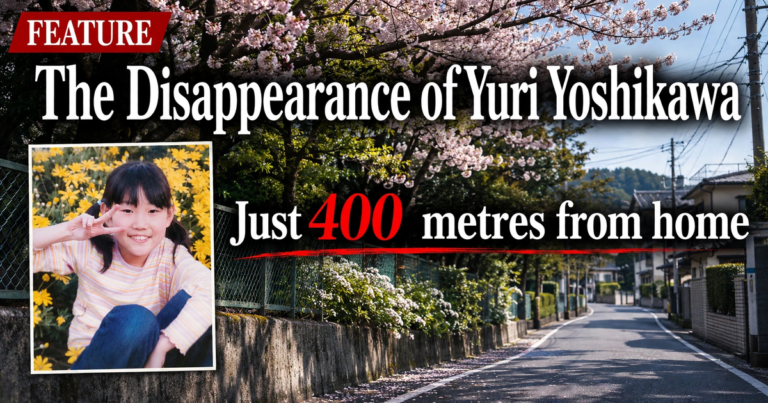
Same case · Feature
The Disappearance of Yuri Yoshikawa: Her Home Was Only 400 Metres Away, but Her Trail Ended There — Investigative Records Revisited 23 Years Later
Case record
The Wanted Case of Katsuyuki Obara and the Death of 17-Year-Old Kozue Sato
Case record
The Muroran High School Girl Disappearance
Case record