
The Disappearance of Naoko Nagao: A Commuter Who Vanished in Sapporo in 1981
Naoko Nagao was 20 and working as an office clerk when she disappeared on the morning of 16 March 1981 while travelling from her home in Sapporo's Kita Ward to work. Hokkaido police continue to list her as a missing person whose possible abduction by North Korea cannot be ruled out. That wording is not an official determination that she was abducted. The Japanese government has formally recognised 17 abductees in 12 cases, and Nagao is not among them. Her whereabouts and the reason for her disappearance remain unknown.
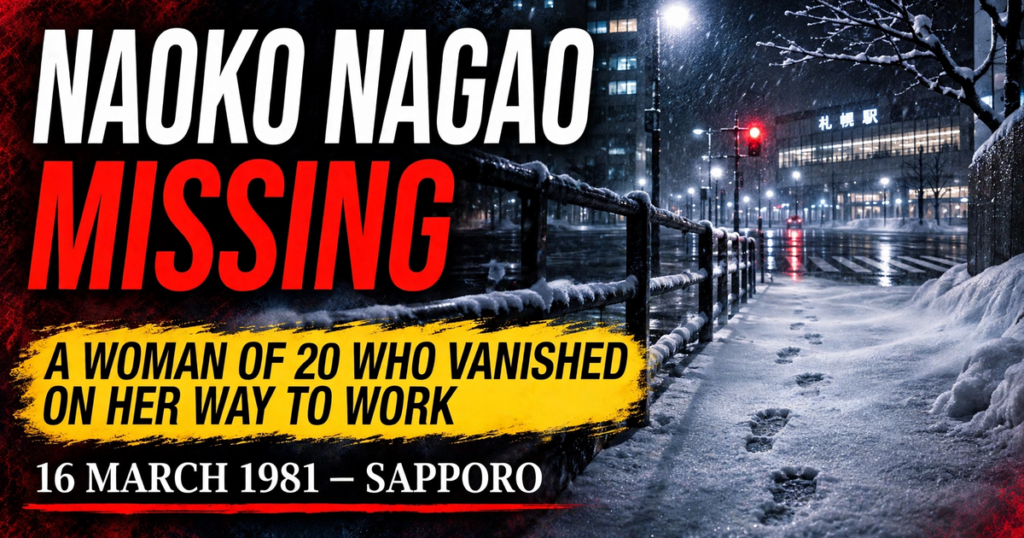
A 20-year-old office worker disappeared on her way to work
At about 8 a.m. on 16 March 1981, Naoko Nagao left her home in Kita Ward, Sapporo, Hokkaido, to go to her workplace. She did not arrive, and her whereabouts have never been confirmed. Hokkaido Prefectural Police list her as a missing person and continue to ask for information. The official description identifies her as a 20-year-old office worker who lived in Kita Ward. The basic fact established by the public police record is that she disappeared while travelling from home to work; the precise point at which she was last seen is not specified.
The official police description records her physical characteristics
Hokkaido Police describe Nagao as 153 centimetres tall, of medium build and having a dark complexion. The police page includes a photograph taken in 1981, when she was 20. It also gives a contact point within the Security Department's Foreign Affairs Division for information. These details are part of an official missing-person appeal, not evidence that a particular person abducted her. The limited public description should not be expanded with unverified details about the route she took, the transport she used or the identity of anyone she may have encountered.
A private organisation has published additional information about the morning
The Investigative Commission on Missing Japanese Probably Related to North Korea has published a more detailed account, based on information gathered from the family and other sources. According to that organisation, Nagao left home as usual, then returned to collect an umbrella. Around the time she was expected at work, the company telephoned the family to say that she had not arrived. The organisation also says that she usually telephoned home once or twice a day from work, but no call came that day, and the family filed a missing-person report the following day. These details are attributed to a private organisation and are not all reproduced in the Hokkaido Police notice.
The public record does not establish where she was last seen
The official police information does not say exactly how far Nagao travelled, whether she walked or used public transport, or whether anyone saw her after she left home. The private organisation's account adds the reported return for an umbrella and the telephone call from her workplace, but it does not establish a precise last-known location. Some reports also describe little change in her personal belongings and no withdrawal from her bank account after the disappearance. Those points are based on private information and should not be treated as a complete official audit of every financial or personal record.
The phrase 'abduction cannot be ruled out' has a specific meaning
Hokkaido Police include Nagao in the category of people whose possible abduction by North Korea cannot be ruled out. This wording means that investigators have not excluded that possibility and continue to consider it. It does not mean that the Japanese government has formally determined that she was abducted. It also does not mean that other explanations, such as an accident, a crime unrelated to North Korea or a voluntary disappearance, have been ruled out. No person has been publicly arrested or indicted for taking her away.
The National Police Agency distinguishes possible cases from officially recognised abductions
The National Police Agency states that it is aware of 869 missing people whose possible abduction by North Korea cannot be ruled out. Of those, 447 are publicly listed with the consent of their families on prefectural police websites. Nagao is one of the people included in that public list. Separately, the Japanese government has officially recognised 17 people in 12 abduction cases; five have returned to Japan and 12 have not. Nagao is not among the 17 officially recognised victims. The two categories must not be combined or described as if they had the same legal or governmental status.
The police and a private organisation use slightly different physical descriptions
There is also a small difference between the published physical measurements. Hokkaido Police list Nagao's height as 153 centimetres. The private Investigative Commission on Missing Japanese Probably Related to North Korea lists her as 155 centimetres and gives a weight of 45 kilograms. The organisation also records her date of birth as 25 October 1960. In an older missing-person case, family reports, contemporary records and later interviews may not match perfectly. For an official appeal, the police description should be presented as the police's own information, while the private organisation's figures should be attributed separately.
Nagao remains a missing person, not a government-recognised abductee
As of 2026, Hokkaido Police continue to publish Nagao's name and photograph and request information. There has been no public confirmation that she is dead, no public evidence establishing that she was taken to North Korea and no criminal judgment identifying a person who abducted her. The phrase used by police leaves the possibility open without declaring it proven. The most accurate description is therefore that Naoko Nagao disappeared while travelling to work on 16 March 1981 and remains the subject of an unresolved missing-person inquiry. Her location and the reason for her disappearance are unknown.
Original Japanese record: 長尾直子さん行方不明事案|札幌の通勤途中に失踪、「拉致の可能性を排除できない」の意味
Last updated:
Related articles
Case record
The Muroran High School Girl Disappearance

Case record
The Akagi Shrine Disappearance: The Unexplained Loss of Noriko Shizuka During a Family Visit
Case record
The Daisetsuzan SOS Mountain Incident: A Giant Signal, a Recorded Cry for Help and a Corrected Bone Identification

Case record