
The Ashikaga Case: How DNA Evidence and a False Confession Led to a Wrongful Conviction
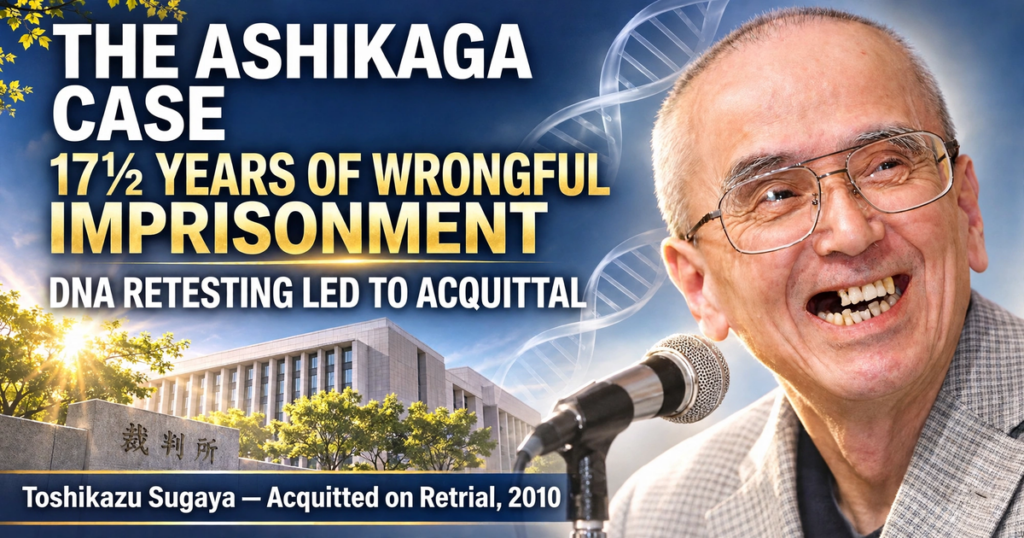
Four-year-old Mami Matsuda disappeared near a pachinko parlour in Ashikaga on May 12, 1990, and was found dead the next morning. Toshikazu Sugaya was convicted on the basis of an early DNA test and a confession, but later STR testing excluded him. He was released in June 2009 and acquitted at retrial on March 26, 2010. The child’s murder remains unsolved.
A four-year-old girl disappeared and was found dead
On May 12, 1990, four-year-old Mami Matsuda disappeared near a pachinko parlour in Ashikaga City, Tochigi Prefecture. Her family and police searched for her. On the following morning, May 13, her body was found in grass beside the Watarase River, approximately 400 metres from the area where she had disappeared. Clothing belonging to the child was also found nearby. Police began investigating the case as a murder. Biological material of male origin was found on her underwear, and that evidence later became central to the investigation and the prosecution of Toshikazu Sugaya. The case became one of Japan’s best-known wrongful convictions because the forensic technique that initially linked Sugaya to the crime was later shown to be unreliable.
An early MCT118 DNA test was treated as a strong link
The investigation used an early form of DNA profiling based on the MCT118 system. Samples from the biological material on Matsuda’s underwear and a sample obtained from Sugaya’s rubbish were both classified as type 16-26. At the time, investigators placed substantial weight on the apparent match and on the estimated rarity of the profile. The test was treated as objective evidence connecting Sugaya to the crime. Later examination, however, raised serious questions about how the test had been carried out and how the electrophoresis images had been interpreted. The retrial court would conclude that the old DNA evidence could not be accepted. The case illustrates why a scientific result must be evaluated in light of the quality of the sample, the method used and whether the analysis can be independently checked.
Sugaya changed from denial to confession during questioning
On December 1, 1991, police asked Sugaya to accompany them voluntarily for questioning. He initially denied involvement. Investigators told him that the DNA types matched and continued questioning him. Later that day, he made a statement admitting the crime. He was arrested in the early hours of December 2 and indicted on December 21. His statements were not consistent throughout the proceedings. At some points he denied the crime in court, while at other times he again admitted it. The retrial judgment later examined how the DNA claim had been presented to him and concluded that being told that the test matched was one of the most important factors leading him to confess. The sequence of voluntary questioning, confession, formal arrest and indictment should not be collapsed into a single event.
The original courts imposed and confirmed a life sentence
On July 7, 1993, the Utsunomiya District Court found Sugaya guilty and sentenced him to life imprisonment. The judgment relied heavily on the old DNA test and his confession. The Tokyo High Court dismissed his appeal on May 9, 1996. On July 17, 2000, the Supreme Court dismissed his final appeal, making the life sentence final. Sugaya continued serving the sentence. At that stage, the conviction had passed through all three levels of the ordinary criminal process. The later retrial did not simply reopen an appeal that had been left undecided; it challenged a final conviction on the basis of new forensic evidence and a reassessment of the confession and the original DNA analysis.
New STR testing excluded Sugaya from the biological evidence
During the retrial proceedings, new DNA testing was conducted using the STR method. The male DNA found on Matsuda’s underwear did not match Sugaya at numerous genetic locations. The retrial court also considered differences in Y-chromosome STR results and concluded that the semen on the underwear was not Sugaya’s. This was not a minor variation in a test result: the new analysis directly contradicted the proposition that the biological material came from him. The new evidence undermined the foundation of the original conviction. The court also examined the old MCT118 analysis and found that the electrophoresis images were unclear and that a competent laboratory would have considered repeating the test. The court therefore rejected the old test as evidence capable of supporting the conviction.
He was released in June 2009 and acquitted at retrial
After the new DNA results became available, Sugaya was released from Chiba Prison in June 2009 through suspension of the execution of his sentence. Approximately seventeen and a half years had passed since his arrest. The Tokyo High Court ordered a retrial that year, and the case returned to the Utsunomiya District Court. On March 26, 2010, the District Court acquitted Sugaya. It found that the new DNA evidence excluded him, that the old DNA test could not be relied upon and that his confession was not credible. The prosecution accepted the acquittal, and the retrial acquittal became final. Sugaya had served a long period of a life sentence before the courts finally determined that he was not criminally responsible for Matsuda’s murder.
The confession was judged false, and investigative practices were reviewed
The retrial court examined more than the laboratory test. It considered Sugaya’s susceptibility to pressure, the way investigators told him that the DNA matched, and the inconsistencies between his statements and objective evidence. It concluded that his confession was false and could not be trusted. The court also examined questioning by prosecutors after the indictment. A December 1992 interview had taken place without advance notice to defence counsel and without sufficient explanation of the right to remain silent or the opportunity to receive legal advice. The judgment did not automatically exclude every statement because of that procedural issue; rather, it assessed the credibility of the confession in light of the new DNA results and the circumstances in which it was formed. The police and prosecutors later reviewed the case and identified excessive reliance on the old DNA test and inadequate verification of the confession.
Sugaya’s acquittal did not solve Matsuda’s murder
The final acquittal established that Sugaya was not the person who killed Matsuda. It did not identify the actual offender. The murder of the four-year-old girl remains unsolved. In May 2026, the National Police Agency told the House of Representatives’ Legal Affairs Committee that its long-standing view had not changed: five child abduction and murder cases in the Ashikaga and Ota areas could not be ruled out as having been committed by the same person because of the proximity of the disappearance locations. Police said that they continued examining all possibilities, while declining to disclose details of the individual investigations. The Ashikaga case therefore has two distinct legal and investigative outcomes: Sugaya’s wrongful conviction was overturned and his acquittal became final, while the original murder remains without an identified perpetrator.
Original Japanese record: 足利事件|旧DNA型鑑定と虚偽自白による誤判、菅家利和さんの17年半と再審無罪
Last updated:
Related articles
Same case · Feature
The Ashikaga Case: How DNA Evidence and a Confession Reinforced Each Other — Why Did a Wrongful Conviction Last 17½ Years?
Case record
The Himi Case: A Wrongful Conviction, a Prosecutor's Retrial Request and an Acquittal
Case record
The Koto Memorial Hospital Case: A Twelve-Year Sentence Overturned by Retrial, and a Death Not Proven to Be Homicide

Case record