
The Niihama Family Murders: Three Victims, Diminished Responsibility and a Final Life Sentence
On October 13, 2021, three members of a family were stabbed to death at their home in Niihama, Ehime Prefecture: a 51-year-old man and his parents, both 80. The defendant, Satoru Kono, had been a former co-worker of the son and held delusional beliefs about electromagnetic attacks. The courts found diminished, but not absent, criminal responsibility. A life sentence was upheld on appeal and became final when the Supreme Court dismissed Kono's appeal on December 9, 2025.
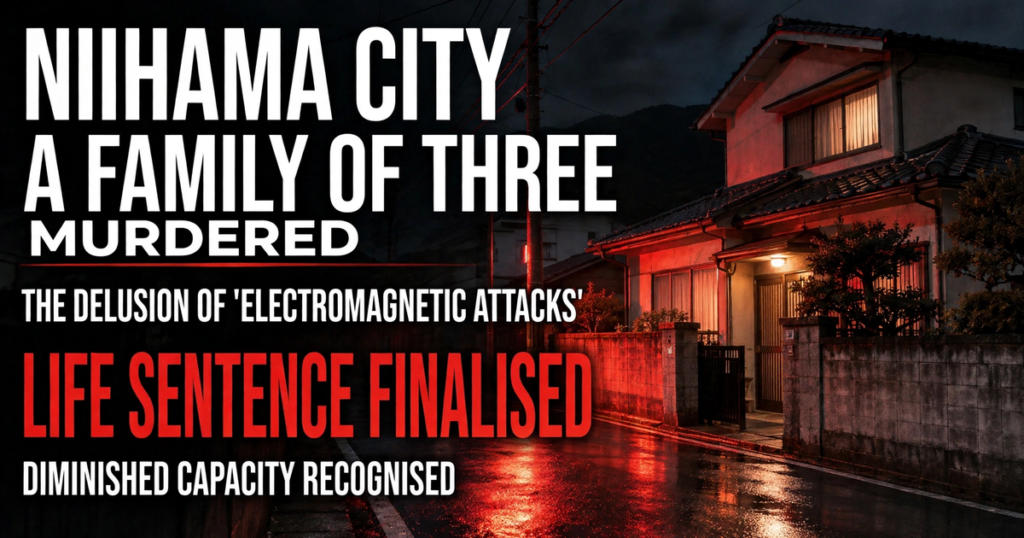
Three members of one family were killed at their home
At approximately 5:40 p.m. on October 13, 2021, an emergency call came from a residence in the Habu area of Niihama, Ehime Prefecture. The caller was 80-year-old Aiko Iwata. She, her 80-year-old husband Tomoyoshi Iwata and their 51-year-old third son Kenichi Iwata were stabbed and killed. The defendant, Satoru Kono, a former co-worker of Kenichi, remained at the scene. Police found him with a bloodstained knife and first arrested him under the Swords and Firearms Control Act. The investigation then developed into a triple-murder case.
The defendant had a history of conflict with the former co-worker
Kono and Kenichi had worked together at the same workplace approximately twenty years earlier. According to the prosecution's opening statement, Kono developed schizophrenia around 2017 and, after encountering online posts, came to believe that he was the target of organised harassment and electromagnetic attacks. He suspected Kenichi of being involved and increasingly blamed him. Kenichi's family reportedly consulted police several times from around 2019. Contact continued shortly before the killings, including visits by Kono to the family home. These facts formed part of the background considered at trial, but the alleged electromagnetic attacks were not real events.
The alleged motive was linked to a delusional belief
A recorded telephone conversation between Kono and an acquaintance, made several days before the killings, was examined at trial. According to reporting from the courtroom, Kono spoke about going to Kenichi's home and expressed frustration that police would not respond to his complaints. He also made a statement indicating that he might kill Kenichi. The recording was relevant to whether the killings were wholly spontaneous. At the same time, the stated reason for his hostility was a delusional belief in electromagnetic attacks. The court had to consider both the planning evidence and the effect of the psychiatric condition on his responsibility.
The case turned on criminal responsibility
The central legal issue was whether Kono had been legally insane at the time of the killings or whether he retained a reduced level of responsibility. Under Article 39 of Japan's Penal Code, a person who is insane at the time of an offence is not punished, while a person whose mental capacity is diminished may receive a reduced punishment. These are legal categories decided by the court after considering psychiatric evidence and the defendant's actions. A medical diagnosis alone does not automatically determine the legal result.
The first trial considered psychiatric evidence
After a psychiatric evaluation detention, prosecutors indicted Kono in March 2022. The first hearing at the Matsuyama District Court began on December 6, 2023. Kono admitted killing the three victims. The defence argued that a delusional form of schizophrenia had dominated his life and deprived him of the ability to control his actions, so he should be found not criminally responsible on the ground of insanity. The prosecution accepted that the illness had strongly influenced him but argued that his ability to judge and control his conduct had not disappeared entirely and that he was diminished in capacity. Kono himself disputed the schizophrenia diagnosis and said he did not regret the possibility of receiving a death sentence if the court found full responsibility.
The district court found diminished responsibility and imposed life imprisonment
The psychiatric expert, Hyodo, testified that Kono had been strongly affected by persecutory delusions but retained some ability to choose and control his actions. Kono also acknowledged in court that he understood murder was wrong. The expert referred to conduct such as changing from one knife to another when the first did not achieve the intended result. The medical assessment was not itself the legal ruling: the court had to determine whether the defendant met the statutory categories of insanity or diminished capacity by considering the expert evidence together with his words, preparations and actions.
The Takamatsu High Court upheld the first-instance judgment
On December 18, 2023, the Matsuyama District Court found that Kono had been in a state of diminished capacity, known in Japanese law as shinshin kōjaku, rather than complete insanity. The court accepted that his illness had shaped the delusional motive, but found that he had not completely lost the ability to understand the wrongfulness of his conduct or make choices. Article 39 requires a reduction in punishment when diminished capacity is established. The court nevertheless imposed life imprisonment, which it treated as the heaviest punishment available after the required reduction, given that three people had been killed.
The Supreme Court made the life sentence final in December 2025
On December 9, 2025, the Supreme Court dismissed Kono's final appeal. The decision meant that the life sentence became final. The criminal process had therefore reached its final stage: the district court had imposed life imprisonment in December 2023, the High Court had upheld it in August 2024, and the Supreme Court had rejected the final appeal in December 2025. The final judgment did not erase the court's finding that the defendant's mental capacity had been diminished; it confirmed that the finding did not require an acquittal.
The prior police consultations are part of a separate public-safety question
The family had reportedly consulted police several times from around 2019 about Kono's claims and repeated contact. The Ehime Prefectural Public Safety Commission's October 27, 2021 meeting record documents a post-incident explanation by the prefectural police about the handling of consultations and coordination with public-health and other agencies. The meeting record also states that the statutory conditions for a report under Article 23 of the Mental Health and Welfare Act were not met in this case. The earlier contacts are relevant to reviewing how police and support services share information. They do not, by themselves, prove that officers could have predicted the triple murder or that a specific intervention would certainly have prevented it.
The case illustrates the distinction between diagnosis and legal responsibility
The Niihama case shows that a psychiatric diagnosis, a delusional belief and legal insanity are not interchangeable. The courts accepted that Kono's illness had strongly influenced his thinking, but also examined whether he understood his actions and retained some ability to choose. The result was diminished capacity, not a complete absence of responsibility. The three deaths and final life sentence remain the central legal outcome. Earlier police consultations and the response of mental-health services raise separate public-safety questions that should be discussed without hindsight certainty.
Original Japanese record: 新居浜市一家3人殺害事件|「電磁波攻撃」の妄想と心神耗弱、無期懲役確定まで
Last updated:
Related articles

Case record
The Matsuyama Hostess Murder: Kazuko Fukuda's 5,459-Day Flight and the Life Sentence Finalized
Case record
The Sumoto Five-Person Murders: From a Death Sentence to Life Imprisonment
Case record
The Murder of Diet Member Koki Ishii: A Political Career, a Fatal Attack and an Unresolved Motive
Case record