
The Sayama Case: A Final Life Sentence, Disputed Evidence and a Fourth Retrial Request After Death
On May 1, 1963, 16-year-old high-school student Yoshie Nakata disappeared in Sayama, Saitama Prefecture, and her family received a ransom demand. Police failed to apprehend the person who appeared at the planned handover, and Nakata's body was found on May 4. Kazuo Ishikawa was arrested on May 23 on an unrelated theft suspicion and later prosecuted for the murder. He initially confessed but withdrew the confession during the appeal. He received a death sentence at first instance, which was changed to life imprisonment on appeal; the life sentence became final in 1977. Ishikawa died in 2025 while maintaining his innocence. His wife filed a fourth retrial request, which remained under examination in the Tokyo High Court in October 2026.
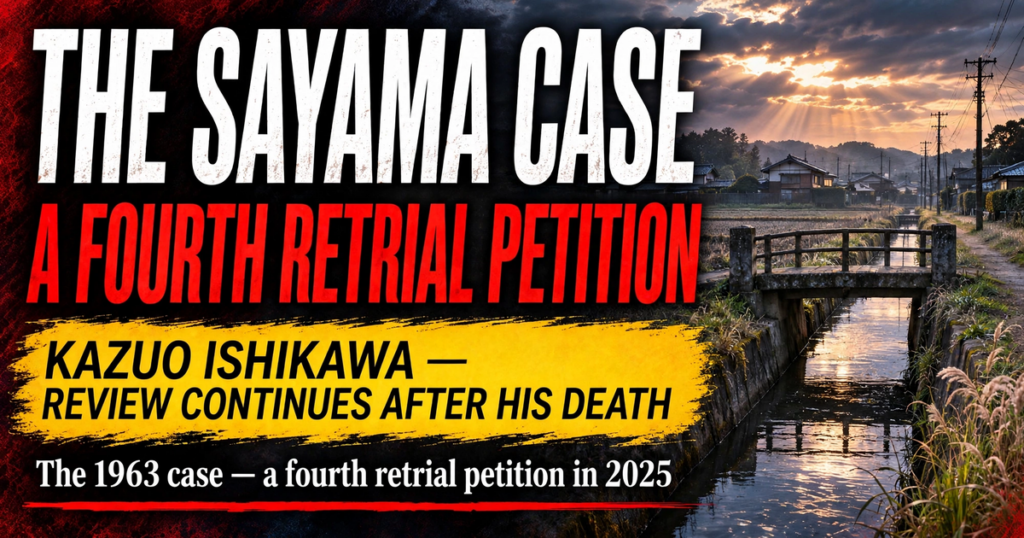
A sixteen-year-old student disappeared on 1 May 1963
On May 1, 1963, Yoshie Nakata, a 16-year-old first-year high-school student in Sayama, Saitama Prefecture, disappeared. Her family received a letter demanding ransom. Police arranged officers at the designated handover location, but the person who appeared was not apprehended. The failure to secure that person became a major part of the public criticism of the investigation. On May 4, Nakata's body was found. The case had begun as a kidnapping for ransom and became a murder investigation after the discovery of her body.
Ishikawa was first arrested on an unrelated theft suspicion
On May 23, 1963, Kazuo Ishikawa was arrested on suspicion of a separate theft offence. Investigators later questioned him in connection with Nakata's kidnapping and murder. He admitted involvement during police questioning and also accepted the charges at his first trial. The fact that he made a confession is part of the procedural history. It must be distinguished from the later dispute over how the statement was obtained, whether it was reliable and whether the other evidence supported the conviction.
Ishikawa withdrew his confession during the appeal
During the appeal proceedings, Ishikawa withdrew his earlier confession and said that he had not taken part in the crime. He maintained his claim of innocence and continued seeking a retrial until his death. The confession therefore remained one of the central disputed pieces of evidence. The later retrial applications examined the circumstances of the interrogation, the changes in his statements and whether the confession could be relied upon alongside the physical and documentary evidence. The existence of a confession in the investigation record does not remove the need to describe the later challenge to its credibility.
The first-instance death sentence was changed to life imprisonment
On March 11, 1964, the Urawa District Court sentenced Ishikawa to death. He appealed. On October 31, 1974, the Tokyo High Court changed the sentence to life imprisonment. The Supreme Court dismissed his appeal on August 9, 1977, and an objection was also rejected, making the life sentence final. It is important to state the sequence accurately: Ishikawa was sentenced to death at first instance, but the death sentence did not become final. The final conviction was for life imprisonment.
The pen, ransom letter and other evidence became central to later retrial disputes
The evidence supporting the conviction included Ishikawa's confession, the ransom letter's handwriting and a fountain pen found at his home that the original judgment identified as belonging to Nakata. Footprints and a shovel were also among the materials later reconsidered. The defence has argued that the handwriting attribution and the identification of the pen were unreliable. It has submitted expert opinions about Ishikawa's literacy and writing characteristics and challenged the relationship between the pen and the ink used by Nakata. These are defence arguments in retrial proceedings, not findings that the conviction has already been overturned.
New ink analysis was submitted in December 2024
In December 2024, the defence submitted a new report using X-ray fluorescence analysis of ink evidence. According to the defence's interpretation, elements detected in material written by Nakata were not detected in samples written with the fountain pen found at Ishikawa's home. Prosecutors disputed the defence's evaluation. Whether the expert should be questioned in court became one of the issues in the retrial process. The scientific disagreement must be described as a dispute between the parties; no final judicial decision had accepted the defence's conclusion by the latest status reported in the Japanese archive.
Ishikawa was released on parole in 1994, not acquitted
Ishikawa was released on parole in December 1994 after approximately 32 years in custody. Parole was a form of executing the life sentence; it did not cancel the conviction or mean that a court had found him innocent. He continued to seek a retrial after his release. The distinction is important because public references to his release can be misunderstood as an acquittal. The legal position remained that the life sentence had become final in 1977 and had not been overturned.
The third retrial request ended because Ishikawa died
Ishikawa pursued a third retrial request from 2006. The court, prosecutors and defence held repeated three-party conferences and dealt with disclosure and examination of evidence. Ishikawa died on March 11, 2025, aged 86. His death caused the third retrial procedure to end in March 2025. It was not a judicial rejection of the request and did not amount to an acquittal. The final life sentence remained in place. The distinction between a procedure ending because the applicant died and a court rejecting a retrial request is essential to the case's chronology.
His wife filed a fourth retrial request on 4 April 2025
After Ishikawa's death, his wife, Sachiko Ishikawa, filed a fourth retrial request with the Tokyo High Court on April 4, 2025. The defence team carried forward evidence and expert reports that had been disclosed or submitted during the third request. The new application sought a posthumous review of the final conviction. Materials included further arguments about the handwriting of the ransom letter and the ink in the fountain pen. The filing did not itself reopen the trial or vacate the conviction; the court first had to decide whether a retrial should begin.
The sixth three-party conference took place on 3 September 2026
A report published by the Buraku Liberation League's central organisation on October 15, 2026, stated that the sixth three-party conference in the fourth retrial proceedings had been held on September 3. Three judges, three prosecutors and eight defence lawyers attended. According to that organisation's account, prosecutors argued that the new evidence on handwriting, footprints, the fountain pen and the confession did not meet the legal requirements of novelty and clarity, and said the request should be rejected without expert questioning. The defence sought questioning of its experts and an order commencing a retrial. This is the organisation's report of the conference, not a court ruling.
The final conviction remained in force while the posthumous request was pending
As of October 28, 2026, the Japanese archive reported no decision granting or rejecting the fourth retrial request. The Tokyo High Court continued to examine the new evidence and the prosecution's objections. The 1977 life sentence therefore remained legally in force, even though Ishikawa had died and his wife continued the challenge. The case should not be described as a retrial acquittal, an overturned conviction or a judicially established wrongful conviction. The current legal position is a final life sentence accompanied by a pending posthumous retrial request.
Original Japanese record: 狭山事件|石川一雄さん死去後の第4次再審請求と、万年筆・脅迫状をめぐる争点
Last updated:
Related articles
Case record
The Kaita Town Robbery Causing Death Without a Body: Seven Participants and a Life Sentence Upheld on Appeal
Case record
The Murder of 18-Year-Old Manae Noguchi
Case record
The Hokuryo Clinic Case: Five Patient Emergencies, a Life Sentence and a Disputed Drug Analysis
Case record