
The Sumoto Five-Person Murders: From a Death Sentence to Life Imprisonment
On March 9, 2015, five people in two neighbouring households in Sumoto, Hyogo Prefecture, were killed. Tatsuhiko Hirano was convicted and sentenced to death by the Kobe District Court in 2017. The Osaka High Court overturned the death sentence in January 2020, finding that a delusional disorder had substantially impaired his capacity to control his actions. It maintained the murder convictions but reduced the sentence to life imprisonment. The Supreme Court dismissed the appeal on January 20, 2021.
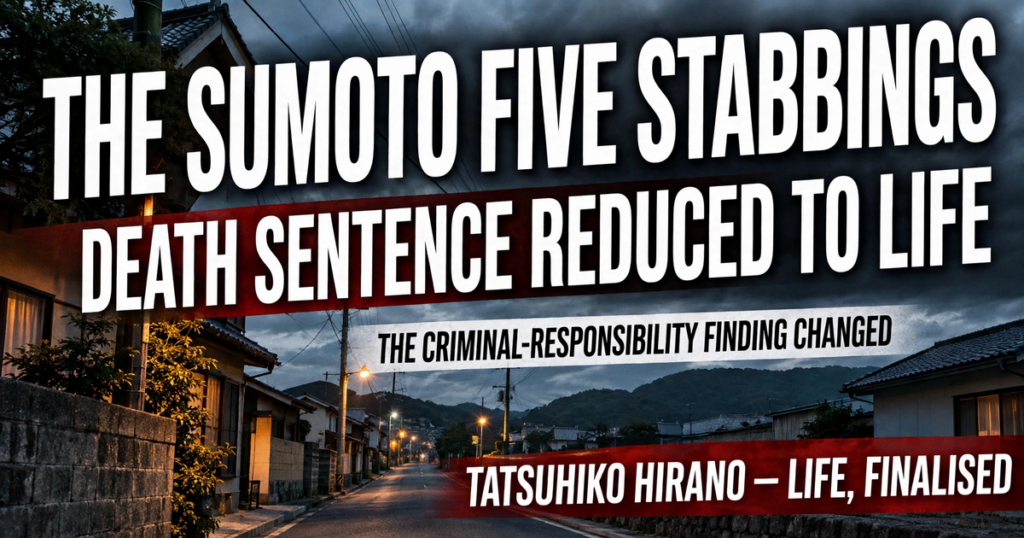
Five neighbours were killed in two homes in Sumoto
In the early hours of March 9, 2015, five people were killed in two neighbouring homes in a residential area of Sumoto on Awaji Island, Hyogo Prefecture. The victims belonged to two households. One home contained an elderly couple, aged 82 and 79. The second household included a man aged 62, his wife aged 59 and his mother, aged 84. The accused, Tatsuhiko Hirano, lived nearby. The case was investigated as five murders and became a major trial about the relationship between mental illness and criminal responsibility.
The defendant's conduct before the murders was examined
Before the killings, Hirano had been expressing beliefs that nearby residents were attacking him and his family through invisible technology. The courts later examined the development of those beliefs and the medical treatment he had received. He had used the prescription stimulant Ritalin over a long period and had been treated for a psychiatric condition. The existence of a mental disorder was not itself the legal question. The central issue was how much the condition had affected his ability to understand his actions and control his behaviour at the time of the killings.
The prosecution and defence disputed criminal responsibility
Hirano did not deny that he had carried out the killings. The defence argued that his mental condition had affected his ability to make decisions and that he should not be held fully criminally responsible. The prosecution maintained that he had understood the nature of his conduct and had been able to choose how to act. Two psychiatric assessments reached different conclusions about the diagnosis and the degree to which the disorder influenced the offences. The trial therefore required the court to evaluate expert evidence, the defendant's behaviour before and after the murders and the sequence of the attacks.
The Kobe District Court imposed the death penalty
On March 22, 2017, the Kobe District Court, sitting as a lay-judge court, sentenced Hirano to death. It accepted the diagnosis of a medication-related psychotic disorder but concluded that the disorder had not substantially impaired his decision-making or control at the time of the killings. The court found that he had understood that murder was a crime and had selected the victims and the timing of the attacks. It therefore recognised full criminal responsibility and imposed the death penalty for the five murders.
The Osaka High Court obtained a further psychiatric assessment
Hirano appealed. The Osaka High Court heard additional expert evidence and examined a new psychiatric assessment. The appellate court accepted that the defendant had a delusional disorder and that his belief that the neighbours were attacking him had become a powerful influence on his thinking. It concluded that the disorder had substantially affected his ability to resist the impulse to attack. The High Court did not find that he had completely lost the ability to understand or control his actions. Its legal finding was diminished responsibility, not a complete absence of criminal responsibility.
The death sentence was replaced by life imprisonment
On January 27, 2020, the Osaka High Court quashed the death sentence and imposed life imprisonment. The court maintained the findings that Hirano had committed the five murders. What changed was the assessment of his mental condition and the degree of responsibility that could legally be attributed to him. Under Japanese criminal law, a person who is legally insane may not be punished, while a person whose capacity is substantially diminished may receive a reduced sentence. The High Court applied the latter category. It did not acquit Hirano.
The Supreme Court left the life sentence in place
Both the defence and the prosecution challenged the High Court judgment. On January 20, 2021, the Supreme Court dismissed the appeals. The life sentence therefore became final. The final legal outcome is not a death sentence and not an acquittal. Hirano remains convicted of the five murders and is serving life imprisonment. The change from death to life imprisonment resulted from the appellate court's assessment of criminal responsibility, which the Supreme Court did not overturn.
The psychiatric findings must be described as judicial findings, not labels for the defendant
The case is sometimes reduced to a simple statement that the defendant was mentally ill. That description is inadequate. The district court and the High Court assessed the same broad history differently, and the appellate court relied on additional expert evidence. The High Court's finding of diminished responsibility did not mean that the victims' deaths were excused or that the defendant was innocent. It meant that the statutory degree of responsibility was reduced because the disorder had substantially affected his ability to control his conduct. The legal distinction explains the change in sentence.
The case raised separate questions about medical care and community support
After the criminal proceedings, attention also turned to Hirano's earlier treatment and the support available when a person leaves hospital and returns to community life. Those policy questions are distinct from the criminal court's task of determining responsibility for the murders. A treatment history does not establish that a particular offence was inevitable, and a later support review does not alter the final criminal judgment. The case is best understood by keeping three matters separate: the five murders, the court's legal assessment of responsibility and the wider discussion of treatment and community support.
Original Japanese record: 洲本5人刺殺事件|一審死刑から無期懲役へ、責任能力の判断を変えた二つの精神鑑定
Last updated:
Related articles
Case record
The Kumagaya Serial Murders: Six Victims, Diminished Responsibility, and a Life Sentence
Case record
The Kashiwa Serial Street Attacks
Case record
The Oguchi Hospital Infusion Poisonings: Three Patients Killed and a Life Sentence Upheld
Case record