The Murder of Diet Member Koki Ishii: A Political Career, a Fatal Attack and an Unresolved Motive
Koki Ishii, a member of Japan's House of Representatives, was stabbed outside his home in Setagaya, Tokyo, on October 25, 2002, and died from his injuries. The suspect, Hakusui Ito, surrendered the following day and was arrested. Ito received a life sentence in 2004; the Tokyo High Court dismissed his appeal in June 2005 and the Supreme Court dismissed his final appeal on November 15, 2005. The conviction became final, but the courts did not establish a complete explanation of the motive or evidence of a wider conspiracy.
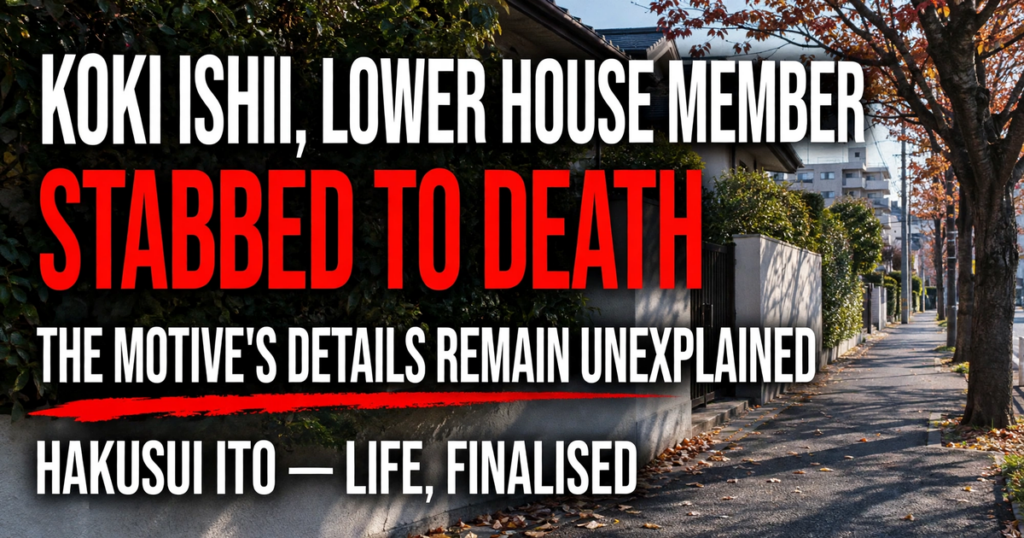
Koki Ishii was attacked outside his home on October 25, 2002
Koki Ishii, a member of the House of Representatives, was attacked outside his home in Setagaya Ward, Tokyo, on the morning of October 25, 2002. He was stabbed with a knife as he was leaving his residence and was taken to hospital, where he died. Ishii was 61. The attack shocked the Diet and the public because it involved a sitting national legislator and raised immediate concerns about political violence. The House of Representatives later recorded October 25 as the date of his death and held a formal memorial address.
The suspect surrendered the following day
The Metropolitan Police Department established a special investigation headquarters. On October 26, the day after the attack, Hakusui Ito appeared at a police station and was arrested on suspicion of murder. The government described the arrest in a House of Representatives committee session on October 30, 2002. At that point, investigators were still examining the motive and background. The official statement made clear that the suspect had been secured, but the full explanation of why Ishii had been attacked remained a matter for the investigation and subsequent trial.
Ishii had pursued investigations into public spending and government structures
Ishii was known for his work on administrative reform and scrutiny of public spending. In the Diet, he questioned the use of public funds, special accounts, public corporations and government-related projects. A memorial address delivered in the House on November 29, 2002 described his sustained work on administrative reform and the extensive material he had collected. His political work is relevant to understanding why the attack raised concerns about violence against elected representatives. It does not, by itself, prove that any particular investigation or political issue caused the murder.
Ito was prosecuted and received a life sentence
Ito was indicted for Ishii's murder. The Tokyo District Court tried the case and on June 18, 2004 imposed a sentence of life imprisonment. Ito's statements included a claim of financial grievance, but the court did not establish a complete and fully supported explanation of every aspect of the motive. The criminal judgment determined the defendant's responsibility for the killing and the appropriate sentence. It did not establish that the murder had been ordered by a political organisation or carried out as part of a wider conspiracy.
The Tokyo High Court dismissed the appeal
Ito challenged the district court judgment. On June 30, 2005, the Tokyo High Court dismissed the appeal and maintained the life sentence. The appellate court did not replace the first-instance conviction with an acquittal or a lesser sentence. The legal finding that Ito had murdered Ishii therefore remained in place. The question of motive, however, remained less fully resolved than the identity of the person who carried out the attack and the criminal responsibility established by the courts.
The Supreme Court made the life sentence final
On November 15, 2005, the Supreme Court dismissed Ito's final appeal. The life sentence became final. The criminal proceedings therefore established Ito's guilt for the murder and fixed the punishment at life imprisonment. The Supreme Court's dismissal should not be described as a separate trial of political theories about the killing. The final judgment settled the criminal responsibility of the defendant, not every question about the wider background or the possible significance of Ishii's political work.
The motive was not fully established by the final judgment
The case continued to attract attention because the motive was not explained with the same certainty as the identity of the attacker. Ito referred to money-related dissatisfaction, but the district court described the detailed motive as difficult to clarify. The final conviction did not establish that Ishii was killed because of a specific Diet investigation, nor did it identify an organiser or accomplice. A responsible account must distinguish what Ito said, what the courts found and what remained unresolved. Political context should not be turned into proof of a conspiracy.
The Diet treated the killing as an attack on democratic representation
On October 30, 2002, members of the House of Representatives raised the killing in committee proceedings. The National Public Safety Commission chair explained that Ishii had been attacked outside his home and that the suspect had surrendered and been arrested the following day. Members also expressed concern that violence could distort or silence political speech. On November 29, the House held a memorial address. The parliamentary record praised Ishii's sustained work on administrative reform and his contribution to scrutiny of government spending.
The memorial record is distinct from the criminal court record
The House of Representatives memorialised Ishii as a legislator who had worked across party lines on administrative reform and public accountability. That record explains his public role and the impact of his death on parliamentary life. The criminal judgments, by contrast, addressed Ito's responsibility and sentence. Neither source should be used to make claims that it does not establish. In particular, Ishii's investigations do not prove a motive, and the absence of a complete motive finding does not undermine the final conviction of the man who carried out the stabbing.
The final status is clear even though some questions remain
The legal sequence is straightforward: Ishii was killed on October 25, 2002; Ito surrendered and was arrested on October 26; the Tokyo District Court imposed life imprisonment in 2004; the Tokyo High Court dismissed the appeal on June 30, 2005; and the Supreme Court dismissed the final appeal on November 15, 2005. The life sentence is final. The detailed motive and any wider background that was not established in court remain unresolved. Those limits should be stated plainly rather than filled with speculation.
Original Japanese record: 石井紘基衆議院議員刺殺事件|無期懲役確定後も「犯行動機の詳細」が解明されなかった理由
Last updated: