
The Nabari Poisoned Wine Case: Five Deaths, a Reversed Acquittal and the Eleventh Posthumous Retrial Request
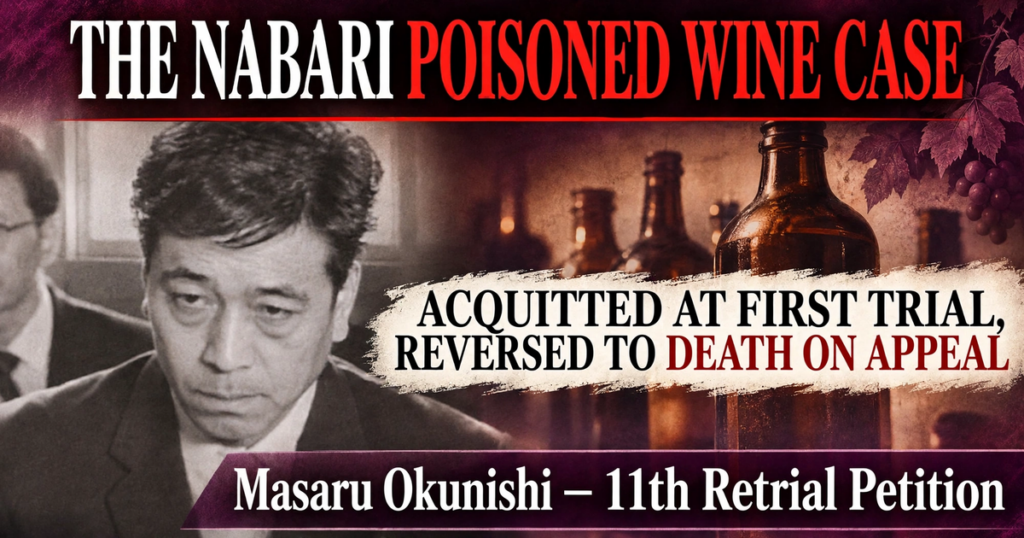
At a village gathering in Nabari on March 28, 1961, 17 women who drank poisoned wine suffered organophosphate poisoning; five died. Masaru Okunishi was acquitted at trial, convicted on appeal and sentenced to death. He died in 2015, but his sister's eleventh posthumous retrial petition, filed in 2026, is being examined.
Seventeen women became ill after drinking wine at a village gathering
On March 28, 1961, residents of Katsuo in Nabari, Mie Prefecture, gathered at a community hall for a social event. Sake was prepared for the men and wine for the women. After the women drank the wine, they began to collapse with symptoms of acute poisoning. Seventeen women who drank it suffered organophosphate poisoning. Five died and twelve survived with poisoning symptoms. Investigators found an organophosphorus agricultural chemical in the wine and treated the incident as deliberate poisoning. The fact that the wine had been prepared for a particular group of people became important to the investigation: police needed to establish who had handled the bottle, who could have opened it and whether poison could have been added before it was served.
Masaru Okunishi became the focus of the investigation
Police focused on Masaru Okunishi, who was 35 at the time and had been involved in preparing or handling the wine. The prosecution later relied on the relationships among people at the gathering, including the fact that Okunishi's wife and a woman said to be his romantic partner were among the victims. Investigators questioned him from the day after the incident. On the fifth day of questioning, he made a statement accepting that he had put pesticide into the wine. He was arrested on April 3 and indicted on April 24 for murder and attempted murder. Okunishi later withdrew the confession and denied responsibility. The case would turn on whether the confession and the prosecution's reconstruction of the bottle's handling were reliable.
The first trial ended in an acquittal
On December 23, 1964, the Tsu District Court acquitted Okunishi. The court found that reasonable doubt remained about the prosecution's account and the evidence linking him to the poisoning. The case was not treated as resolved simply because he had confessed during questioning. A confession must be assessed against objective facts, including whether the described method was possible and whether the surrounding evidence supports it. The prosecution appealed. On September 10, 1969, the Nagoya High Court reversed the acquittal and sentenced Okunishi to death. The Supreme Court dismissed his appeal on June 15, 1972, making the death sentence final. The reversal from acquittal to death became one of the most disputed features of the case.
The bottle and the confession remained central to the dispute
The prosecution's theory depended on the opportunity to introduce pesticide into the wine bottle and on the credibility of Okunishi's statements. The defence challenged the confession and the reconstruction of how the bottle had been opened, contaminated and resealed. Scientific testing of the bottle and its seal became important in later retrial applications. The issue was not simply whether pesticide had been present: that fact was established by the poisoning. The harder question was whether the evidence proved that Okunishi had introduced it. The courts that upheld the conviction treated the confession and circumstantial evidence as sufficient, while later defence applications argued that new scientific findings undermined the assumptions supporting the final judgment.
A retrial was once ordered, then the order was cancelled
The retrial history has lasted for decades. On April 5, 2005, the Nagoya High Court ordered a retrial, accepting that new evidence could undermine the conviction. The prosecution filed an objection, and on December 26, 2006, a different panel of the High Court cancelled the retrial order. The Supreme Court set that decision aside in April 2010 and sent the matter back. In May 2012, the High Court again cancelled the retrial order. In October 2013, the Supreme Court rejected the special appeal, ending the seventh retrial request without a new trial. These procedural stages must not be compressed into the statement that a retrial was granted and held. The 2005 order never led to a completed retrial or an acquittal.
Okunishi died while the death sentence remained final
Okunishi continued to seek a retrial through later applications. During the ninth request, he died of pneumonia at Hachioji Medical Prison on October 4, 2015, aged 89. His death ended the personal application then pending, but it did not overturn the conviction or cancel the death sentence. His sister, Miyoko Oka, and other supporters continued the legal effort through posthumous retrial procedures. The tenth request was rejected by the Nagoya High Court in 2017, an objection was dismissed in 2022, and the Supreme Court rejected the special appeal on January 29, 2024. Justice Katsuya Uga dissented, arguing that a retrial should begin. The dissent did not change the result, but it showed that the new evidence remained contested within the Supreme Court.
The eleventh posthumous retrial request was filed in January 2026
On January 22, 2026, Oka and other supporters filed an eleventh retrial request with the Nagoya High Court. The defence submitted expert findings concerning the adhesive on the sealing paper around the wine bottle. They argued that the adhesive contained components consistent with commercially available glue rather than the material used in the original manufacturing process. The condition of the sealing paper could bear on when the bottle was opened and whether it could have been resealed. As of August 27, 2026, the court had not granted or rejected the eleventh request. The application remains a posthumous proceeding: Okunishi cannot be retried personally, but the legal process can still examine whether the conviction should be set aside.
The High Court ordered testing of the original sealing paper
On October 28, 2026, the defence team disclosed at a press conference that the Nagoya High Court had decided to conduct laboratory testing of the original sealing paper and related items. The decision was dated October 13. The court is to examine eight items, including part of the sealing paper and the bottle label. This is a decision to test evidence; it is not a decision to begin a retrial and does not mean the conviction has been overturned. A separate information-disclosure lawsuit concerning documents related to the execution also continued after Okunishi's death. The Supreme Court sent that case back to the Nagoya High Court on January 27, 2026, but it is procedurally separate from the eleventh retrial request. As of November 22, the death sentence remains formally in place while the posthumous retrial request is pending.
Original Japanese record: 名張毒ぶどう酒事件|一審無罪から逆転死刑、奥西勝の死後も続く第11次再審
Last updated:
Related articles
Same case · Feature
The Nabari Poisoned Wine Case: A First-Instance Acquittal Became a Death Sentence — The Seal Paper and the Eleventh Retrial Request
Case record
The Teigin Bank Poisoning: Twelve Deaths and a Conviction Challenged for Decades

Case record
The Wakayama Curry Poisoning: Four Deaths, a Final Death Sentence and a Third Retrial Petition
Case record