
The Nabari Poisoned Wine Case: A First-Instance Acquittal Became a Death Sentence — The Seal Paper and the Eleventh Retrial Request
At a gathering in Nabari, Mie Prefecture, on 28 March 1961, seventeen women drank poisoned wine. Five died and twelve were injured. Masaru Okunishi was acquitted at first instance, but the acquittal was overturned and a death sentence became final in 1972. Retrial efforts continued after his death in 2015. In the eleventh request, the court permitted destructive testing of eight items of evidence in October 2026. That permission was not a decision to reopen the trial.
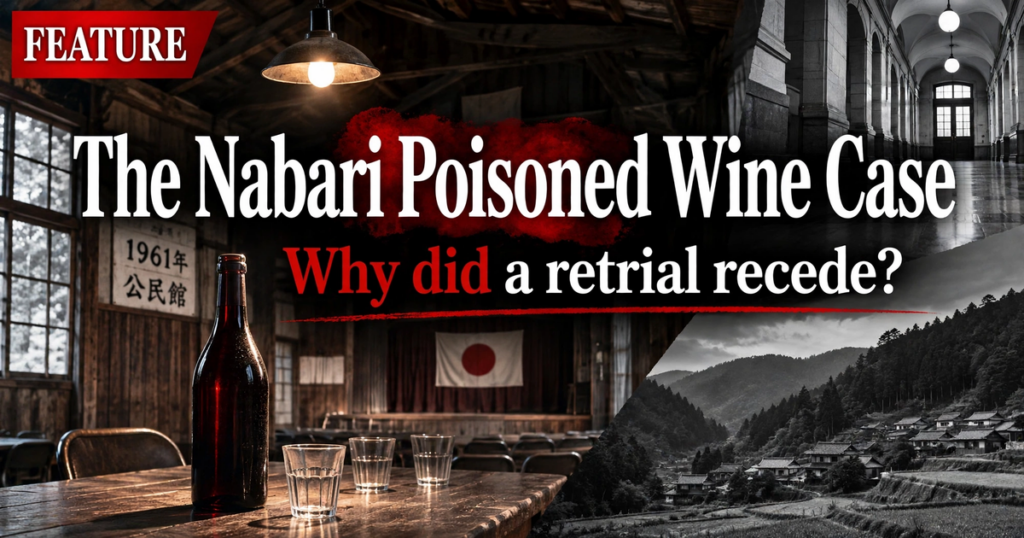
Introduction: The first-instance acquittal was overturned, and the retrial fight continued after death
On 28 March 1961, a gathering at a community centre in Katsuo, Nabari City, Mie Prefecture, ended in a mass poisoning. Seventeen women drank wine and developed symptoms. Five died and twelve suffered injuries caused by an organic phosphorus pesticide.
Masaru Okunishi was arrested and later confessed, but he withdrew the confession. On 23 December 1964, the Tsu District Court acquitted him. The prosecution appealed, and on 10 September 1969 the Nagoya High Court overturned the acquittal and sentenced him to death. The Supreme Court dismissed his appeal on 15 June 1972, making the death sentence final.
Okunishi continued to seek a retrial. A retrial-opening decision was issued in 2005 but was later overturned. He died on 4 October 2015 without seeing the retrial process reach a new trial. His younger sister, Miyoko Oka, continued the applications after his death. An eleventh retrial request was filed on 22 January 2026.
In October 2026, the Nagoya High Court permitted testing that would remove small portions of the sealing paper and other evidence. That was an important procedural development, but it was not a decision to begin a retrial or to acquit Okunishi. The case must be understood by separating the original trial, retrial-opening decisions, forensic testing and any future judgment.
A group poisoning at a community-centre gathering
The poisoning occurred at about 8 p.m. on 28 March 1961, at a gathering held after a general meeting of the Minano-kai life-improvement club at a community centre in Katsuo, Nabari City. The club was made up of residents of the Katsuo area on both the Mie and Nara sides of the prefectural boundary.
Japanese sake was prepared for the men and grape wine for the women. Of the twenty women present, seventeen drank the wine. They developed symptoms of poisoning, and five died. Twelve others suffered injuries from organic phosphorus poisoning. Investigators detected an organic phosphorus pesticide in the wine and began treating the incident as a poisoning murder.
The pesticide was identified as a TEP formulation. The incident was not a case in which every person present drank the same beverage: the reported poisoning affected the women who drank the wine.
The basic figures are important because they recur throughout the retrial history: five deaths and twelve injured people, among seventeen women who drank the wine.
How the wine bottle reached the community centre
The wine used at the gathering had been delivered from a liquor store to the home of the Minano-kai chair and then carried to the community centre. Okunishi was the person who transported both the wine and sake from the chair's home to the centre. The route of the bottles and where they were placed became important issues in the later trials.
Police initially questioned several men involved in purchasing or transporting the beverages. Okunishi was questioned repeatedly from the day after the incident. It was reported that on the fifth day, late at night, he made a statement to the effect that he had mixed pesticide into the wine. He was arrested on 3 April and indicted for murder and attempted murder on 24 April 1961.
The prosecution's proposed motive was that Okunishi wanted to remove his wife so that he could continue a relationship with his own mistress. The prosecution alleged that he prepared pesticide called Nikarin T, carried it in a bamboo tube and added it to the wine bottle while he was alone at the community centre.
The issue was not settled by the motive theory. The courts had to examine whether Okunishi had an opportunity to add the poison, how the bottle was opened, whether the confession matched the physical evidence and whether the timing and movements of the bottles were established reliably.
What did the Tsu District Court doubt when it acquitted him?
On 23 December 1964, the Tsu District Court acquitted Okunishi. It did not find that no poisoning had occurred. It accepted that poison had been mixed into the wine, five women had died and twelve had been injured. The issue was whether the prosecution had proved that Okunishi was the person who carried out the poisoning.
One major issue was whether the opportunity to add the pesticide was limited to approximately ten minutes at the community centre. The prosecution argued that Okunishi had been alone for that period after the wine was brought into the room. The first-instance court pointed out that the wine had also been at the chair's home, where another opportunity might have existed.
The time when the wine arrived at the chair's home depended on witness statements. Accounts made immediately after the incident differed from later statements. The court did not accept the prosecution's attempt to confine the opportunity to the ten-minute period at the community centre.
The first-instance judgment also examined the bottle, the stopper and the consistency of the confession with the physical evidence. It found that reasonable doubt remained about whether Okunishi had committed the crime.
The death sentence became final in 1972
The Nagoya High Court overturned the acquittal on 10 September 1969 and sentenced Okunishi to death. He appealed to the Supreme Court, but on 15 June 1972 the Supreme Court's First Petty Bench dismissed the appeal. The death sentence became final.
Okunishi continued to seek a retrial, but the sentence was not carried out and the final judgment was not overturned. He died at Hachioji Medical Prison on 4 October 2015, aged eighty-nine. His death did not mean that the conviction had been cancelled or that an acquittal had been entered.
The retrial applications continued to challenge the evidence underlying the final judgment. The main issues included the marks on the bottle stopper, the identity of the pesticide, the way the bottle had been opened, the sealing paper and the credibility of the confession.
The seventh retrial request briefly opened the door in 2005
The seventh retrial request focused in part on whether the substance detected in the wine matched the pesticide Nikarin T that the final judgment had treated as the poison.
On 5 April 2005, the Nagoya High Court's Criminal Division 1 ordered a retrial and suspended the execution of the death sentence, relying on new expert evidence submitted by the defence. It was the first time a retrial had been ordered after the death sentence had become final more than thirty years earlier.
The prosecution objected. On 26 December 2006, Criminal Division 2 of the Nagoya High Court cancelled the retrial-opening decision. The defence filed a special appeal. On 5 April 2010, the Supreme Court quashed the 2006 cancellation and remanded the matter to the Nagoya High Court, finding that the scientific assessment of the pesticide evidence had not been sufficiently examined.
The 2010 Supreme Court decision did not finally order a retrial. After remand, the Nagoya High Court cancelled the retrial-opening decision again on 25 May 2012. On 16 October 2013, the Supreme Court dismissed the special appeal, and the seventh request ended without a retrial trial.
The eighth and ninth requests, and Okunishi's death
The eighth retrial request was filed on 5 November 2013. The Nagoya High Court rejected it in May 2014 and dismissed an objection in January 2015. The defence withdrew its special appeal in May 2015 and moved to a ninth request.
Okunishi died on 4 October 2015. The ninth request, which had been filed by him personally, ended because he had died. His death did not overturn the death sentence, and no acquittal was issued.
After his death, his younger sister Miyoko Oka became the applicant. On 6 November 2015, she filed the tenth retrial request. The legal effort to review the final conviction continued through a family member rather than ending with Okunishi's death.
The tenth request focused on glue on the bottle's sealing paper
One central issue in the tenth retrial request was the type of adhesive found on the reverse side of the sealing paper that had been wrapped around the neck of the wine bottle. Professor Chie Sawatari's defence examination reported that PVA glue was present in addition to the CMC glue said to have been used when the sealing paper was originally attached during manufacture.
CMC glue was described as the adhesive used to attach the sealing paper to the bottle at the factory. PVA glue is made from polyvinyl alcohol and has also been used in household laundry starch and similar products.
The defence argued that, if PVA glue had been added later, the bottle might have been opened after manufacture, poisoned and then resealed. That mattered because the final judgment had found that the poisoning took place in the hearth room at the community centre, during a period of approximately ten minutes when Okunishi was alone. If the bottle had been opened and resealed elsewhere, the place and opportunity for the poisoning would need to be reconsidered.
On 8 December 2017, the Nagoya High Court's Criminal Division 1 rejected the tenth request. It did not consider the glue examination sufficient new evidence to create reasonable doubt about the final conviction. On 3 March 2022, Criminal Division 2 rejected the objection, and the defence filed a special appeal.
The Supreme Court in 2024: the majority and a dissenting justice disagreed
On 29 January 2024, the Supreme Court's Third Petty Bench dismissed the special appeal concerning the tenth retrial request. The retrial was not opened. The decision included a dissent by Justice Katsuya Uga.
The majority questioned whether the PVA glue had been identified scientifically. It noted that when multiple substances are present in a sample, the peaks in an ATR spectrum may be difficult to attribute to a particular substance. The Court also considered the long period since the incident, the possibility that other substances had adhered to the sealing paper during collection or storage and the possibility that its composition had changed over time. It questioned changes in the examiner's identification criteria and whether the basis for the conclusion had been sufficiently explained.
The majority therefore did not accept the claim that PVA glue had been reliably identified. It concluded that the examination did not sufficiently show that the sealing paper had been replaced or that the final judgment's finding about the opportunity at the community centre was undermined.
The majority also rejected the new pesticide experiments as grounds for retrial. It considered that hydrolysis of components in Nikarin T and the conditions of the paper-chromatography test could explain differences between the samples. It did not find that the new material undermined the confession concerning the use of Nikarin T. The new evidence about marks on the stopper was also considered insufficient, because the reduced identifying value of the marks had already been recognised in an earlier Supreme Court decision.
Justice Uga disagreed. He considered ATR to be a standard method for identifying substances and the examination to have been conducted in the presence of court personnel. He regarded Sawatari's examination as highly reliable. If PVA glue had been on the reverse of the sealing paper, he reasoned, the paper might have been reattached with a different adhesive, raising the possibility that the wine had been poisoned somewhere other than the community centre.
Uga also raised doubts about the confession: the pesticide bottle described in the confession had never been found despite a long search; phosphorus had not been detected at the location where the bamboo tube was said to have been burned; the alleged preparation of the offence raised practical questions; and several witnesses had described a petroleum-like smell from the wine. He concluded that the sealing-paper examination and the earlier evidence together created reasonable doubt and that a retrial should begin.
The majority's conclusion was that the tenth request did not meet the legal standard. Uga's dissent argued that the new examination and the older evidence were sufficient to reopen the case. The dissent did not change the result of the Court's decision.
The eleventh retrial request was filed by Okunishi's sister
On 22 January 2026, Miyoko Oka filed an eleventh retrial request with the Nagoya High Court. The defence submitted further experimental results intended to strengthen the sealing-paper examination and again challenged who had opened the bottle and how it had been opened.
One new argument concerned the way the sake bottles prepared for the gathering had been opened. The final judgment had found that Okunishi opened the inner stopper of the wine bottle with his teeth. The defence submitted an examination suggesting that the crown cap of a sake bottle at the gathering had been opened with a rod-like tool. It argued that a man's statement that he had opened the sake bottle with his teeth was mistaken and that he might have opened the wine bottle as well.
That is the defence's argument. The court has not found that the man actually opened the wine bottle. The evaluation of the examination and witness statement remains part of the retrial proceedings.
The eleventh request also included additional analysis and experiments relating to the PVA glue claim. The defence said that material from another institution supported the possibility that the sealing paper had been reattached after the bottle was opened.
In October 2026, destructive testing of eight items was permitted
A significant development occurred in October 2026. At a press conference on 28 October, the defence team announced that the Nagoya High Court had issued a decision dated 13 October permitting testing on eight items, including the wine bottle's sealing paper and labels. The examination would remove small portions of the evidence to analyse the adhesive components. Reports described it as the first time that a portion of the sealing paper itself would be cut away for analysis.
The procedure is a form of destructive testing because part of the physical evidence is consumed. The defence wants to examine the adhesive on the reverse side directly and determine whether PVA or another adhesive different from the CMC glue used during manufacture is present. Comparing the remaining sealing paper, fragments still attached to the bottle neck and labels is part of the proposed examination.
The prosecution reportedly argued that, even if a different adhesive component were detected, the fact that more than sixty-five years had passed meant that the result alone could not establish that the sealing paper had been replaced. It said it would present its views so that the facts could be assessed accurately.
Permission to conduct the test does not decide what the result will show. Even if the examination is completed, the result must be assessed with the condition of the sealing paper, the way the bottle was opened, the delivery of the wine, witness statements, the confession and the pesticide analysis.
The procedure had not yet reopened the case
As of 5 November 2026, no decision had been announced either granting or rejecting the eleventh retrial request. The information available at that point was that the Nagoya High Court had permitted testing of eight items on 13 October, as disclosed by the defence at its 28 October press conference. The test results had not been published.
The procedural position was as follows: the death sentence had become final in 1972; Okunishi died on 4 October 2015 at age eighty-nine; the Supreme Court dismissed the special appeal in the tenth request on 29 January 2024, with a majority rejecting retrial and Justice Uga dissenting; Oka filed the eleventh request on 22 January 2026; and the new issues concerned the adhesive on the sealing paper, the way the bottles were opened and the stopper on the sake bottle.
The death sentence had not been overturned. A retrial had not been opened. The permission to test evidence was a procedural decision about how the evidence could be examined, not a decision that the final conviction was wrong.
The case is often described through three events that can sound similar but are legally different: the first-instance acquittal, the 2005 retrial-opening decision and the 2026 permission for destructive testing. None of those events is a final retrial acquittal. The first-instance acquittal was overturned; the 2005 retrial order was cancelled; and the 2026 testing decision did not itself open a retrial.
A first-instance acquittal, a retrial opening and a retrial acquittal are different
Three distinctions are essential when describing the Nabari case.
First, the first-instance acquittal did not become final. The Tsu District Court acquitted Okunishi, but the prosecution appealed and the Nagoya High Court overturned the judgment and imposed death. That sentence became final in 1972.
Second, the 2005 retrial-opening decision did not become final. The prosecution objected, the decision was cancelled and the later proceedings did not lead to a retrial trial.
Third, the permission in 2026 to cut and examine parts of eight items of evidence is not a retrial-opening decision. It is a significant step in examining evidence, but the results and the question whether a retrial should begin remain undecided.
The five women who died and the twelve people who were injured must remain at the centre of the record. The final judgment, the defence's arguments, the prosecution's position, the Supreme Court majority and the dissenting opinion should be presented separately. That is the only way to explain the long history without turning a procedural development into a claim of acquittal.
At a glance
Incident: 28 March 1961, around 8 p.m., at a gathering at the community centre in Katsuo, Nabari City, Mie Prefecture. Victims: 17 of 20 women drank the wine; five died and twelve were injured. Poison: organic phosphorus pesticide, identified as a TEP formulation. Defendant: Masaru Okunishi. Arrest: 3 April 1961; indictment: 24 April 1961. First instance: acquittal by Tsu District Court on 23 December 1964. Appeal: death sentence by Nagoya High Court on 10 September 1969. Supreme Court: appeal dismissed on 15 June 1972; death sentence final. Okunishi died on 4 October 2015, aged 89. Seventh retrial request: opening order in 2005 later cancelled; no retrial trial. Tenth request: filed by his sister on 6 November 2015; rejected, with Supreme Court special appeal dismissed on 29 January 2024 and a dissent by Justice Uga. Eleventh request: filed 22 January 2026. On 13 October 2026, the Nagoya High Court permitted destructive testing of eight items. As of 5 November 2026, test results were unpublished, no retrial had begun and the death sentence remained in force.
Original Japanese feature: 名張毒ぶどう酒事件【特集】|一審無罪が死刑に変わった――封緘紙を追う第11次再審まで
Last updated:
Related articles
Same case · Case record
The Nabari Poisoned Wine Case: Five Deaths, a Reversed Acquittal and the Eleventh Posthumous Retrial Request

Case record
The Teigin Bank Poisoning: Twelve Deaths and a Conviction Challenged for Decades

Case record
The Wakayama Curry Poisoning: Four Deaths, a Final Death Sentence and a Third Retrial Petition

Case record