
The Katsuta Kiyotaka Serial Murders: The Reported 22-Victim Confession, Eight Judicially Established Deaths and the Nationwide No. 113 Investigation
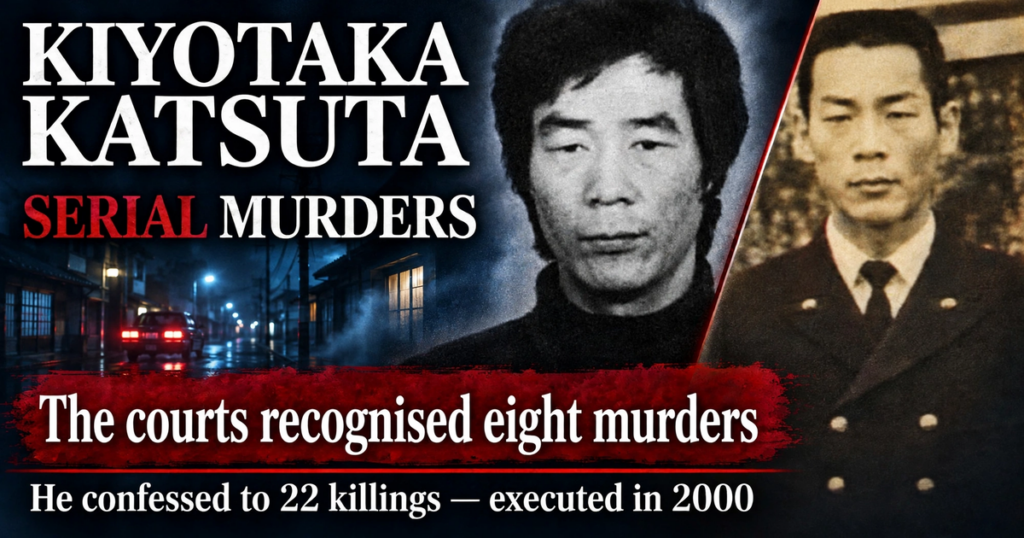
From 1972 to 1983, Katsuta Kiyotaka committed robberies and murders across several prefectures. His arrest in a failed armed robbery in Nagoya exposed a much wider series of crimes, including the police-designated Wide-Area Important Case No. 113. Later reporting described statements concerning 22 victims, but the courts established eight killings. The Supreme Court upheld the death sentences in January 1994; Katsuta was executed in November 2000.
A decade of crimes crossed prefectural borders
Between 1972 and 1983, Katsuta Kiyotaka carried out a succession of robberies, thefts and killings across the Kansai and Tokai regions. The victims were not linked by a single relationship or setting. Some attacks began with intrusions into women's homes; others involved people travelling, working or handling money. Katsuta used different methods, including strangulation and firearms. Because the incidents occurred in different prefectures and did not all share the same method, police initially investigated them as separate crimes rather than as one continuous series.
The stolen police handgun created a nationwide investigative trail
A major change came in October 1982, when a police officer was attacked and a service handgun was stolen. A series of armed robberies and shootings followed in several prefectures. The National Police Agency designated the related crimes Wide-Area Important Case No. 113 and coordinated a broader search. The stolen weapon provided a common investigative link between incidents that had occurred far apart. Earlier crimes attributed to Katsuta had not all involved guns, however, so the No. 113 investigation did not by itself explain the full history of the killings.
A failed bank robbery led to Katsuta's arrest
On 31 January 1983, Katsuta attempted to rob a customer in the parking area of a bank branch in Nagoya. The customer resisted, and people nearby helped restrain him. Police arrested him at the scene. The arrest brought the No. 113 investigation to a decisive point, but it also opened a second line of inquiry: whether Katsuta was responsible for older unsolved robberies and murders. Investigators began comparing his accounts with the dates, locations, victims and physical evidence from crimes going back roughly a decade.
The figure of 22 must not be confused with the court's findings
Later reporting, including a 2025 TBS retrospective, repeated the figure of 22 people in connection with Katsuta's reported statements after arrest. That number was not a judicial finding. At a parliamentary hearing on 30 March 1983, a senior police official described seven additional cases involving seven people as being under investigation at that stage, alongside one death in an earlier incident, and emphasised that the inquiries were still being verified. The final Supreme Court judgment established eight deaths in the crimes before it. The reported figure of 22 and the judicially established total of eight therefore have different evidentiary status.
The Supreme Court judgment separated two groups of offences
The Supreme Court's judgment described two groups of crimes. The first covered offences committed from September 1972 to July 1980: Katsuta entered or approached women's homes, killed five women by strangulation and took property, and also committed armed robberies in which two financial-sector employees were shot dead. The second group covered crimes from August 1982 to January 1983, after he had received a suspended sentence for an earlier theft. In this later period he used a vehicle and a stolen police handgun in further robberies and attacks, killing one more person. Together, the two groups accounted for eight deaths.
The court record included far more than the killings
The prosecution was not limited to eight murders. The cases also involved robbery, attempted robbery, robbery causing injury, theft, unlawful entry, firearms offences and other conduct connected with the attacks. The Supreme Court described how Katsuta had stolen a shotgun and vehicles, used weapons to take money, and crossed a wide area between the Kansai and Tokai regions. It also considered the seriousness of the injuries and fear inflicted on survivors. The legal record is therefore broader than a list of eight victims, even though those eight deaths were central to the capital sentences.
Two death sentences survived the appeals
The Nagoya District Court imposed death sentences in the two groups of proceedings. The Nagoya High Court dismissed Katsuta's appeal on 19 February 1988. On 17 January 1994, the Supreme Court's First Petty Bench dismissed his final appeal in case No. 1988 (A) 352. The official judgment identified the matter as an eight-person robbery-murder case and upheld the two death sentences imposed at first instance. The court considered the repeated killings, the planned use of weapons, the financial motives and the danger posed to the public. It also noted that Katsuta had come to recognise the gravity of his crimes and expressed remorse, but concluded that these circumstances did not justify reducing the sentences.
The death sentence was carried out in 2000
Katsuta was executed at Nagoya Detention Centre on 30 November 2000, at the age of 52. The execution came nearly seven years after the Supreme Court dismissed his appeal. His death ended the enforcement of the sentences against him, but it did not turn every additional incident mentioned in later accounts into a proven offence. The legal outcome remained tied to the crimes established in the two proceedings, including the eight killings.
The case is also a lesson in how a confession must be tested
The story is often condensed into the striking contrast between 22 reported victims and eight deaths recognised by the courts. The more important distinction is between a lead in an investigation and proof in a criminal trial. Police testimony before the Diet in March 1983 described how different methods, sparse physical evidence and travel across prefectural borders had made the incidents difficult to connect. The Supreme Court later assessed the offences that had been proved, not every allegation that circulated after the arrest. A careful account must preserve that boundary: the No. 113 investigation, the reported statements, the charges and the final judicial findings are related, but they are not interchangeable.
Original Japanese record: 勝田清孝連続殺人事件|22人の自供と8人の有罪認定、113号事件から死刑執行まで
Last updated:
Related articles
Case record
The Norio Nagayama Case: Four Murders and the Origins of Japan's Death Penalty Sentencing Standard
Case record
The Kiyoshi Okubo Murders: Eight Women Killed in Forty-One Days
Case record
The Matsusaka Murder of Two Filipino Women: A Deceptive Invitation and a Final Death Sentence

Case record