
The Wakayama Curry Poisoning: Four Deaths, a Final Death Sentence and a Third Retrial Petition
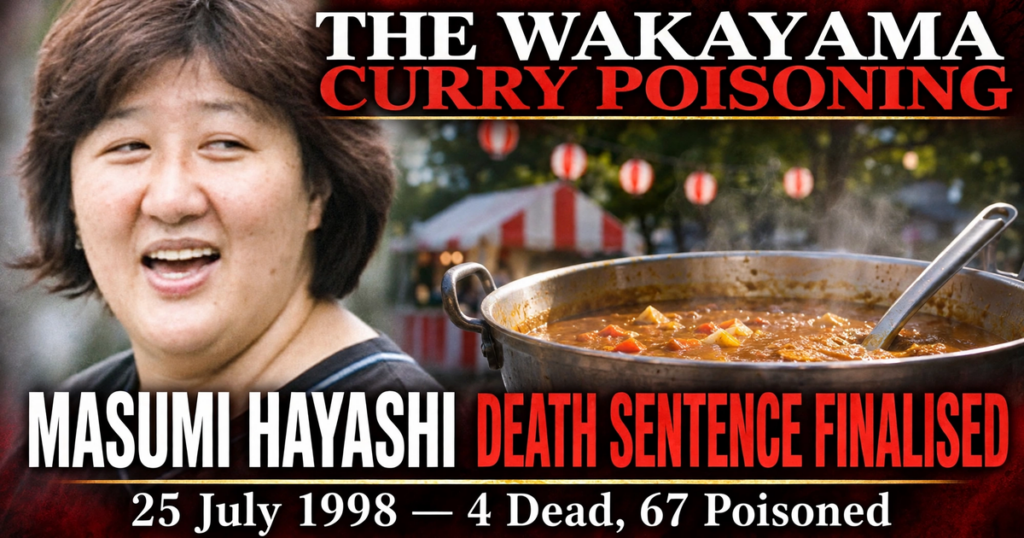
At a summer festival in Wakayama on July 25, 1998, 67 people suffered acute arsenic poisoning after eating curry; four died. Masumi Hayashi's death sentence became final in 2009 on circumstantial evidence. A third retrial petition remains pending, but no retrial has been ordered.
A summer festival became the scene of a mass poisoning
On the evening of July 25, 1998, residents of the Sonobe district of Wakayama City gathered for a local summer festival. Curry was prepared and served to people attending the event. Soon afterward, residents who had eaten it began suffering symptoms including vomiting and abdominal pain. Many were taken to medical facilities. Investigators eventually identified 67 people as having suffered acute arsenic poisoning. Four died: neighborhood association chairman Takatoshi Yanaka, aged 64; deputy chairman Takaaki Tanaka, aged 53; high-school student Miyuki Torii, aged 16; and elementary-school pupil Hirotaka Hayashi, aged 10. The deaths affected adults involved in community activities as well as children. What began as a medical emergency at a neighbourhood celebration became a major criminal investigation into how arsenic had entered the food.
The investigation focused on the curry and access to the cooking area
Police examined the curry, cooking equipment, ingredients and people who had been near the pot while food was prepared or stored. The investigation had to address two different questions: what substance caused the illness, and who had introduced it into the curry. The presence of arsenic established the poisoning mechanism, but it did not by itself identify the person responsible. Investigators reconstructed who could approach the pot, when the lid had been opened and what witnesses had seen. The festival was a community event, so many people were moving around the site. The prosecution would later rely on a combination of forensic findings and circumstances surrounding access, rather than a witness who directly saw the poison being added.
The courts relied on several strands of circumstantial evidence
Masumi Hayashi denied putting arsenic into the curry, and there was no confession to that act. The prosecution therefore presented a body of circumstantial evidence. One part concerned the chemical characteristics of the arsenic in the curry and samples seized from places connected with Hayashi. The Supreme Court treated similarities in their composition as one link between the poison and the defendant. The judgment did not say that a single laboratory result, standing alone, proved guilt. It assessed the chemical evidence alongside other forensic findings and the circumstances of the festival. This distinction matters because the case has continued to attract debate about scientific interpretation. The final judgment was based on the combined force of multiple items, not on a claim that a unique chemical signature alone named the offender.
Hair evidence and the opportunity to approach the pot were also considered
A further part of the prosecution case concerned arsenic detected in Hayashi's hair. The Supreme Court considered the concentration and pattern of the finding and concluded that it supported an inference that she had handled arsenic. The court also examined evidence about her movements and opportunity to approach the curry pot while the food was being prepared or stored. Witness accounts concerning the opening of the pot's lid were assessed with the other evidence. The court's reasoning was cumulative: chemical composition, hair analysis, opportunity and observations at the festival were considered together. The judgment held that the combined circumstances excluded reasonable doubt. Hayashi and her supporters have continued to challenge that conclusion, but a later challenge to evidence does not itself amount to a court finding that the original conviction was wrong.
The motive was never established, and separate insurance offences must be kept distinct
The specific reason why Hayashi would have poisoned curry served to local residents was not established. The Supreme Court acknowledged that the motive remained unknown. It nevertheless held that the absence of a proven motive did not negate the other evidence. Hayashi was also prosecuted in connection with separate insurance-related fraud and attempted-murder offences. Those matters formed part of the wider criminal proceedings and were considered in sentencing. They must not be used as a substitute for proof of the curry poisoning. The court's finding that Hayashi was responsible for the festival attack rested on evidence relating to that incident itself. Keeping the separate offences distinct is essential to an accurate account: a defendant's involvement in one criminal matter does not automatically prove responsibility for another.
A death sentence passed through the ordinary appeals process
On December 11, 2002, the Wakayama District Court sentenced Hayashi to death. The Osaka High Court dismissed her appeal on June 28, 2005. On April 21, 2009, the Supreme Court's Third Petty Bench rejected her final appeal. The death sentence became final on May 19, 2009. The Supreme Court considered the four deaths, the poisoning of 63 other people and the indiscriminate nature of the attack at a community festival. It also considered mitigating matters, including the absence of prior convictions and the form of intent attributed to the poisoning, but concluded that the death sentence should stand. The distinction between the date the Supreme Court dismissed the appeal and the later date the judgment became final is preserved here.
Earlier retrial proceedings did not overturn the conviction
After the death sentence became final, Hayashi continued to seek a retrial. Her first retrial petition was rejected by the Wakayama District Court on March 29, 2017, and the Osaka High Court dismissed the immediate appeal on March 24, 2020. A separate second petition was rejected by the Wakayama District Court on January 31, 2023. The Osaka High Court dismissed the immediate appeal on January 27, 2025. The Supreme Court rejected the special appeal concerning that second petition on November 11, 2025. That ruling ended the second retrial route; it did not decide the separate third petition. Different retrial applications have proceeded on different evidence and procedural histories, so their outcomes cannot be compressed into a statement that all requests were rejected.
The third retrial petition remains separate from the final conviction
Hayashi filed a third retrial petition in February 2024. Reporting on July 25, 2026, the twenty-eighth anniversary of the poisoning, stated that the petition was still being examined by the Wakayama District Court. As of the Japanese archive's November 14, 2026 update, no order granting a retrial had been confirmed. The legal position is therefore twofold: the 2009 death sentence remains final and in force, while a third request to reopen the case is pending. A retrial petition is not itself a retrial order, and the filing does not suspend or erase the original judgment. Hayashi continues to claim innocence. Any future change in the legal status must be based on a court decision, not on the mere existence of a new forensic argument or petition.
Original Japanese record: 和歌山毒物カレー事件|67人がヒ素中毒・4人死亡、林真須美の死刑確定と第3次再審請求
Last updated:
Related articles
Same case · Feature
The Wakayama Curry Poisoning: Where Did the Arsenic in the Curry Come From? — A Final Death Sentence and the Battle over Scientific Evidence
Case record
The Osaka Private Video Booth Fire: Sixteen Deaths, a Final Death Sentence and a Second Retrial Denial
Case record
The Nabari Poisoned Wine Case: Five Deaths, a Reversed Acquittal and the Eleventh Posthumous Retrial Request
Case record