
The Lucy Blackman Case: A British Woman's Disappearance and the Criminal Case Against Joji Obara
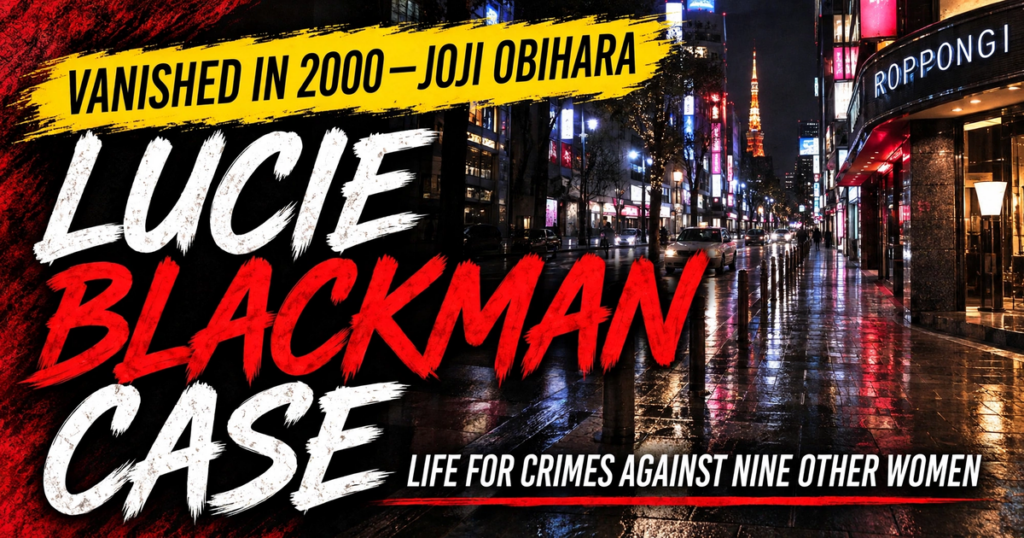
Lucy Blackman, a 21-year-old British woman working in Tokyo, disappeared on 1 July 2000 after telling a friend that she was going to the coast with a customer. Her remains were found in a cave in Miura, Kanagawa Prefecture, on 9 February 2001. Joji Obara was convicted of several offences involving her, including abduction for sexual purposes, attempted quasi-rape, and destruction and abandonment of her remains. The courts did not find him guilty of causing her death because the cause of death could not be established. His life sentence became final in December 2010.
A British woman disappeared after leaving Tokyo to meet a customer
Lucy Blackman was 21 and working at a club in Roppongi, Tokyo, when she disappeared on 1 July 2000. She had previously worked as a flight attendant for British Airways and had come to Japan with a friend. On the afternoon of 1 July, she received a telephone call from a man and left the residence where she was staying in Shibuya. She later told a friend that she was driving with a customer toward the coast. She expected to return within about an hour, but no further contact came from her.
The last calls and messages were examined as possible attempts to disguise the disappearance
At around 5 p.m., Blackman told a friend that she was travelling toward the coast with a customer. At about 7 p.m., she said she expected to return in roughly an hour. This was the last known telephone contact from her to the friend. At around 9 p.m., a call was made to the Zushi City fire department asking about nearby emergency hospitals; investigators later examined its connection to Obara. On 2 July, a man telephoned the friend and said, in substance, that Blackman had joined a religious group and would not return. Later calls and letters referred to religious training and debt, but investigators concluded that the letters were not written in her handwriting.
Her family travelled from Britain and appealed for information
Blackman's father, Tim, and her sister, Sophie, travelled from Britain to Japan and held press conferences and appeals for information. The British Embassy assisted with public appeals, and the case attracted attention in both countries. The family did not accept the suggestion that she had voluntarily joined a religious group and disappeared. The investigation began as a search for a missing woman, but it gradually expanded as police examined other reports involving women who had met the same man and later lost consciousness or reported sexual assault.
The investigation widened to include other women who had encountered Obara
Joji Obara, a real-estate-related business operator, came under investigation after reports from several women were connected. He was first arrested in October 2000 on suspicion of a sexual offence involving another woman. Police searched properties associated with him and examined reports of women who said they had lost consciousness after meeting him and had then been sexually assaulted. The investigation also revisited the 1992 death of Australian woman Karita Ridgway. That separate case later resulted in a conviction for quasi-rape resulting in death. It was important to distinguish Ridgway's case from Blackman's because the evidence and legal findings were not identical.
Blackman's remains were found in a cave in Miura in February 2001
On 9 February 2001, human remains were discovered in a cave on the coast of Miura City, Kanagawa Prefecture, near a property owned by Obara. DNA testing identified the remains as Blackman's. The body had been dismembered and had deteriorated substantially during the seven months since her disappearance. The condition of the remains made it difficult for medical examiners to establish a cause of death. That limitation became central to the criminal proceedings: investigators could examine the handling of the body and the events leading to her disappearance, but proving that a particular act had caused her death was a separate question.
The criminal trial covered ten women, not only Blackman
Obara was indicted in connection with offences involving ten women, including Blackman. The victims included Japanese and foreign women, and the incidents occurred at different times. Prosecutors argued that he repeatedly used drugs to render women unable to resist before sexually assaulting them. The evidence included reports from victims, records and material recovered from properties associated with him. Obara denied the charges and disputed his involvement in Blackman's disappearance, death and the treatment of her remains. The trial therefore considered a series of offences, not one isolated incident.
The Tokyo District Court acquitted Obara of the charges relating to Blackman
On 24 April 2007, the Tokyo District Court sentenced Obara to life imprisonment for offences involving nine other women, including Ridgway. However, it acquitted him of the charges concerning Blackman. The first-instance court considered that the cause of her death had not been established and that the evidence did not prove beyond reasonable doubt that Obara had committed the charged acts against her. The life sentence was imposed because of the other offences; it was not a sentence for murdering Blackman. This distinction is essential when describing the first trial.
The Tokyo High Court changed part of the result in December 2008
Both the prosecution and the defence appealed. On 16 December 2008, the Tokyo High Court partly overturned the first-instance judgment and found Obara guilty of abduction for the purpose of committing an indecent act, attempted quasi-rape, destruction of a corpse and abandonment of a corpse in relation to Blackman. The High Court found that he had abducted her and attempted a sexual offence, and that he had been involved in the destruction and abandonment of her remains. It did not find him guilty of quasi-rape resulting in death because the cause of death could not be established. The sentence remained life imprisonment.
The life sentence became final in 2010, but the court did not convict him of causing Blackman's death
Obara appealed to the Supreme Court. In December 2010, the Supreme Court rejected his appeal, and the life sentence became final. The final judgment therefore included the offences recognised by the High Court in relation to Blackman, as well as the separate offences involving other women. It did not establish that Obara had caused Blackman's death. In May 2026, he was still reported as a life-sentence prisoner when the Tokyo District Court dismissed a separate damages claim he had brought over a documentary and an interview article. That later civil case did not alter the criminal findings. The criminal record must preserve the difference between the convictions that were entered and the death-related charge that was not proved.
Original Japanese record: ルーシー・ブラックマン事件|一審無罪を高裁が一部破棄、織原城二の無期懲役確定まで
Last updated:
Related articles
Case record
The Wanted Case of Katsuyuki Obara and the Death of 17-Year-Old Kozue Sato
Case record
The Shimada Case: A Death Sentence Overturned After 35 Years as Confession and Forensic Evidence Collapsed
Case record
The Matsudo Female University Student Murder-Arson: A Death Sentence Replaced by Life Imprisonment
Case record