
The Imaichi First-Grade Girl Murder
Seven-year-old Yuki Yoshida disappeared on her way home from school in December 2005 and was found dead in a forest in Ibaraki Prefecture the next day. Takuya Katsumata was arrested and convicted after a long investigation. The Tokyo High Court overturned the first-instance judgment's reasoning but again found him guilty on circumstantial evidence and imposed life imprisonment. The Supreme Court rejected his appeal in 2020; efforts to seek a retrial continued.
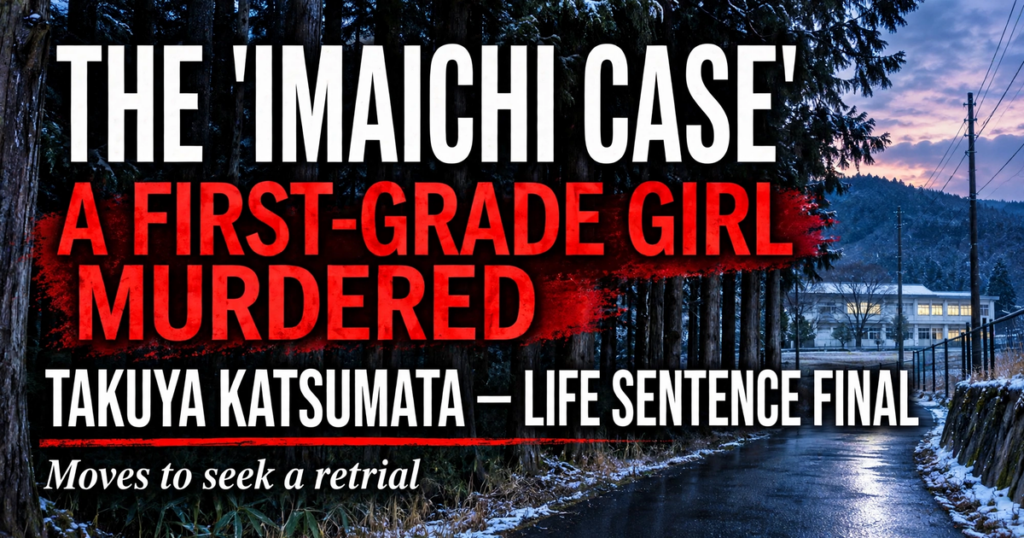
A seven-year-old girl disappeared on her way home from school
On the afternoon of 1 December 2005, Yuki Yoshida, a first-grade pupil aged seven, disappeared in the former city of Imaichi, Tochigi Prefecture, now part of Nikko City. She had been walking home from school and was last seen after separating from a classmate. At about 2 p.m. the following day, her body was found in woodland in Hitachiomiya City, Ibaraki Prefecture, more than 60 kilometres away. She had sustained numerous knife wounds to the chest. The distance between the disappearance location and the place where her body was found became an important part of the investigation.
The case remained unresolved for years
Police investigated the disappearance and killing for approximately eight years before a suspect was arrested. On 29 January 2014, Takuya Katsumata was arrested in a separate case involving trademark violations related to counterfeit branded goods. During that period of detention, investigators questioned him about Yoshida's murder. He was arrested on suspicion of murder on 3 June 2014 and indicted for murder on 24 June. The distinction between the initial arrest for a separate offence and the later arrest and indictment for this homicide matters when following the chronology of the investigation and the later disputes about the interrogation and confession.
Katsumata confessed during questioning but denied the murder at trial
During the investigation, Katsumata made statements admitting that he had killed Yoshida. In court, however, he denied the murder and said that he had not killed her. The prosecution relied on the confession and other circumstantial evidence. The defence challenged the reliability of the statements and disputed the prosecution's reconstruction of the abduction, the location and the time of the killing. The first-instance court accepted the prosecution's account and found Katsumata guilty. The later appellate judgment, however, did not simply affirm every part of the first court's reasoning.
The first-instance court imposed life imprisonment
On 8 April 2016, the Utsunomiya District Court sentenced Katsumata to life imprisonment. The judgment relied on his confession and circumstantial evidence, including records from the vehicle-monitoring system commonly referred to as N-system. The court found that he had abducted Yoshida, sexually assaulted her, stabbed her and abandoned her body in woodland. Katsumata appealed. The case was then examined by the Tokyo High Court, where the evidentiary basis and the way the prosecution had specified the time and place of the killing became central issues.
The Tokyo High Court overturned the first judgment but again convicted him
On 3 August 2018, the Tokyo High Court set aside the first-instance judgment but imposed life imprisonment again. The high court found problems with the first court's evaluation of evidence and its findings about the date and location of the killing. It did not conclude that Katsumata was innocent. Instead, after allowing a revised or alternative description of the charge that covered a broader time and place, it assessed the circumstantial evidence as a whole and found that he had committed the murder. This distinction is essential: the first-instance judgment was overturned, but the appellate court entered a new conviction and a new life sentence.
The circumstantial evidence was assessed as a combination
The high court considered a number of items rather than treating any single one as conclusive. Katsumata had owned an older white four-door sedan whose characteristics overlapped with a suspicious vehicle reported near the school route. He had been in a location from which he could have reached the abduction area during the relevant period and had previously lived in the former Imaichi area. A hair found on Yoshida's hand had a mitochondrial DNA type in the same group as a cat kept by Katsumata, but the high court corrected the strength with which that match could be expressed. It did not treat the hair as proof that it came from his cat.
Other evidence was also treated with qualifications
A mark on Yoshida's neck was found to be compatible with an injury that could have been caused by a stun gun owned by Katsumata, but the high court did not regard that fact alone as identifying the instrument or proving the killer's identity. DNA recovered from adhesive tape on the body did not match Katsumata; the court reasoned that the evidence did not establish that the DNA necessarily came from the person who killed her. The high court also considered a letter Katsumata sent to his mother shortly after questioning began, in which he apologized for having caused an incident. It interpreted the reference in context as relating to the Imaichi case. Possession of child pornography and knives was not treated as direct proof of murder.
The Supreme Court rejected the appeal in 2020
Katsumata appealed to the Supreme Court. On 4 March 2020, the Supreme Court's Second Petty Bench dismissed his appeal, leaving the Tokyo High Court's life sentence in place. The Supreme Court did not issue a new, lengthy reassessment of every item of evidence; the appeal was dismissed on the grounds that the arguments did not meet the statutory requirements for a further appeal. The life sentence consequently became final in March 2020. The charge formally adjudicated was murder. The high court explained that the limitation period for the separate acts of abduction and abandonment had expired by the time of prosecution, so those acts were examined as part of the factual context rather than as separately adjudicated offences.
The final conviction and the continuing retrial campaign are separate matters
As reported in the Japanese article updated in October 2026, Katsumata continues to claim that he did not kill Yoshida, and supporters have continued activities aimed at seeking a retrial. A new defence team was formed in 2025 and pursued investigation and review of the evidence. A retrial request is a procedure through which a person seeks to reopen a final conviction by presenting grounds such as new evidence. The source did not report that a retrial had been ordered or that the conviction had been set aside. The legal position therefore remains a final murder conviction and life sentence, alongside a continuing claim of innocence and efforts to obtain a retrial.
Original Japanese record: 栃木小1女児殺害事件(今市事件)|吉田有希さん殺害、東京高裁が一審破棄後も無期懲役
Last updated:
Related articles
Case record
The Hiroshima First-Grader Murder: A Life Sentence After a Complex Appeal and Remand
Case record
The Murder of Lindsay Ann Hawker: Police Encounter and Flight on Foot, Arrest 961 Days Later
Case record
The Matsudo Female University Student Murder-Arson: A Death Sentence Replaced by Life Imprisonment
Case record