
The Wanted Case of Katsuyuki Obara and the Death of 17-Year-Old Kozue Sato
Seventeen-year-old Kozue Sato was found dead in a mountainous area of former Kawai Village in July 2008. Police obtained a murder arrest warrant for Katsuyuki Obara, who also disappeared soon afterward; neither his location nor his fate has been publicly established.
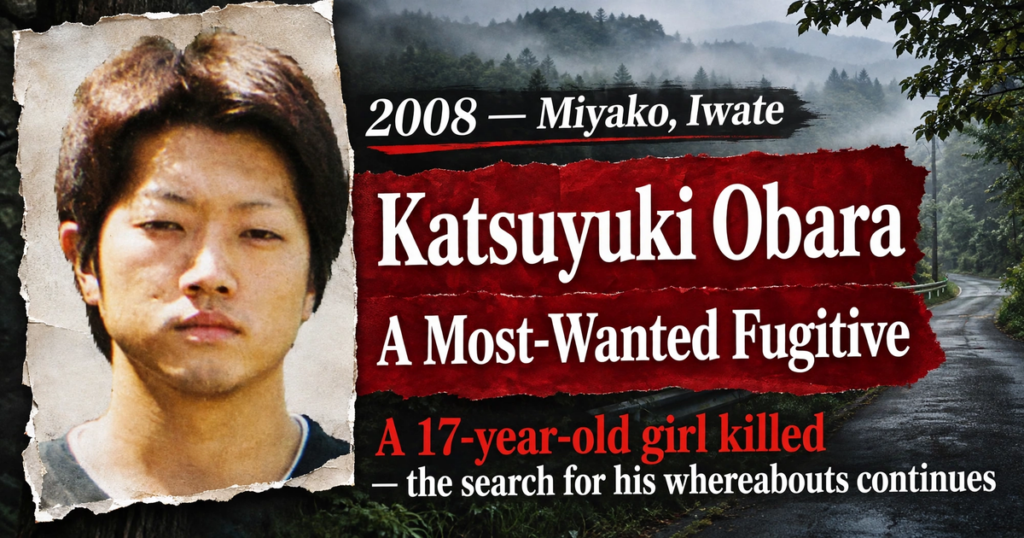
A 17-year-old girl was found dead in former Kawai Village
On 1 July 2008, the body of 17-year-old Kozue Sato was found in a mountainous area of the former Kawai Village in Iwate Prefecture. The municipality is now part of Miyako City. Iwate Prefectural Police investigated the death and, on 29 July, obtained an arrest warrant for Katsuyuki Obara on suspicion of murder. Obara, born in 1979, was described in police materials as approximately 170 centimetres tall. The public police summary is brief. It confirms the date on which Sato's body was found and the date on which Obara was wanted, but it does not publish the individual items of evidence relied on when seeking the warrant or a detailed account of the circumstances of Sato's death. Because Obara has not been arrested, those allegations have never been tested in a criminal trial.
Obara also disappeared before police could arrest him
The case became more complicated because Obara himself disappeared soon after Sato's death. Contemporary reporting described a single-vehicle accident on 1 July and said that Obara travelled toward the Unosu Cliffs area on the following day. Personal belongings were reportedly found nearby, creating speculation that he might have died by suicide. No body was found, however, and the authorities did not publicly establish that he was dead. Police continued to treat him as a wanted suspect and did not rule out the possibility that he was alive and had escaped. These are separate questions: the disappearance of a suspect does not establish either guilt or death. The official status remains that Obara is wanted in connection with Sato's murder and that his whereabouts are unknown. Claims that he staged his death or that he is certainly alive would go beyond what has been established.
Investigative reporting questioned the basis of the wanted notice
Journalist Akio Kuroki, a former Tokyo police officer, investigated the case for a series of articles in Weekly Asahi beginning in 2008. His reporting questioned whether the police had adequately examined the circumstances surrounding Sato's death and Obara's disappearance. Later articles also raised questions about an alleged extortion matter involving Obara and the police response to it. These reports are part of the public history of the case, but they are not official findings or judicial determinations. They should not be presented as proof that the police theory was wrong, just as the police wanted notice should not be treated as proof that Obara committed murder. The absence of a criminal trial has meant that the competing accounts have not been tested through the ordinary process of prosecution and defence evidence.
The prefectural assembly examined questions about the investigation
The controversy reached the Iwate Prefectural Assembly in 2010. Legislators asked what evidence had supported the decision to seek an arrest warrant, whether police had investigated a separate alleged extortion incident involving Obara, and how the authorities had responded to objections from his father and local residents. The prefectural police explained that they had conducted an investigation after Sato's body was found on 1 July and obtained the murder arrest warrant on 29 July. They declined to disclose details of the extortion inquiry, citing the confidential nature of individual investigative matters. The police also acknowledged that Obara's family had filed a lawsuit seeking to stop the wanted notice. The exchange demonstrated the tension between the police duty to investigate a serious death and the public's ability to examine the evidence underlying an active investigation.
Obara's father challenged the public search in a civil lawsuit
In 2010, Obara's father sued Iwate Prefecture and the national government, seeking to stop the public wanted campaign and reward advertisements and claiming damages. The lawsuit did not ask the civil court to decide directly whether Obara had murdered Sato. Its subject was whether the police and national authorities had unlawfully infringed the father's reputation or personal rights through the public search. On 11 April 2014, the Morioka District Court dismissed the claims. The court nevertheless noted that aspects of the first three wanted posters were difficult to regard as appropriate. It concluded, however, that the public search and reward notices had not crossed the legal threshold for an unlawful infringement of the father's rights. The decision was not a criminal judgment against Obara and did not determine whether he was guilty of murder.
The reward programme and wanted notice continued into 2026
The National Police Agency continued to designate the case as eligible for its special reward programme. The published reward ceiling was three million yen for information that leads to Obara's apprehension or the resolution of the case. The programme is not an automatic payment for any tip: the amount depends on how substantially the information contributes to an arrest or resolution. The current notice announced continuation of the application period from 1 November 2026 through 31 October 2027. Iwate Prefectural Police updated its official wanted information in November 2025, listing Obara as born in 1979 and approximately 170 centimetres tall. Given the passage of time, the police recognize that his appearance may have changed. The notice remains a request for information, not a statement that he has been located.
The case remains legally unresolved, with no trial or conviction
The known facts are that Sato, aged 17, was found dead on 1 July 2008, that police obtained a murder arrest warrant for Obara on 29 July, and that he disappeared before he could be arrested. His family challenged the public search in civil court, but the 2014 judgment addressed the legality of the public campaign, not the murder allegation. Kuroki's investigative reporting raised questions but did not produce a court finding. Police continue to seek information, and the reward programme has been extended. No criminal trial has examined the evidence against Obara, and no court has convicted him. Nor has his death been officially confirmed. Any responsible account must preserve these uncertainties rather than present the police theory, the family's objections or the reports about his disappearance as a final answer.
Original Japanese record: 小原勝幸指名手配事件|17歳女性殺害と消えた被疑者、18年続く捜査
Last updated:
Related articles
Case record
The Disappearance of Mayumi Arashi: What Is Known, and What the “Do Not Believe Yoko” Note Does Not Prove
Case record
The Disappearance of Yuri Yoshikawa: The Unresolved Route Home from School
Case record
The Higashi-Ueno 2-chome Condominium Murder
Case record