
The Matsudo Female University Student Murder-Arson: A Death Sentence Replaced by Life Imprisonment
On the night of October 20–21, 2009, a 21-year-old university student, Ogino, was killed in her apartment in Matsudo, Chiba Prefecture, during a robbery. The offender returned the following day to steal cash using her bank card and returned again on October 22 to set fire to the room. A lay-judge trial imposed death in 2011, but the Tokyo High Court overturned that sentence and imposed life imprisonment in 2013. The Supreme Court upheld the life sentence on February 3, 2015.
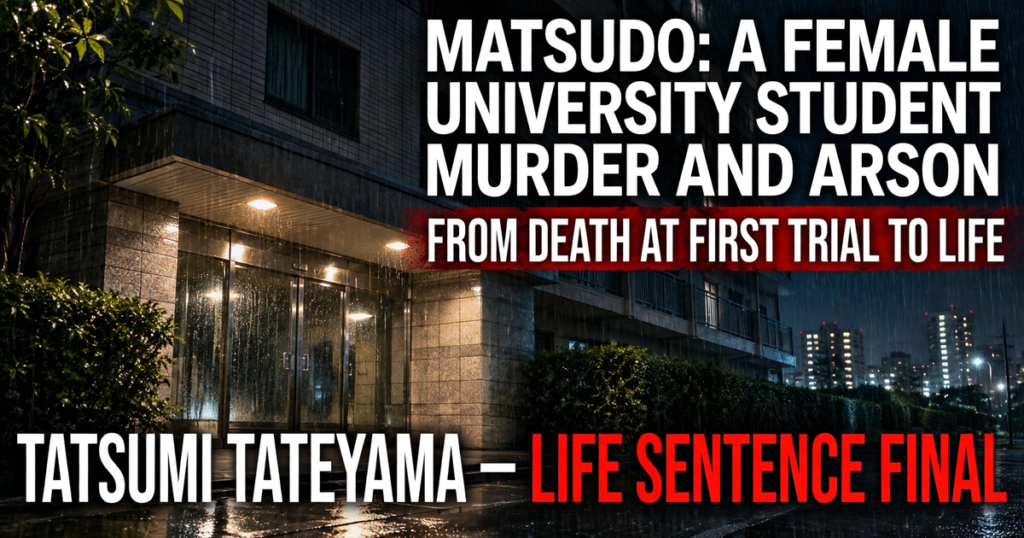
A university student was attacked in her apartment
Between the night of October 20 and the early hours of October 21, 2009, a 21-year-old university student, Ogino, was killed in her apartment in Matsudo, Chiba Prefecture. The offender entered the apartment while she was away and waited for her to return. When she came home, he restrained her and demanded valuables. The case involved one death. The later fire and thefts were part of the same sequence of offences, but they did not create additional homicide victims. The public record identifies the victim by name and age, and the English account retains those facts without adding private information about her life.
The entry and robbery were prepared in advance
The Supreme Court's decision found that the offender entered Ogino's room while she was absent and waited for her return. He intended to steal property and used a knife to threaten her, tying her wrists. The robbery had been prepared, but the courts distinguished that preparation from a plan to kill Ogino. The evidence did not establish that he had decided in advance to take her life. During the robbery, he formed the intent to kill and stabbed her three times in the left chest. This distinction between planning the robbery and planning the murder became central to the later sentencing dispute.
The offender used her bank card after the killing
After killing Ogino, the offender used her cash card to withdraw money on multiple occasions on October 21. These withdrawals formed part of the financial offences considered in the case. The next day, October 22, he returned to the apartment and set fire to the room in an attempt to conceal evidence of the crime. The Supreme Court noted that fifteen people lived in the apartment building at the time. The fire therefore created a danger beyond the victim's room. The court considered the potential spread of the fire when evaluating the seriousness of the conduct.
The prosecution included other serious offences committed over a short period
The trial did not concern the Matsudo murder alone. The Supreme Court's summary referred to other offences committed within a period of approximately two months, including robbery causing injury, robbery accompanied by sexual violence, confinement and unlawful entry. The defendant had committed the series of offences less than three months after completing a previous prison term. These additional offences were relevant to the prosecution's request for the death penalty and the first-instance court's sentencing assessment. They must not, however, be described as additional murders: the Matsudo case had one deceased victim, and the other offences involved different forms of harm.
The lay-judge trial imposed death in June 2011
On June 30, 2011, the Chiba District Court, sitting as a lay-judge trial, sentenced the defendant to death. The court emphasized the strength of the intent to kill, the repeated stabbing, the danger created by the arson and the repeated commission of serious offences shortly after release from prison. It also considered the defendant's criminal record and the degree of remorse. The district court acknowledged that only one person had died and that the killing itself had not been planned in advance, but concluded that the aggravating circumstances justified the death penalty.
The Tokyo High Court overturned the death sentence
In October 2013, the Tokyo High Court overturned the district court's death sentence and imposed life imprisonment. The high court did not reject the essential findings that Ogino had been robbed and killed or that the apartment had later been set on fire. Instead, it reconsidered the weight given to the circumstances in deciding whether death was justified. It noted that the killing itself had not been planned in advance and that the other offences did not involve an intention to kill. The court considered that those offences were serious but should not be treated as though several people had been murdered.
The distinction between a planned robbery and an unplanned killing mattered
The Supreme Court explained that a single-victim robbery-murder can in some cases justify the death penalty. It also explained that a planned killing, prepared in advance as part of a profit-driven crime, may show a higher degree of disregard for human life than a killing that was not planned before the robbery began. In this case, the robbery was prepared, but the decision to kill Ogino was not found to have been made beforehand. The courts therefore had to assess the murder, the later arson, the other offences and the criminal record without automatically treating the case as equivalent to a planned multiple murder.
The Supreme Court upheld life imprisonment on 3 February 2015
Both the prosecution and the defence appealed the Tokyo High Court's decision. On February 3, 2015, the Supreme Court's Second Petty Bench dismissed both appeals. The life sentence therefore became final. The Supreme Court did not rule that one-victim murder can never attract the death penalty. It stated that the sentencing court must compare the case with the accumulated body of Japanese death-penalty decisions and give a concrete and persuasive explanation for choosing death. The Court accepted the high court's conclusion that the aggravating factors did not provide sufficient grounds to restore the death sentence in this case.
Why the final sentence differs from the first-instance judgment
The legal outcome of the Matsudo case is life imprisonment, not death. The first-instance death sentence was overturned by the Tokyo High Court, and the Supreme Court left that change in place. The central issue was the fairness and consistency of capital sentencing, not a finding that the crime was minor or that the offender lacked intent to kill. The record includes a single murder, robbery, repeated cash withdrawals, arson in a building occupied by fifteen people and other serious offences. Keeping the three court stages distinct explains how a lay-judge death sentence became a final life sentence after appellate review.
Original Japanese record: 松戸女子大生殺害放火事件|裁判員の死刑を無期へ変えた計画性と量刑の公平性
Last updated:
Related articles

Case record
The Sendai Arcade Truck Attack: Three Dead, Four Injured and a 28-Year Sentence Replaced by Life
Case record
The Nagoya University Student Murder: Criminal Responsibility, Earlier Poisonings and a Final Life Sentence
Case record
The Murder of Lindsay Ann Hawker: Police Encounter and Flight on Foot, Arrest 961 Days Later
Case record