
The Hioki Five-Person Murders
Between 31 March and 6 April 2018, Tomohiro Iwakura killed five relatives and acquaintances in Hioki, Kagoshima Prefecture, according to the courts. He received a death sentence at trial and again on appeal, but his defence appealed to the Supreme Court in March 2025. As of the source article's August 2026 update, the appeal remained pending and the sentence was not final.
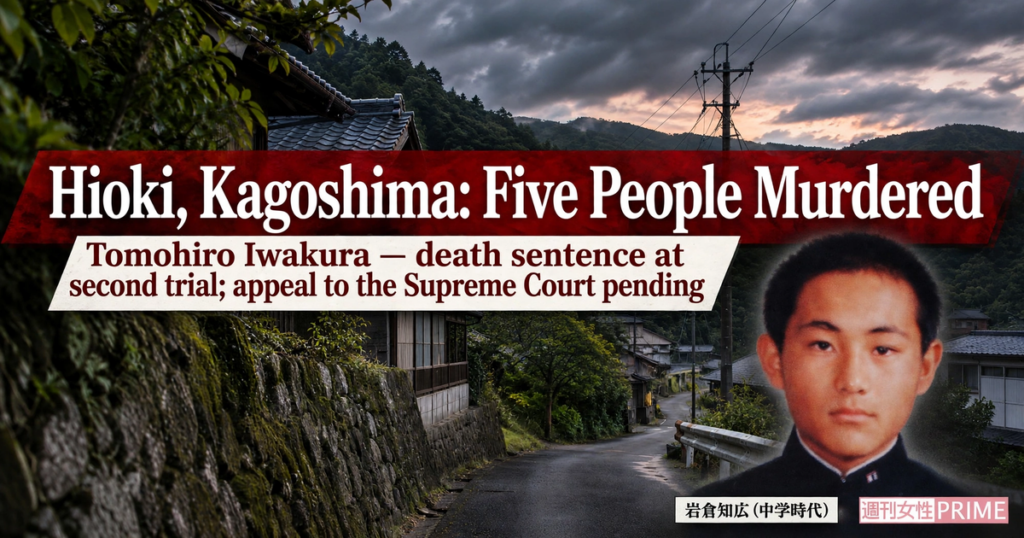
Five people were killed over the course of one week
The Hioki murders took place between 31 March and 6 April 2018 in Yuda, Higashiichiki Town, Hioki City, Kagoshima Prefecture. The defendant, Tomohiro Iwakura, was 38 and unemployed at the time. The five victims were his father, Masatomo Iwakura, aged 68; his grandmother, Hisako Iwakura, aged 89; Takako Iwakura, aged 69; Takako's older sister, Noriko Sakaguchi, aged 72; and Hiroyuki Goto, aged 47, an acquaintance. The killings occurred in two stages, with the first two victims killed before the three people who came to check on the family.
The father and grandmother were killed first
The first two deaths occurred between 31 March and 1 April. According to the appellate judgment described in the article, Iwakura strangled his father and grandmother at the grandmother's home, causing death by compression of the neck. Their bodies were later buried in an open lot in Hioki. Their absence and the concealment of their bodies meant that relatives and acquaintances did not initially know that the two had been killed. The later visit to check on the missing family members became the setting for the second stage of the crimes.
Three visitors were killed when they came to check on the family
On 6 April, Takako Iwakura and her older sister Noriko went to the grandmother's home because they could not contact relatives. Hiroyuki Goto, an acquaintance, also visited. The prosecution's case was that Iwakura killed the three visitors to prevent them from discovering the earlier murders and the concealed bodies. The three were also killed by neck compression. The court treated the later killings as part of the same sequence of crimes, but the reasons for each death and the disputed evidence concerning the father and grandmother were examined separately.
Iwakura was arrested the day after the three later killings
On 7 April 2018, Kagoshima Prefectural Police arrested Iwakura on suspicion of murdering Goto. The investigation then expanded to the other deaths, including those of his father, grandmother and the two sisters. The case involved allegations of five murders and the disposal of the first two victims' bodies. The arrest was an investigative step, not a conviction. Prosecutors needed to determine the charges and assess Iwakura's mental condition before the case could proceed to trial.
A lengthy psychiatric examination preceded the indictment
The prosecution arranged a psychiatric examination detention beginning in June 2018. The detention was extended several times and lasted approximately seven and a half months. The purpose was to examine Iwakura's mental state and criminal responsibility, not to decide guilt. On 23 January 2019, prosecutors indicted him for the five murders and for abandoning the bodies of his father and grandmother. The distinction between arrest, examination detention and indictment matters: the charges were formally brought only after the prosecution completed its assessment.
The first trial disputed the deaths of the father and grandmother
At the 2020 lay-judge trial, Iwakura admitted killing the three people who had visited the house on 6 April, but contested important aspects of the allegations concerning his father and grandmother. He said that his father had brought out a knife and that the two had struggled. The defence disputed the alleged intent and acts concerning the grandmother as well, and raised self-defence and criminal responsibility. The prosecution argued that Iwakura had killed the father after he intervened in an assault on the grandmother, then killed the grandmother and the three visitors to conceal the earlier crimes.
The court rejected the self-defence argument concerning the father
The defence maintained that Iwakura had acted to protect himself when his father approached with a knife. The High Court later accepted that the father had been trying to protect the grandmother and concluded that Iwakura had alternatives to using lethal force. It therefore rejected self-defence. The court also relied on the objective circumstances, including the sustained pressure applied to the father's neck, in finding intent to kill. It upheld the finding that the grandmother had died from neck compression and rejected the defence challenge to the acts and intent alleged in her case.
The mental-health evidence changed, but the appellate court upheld full responsibility
The psychiatric evidence was not identical at the two trials. At the appeal, an expert described Iwakura as having schizophrenia and said that the condition had affected him during the offences. The expert also discussed the possibility of a transient dissociative state during the father's killing, after the assault on the grandmother and the confrontation involving the knife. The High Court nevertheless stressed that a medical diagnosis does not automatically determine legal responsibility. It assessed how the disorder affected decision-making and behaviour in each offence and upheld the first-instance conclusion that Iwakura had full criminal responsibility.
The district court imposed death in December 2020
On 11 December 2020, the Kagoshima District Court sentenced Iwakura to death. The court found him responsible for all five murders and rejected the defence arguments that would have reduced or excluded responsibility. The number of victims, the sequence of the killings, the concealment of the first two bodies and the killing of three people who came to check on the family were central to the seriousness of the case. The sentence was a first-instance judgment and remained subject to appeal.
The High Court upheld death, but the Supreme Court appeal remained pending
On 13 March 2025, the Fukuoka High Court's Miyazaki Branch dismissed Iwakura's appeal and upheld the death sentence. The defence filed an appeal to the Supreme Court on the same day. The Japanese article, updated on 28 August 2026, stated that the Supreme Court had not yet announced a decision as of 26 August 2026. Iwakura must therefore be described as a defendant under a death sentence that has not become final. The two lower-court death sentences are not equivalent to a final death sentence, and the pending Supreme Court proceeding must not be omitted. A separate case chronology checked on 21 November 2026 also continued to list the Supreme Court appeal as pending; no later final judgment was identified in that current listing.
Original Japanese record: 鹿児島県日置市5人殺害事件|責任能力をめぐり二審も死刑、岩倉知広被告は最高裁上告中
Last updated:
Related articles
Case record
The Kyoto Animation Arson Attack: 36 Deaths, Criminal Responsibility and the Disputed Appeal Withdrawal
Case record
Sagamihara Care Home Attack: Third Retrial Petition Accepted
Case record
The Sumoto Five-Person Murders: From a Death Sentence to Life Imprisonment
Case record