
Sagamihara Care Home Attack: Third Retrial Petition Accepted
On July 26, 2016, former care-home employee Satoshi Uematsu killed 19 residents of Tsukui Yamayuri-en and injured 26 others. His death sentence became final after he withdrew his appeal. A second retrial petition was finally rejected on September 29, 2026; a third was filed on November 1 and accepted on November 4, 2026. No retrial has been ordered.
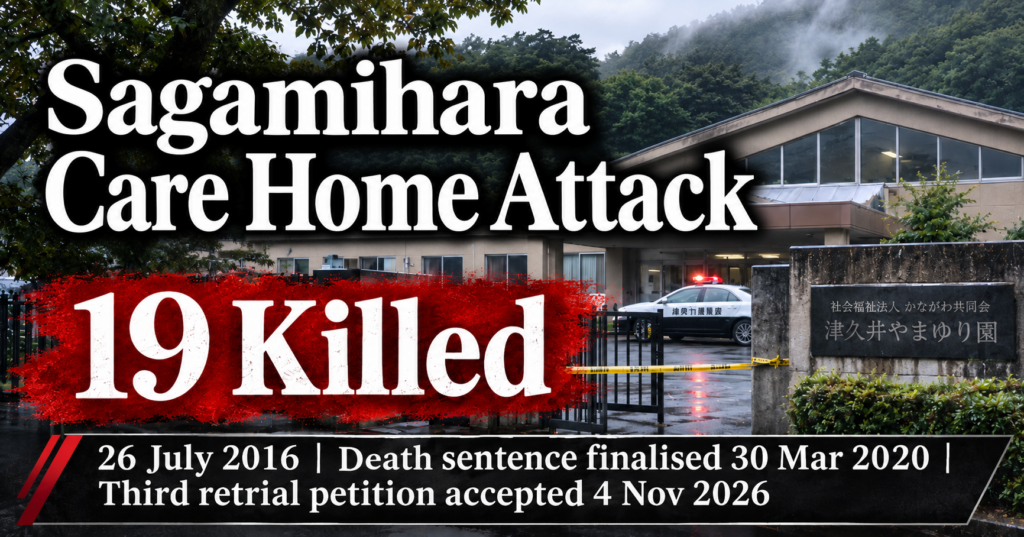
Nineteen residents were killed at Tsukui Yamayuri-en
On July 26, 2016, an attack took place at Tsukui Yamayuri-en, a residential facility in Sagamihara, Kanagawa Prefecture, providing care and support for people with intellectual disabilities. Nineteen residents were killed. Twenty-four residents and two employees were injured, for a total of 26 injured people. Satoshi Uematsu, a former employee, surrendered at Tsukui Police Station and was arrested under Japan’s emergency arrest procedure on suspicion of attempted murder and unlawful entry into a building. His discriminatory belief that some lives were less valuable formed a central part of the case.
His former employment gave him knowledge of the building
Uematsu had previously worked at Tsukui Yamayuri-en. The court considered his former employment and the planned nature of the crime when assessing criminal responsibility and sentencing. It found that his discriminatory beliefs about the value of disabled people’s lives were central to the case. The Yokohama District Court found that Uematsu asked about residents’ levels of disability and selected people he considered less able to communicate, and treated that selection as reflecting his view that the value of a life depended on disability.
A warning letter had been delivered months before the attack
Before the killings, Uematsu had expressed discriminatory views about people with severe disabilities. On February 14 and 15, 2016, he visited the official residence of the Speaker of the House of Representatives with a letter expressing an intention to kill disabled people. The Speaker’s office notified police. On February 19, Uematsu was admitted under the emergency compulsory hospitalization procedure. On February 22, his admission was converted to ordinary compulsory hospitalization, and he was discharged on March 2. Both procedures are provided for under Japan’s Act on Mental Health and Welfare for Persons with Mental Disabilities. The fact of his hospitalization became part of the public debate after the attack. It is important, however, to distinguish the sequence of events from a legal conclusion that psychiatric illness generally causes violence. The court assessed Uematsu’s individual mental state at the time of the attack, not the dangerousness of people with mental illness as a group.
The victims’ identities were handled with care during the trial
Many of the victims were referred to by initials or anonymous designations during the criminal proceedings. Families differed in their views about whether the names of their relatives should be made public. Some wanted the public to know the individuals who had died; others wanted to protect private information about disability and daily life. The court process took account of those wishes. The number of 19 deaths is necessary to understand the scale of the crime, but it should not erase the individual lives of the residents or override families’ decisions about disclosure. The 26 injured people included residents and employees. The distinction between residents killed, residents injured and employees injured is preserved because the totals describe different groups.
The trial concentrated on criminal responsibility
At trial, Uematsu did not substantially dispute that he had carried out the attacks. The principal issue was whether cannabis use and mental symptoms had deprived him of criminal responsibility. The defence argued that a cannabis-related psychotic condition and delusional thinking had controlled his actions. The prosecution argued that he had developed his discriminatory beliefs as his own values, set a goal and carried out a plan. The Yokohama District Court considered the planned and consistent nature of his conduct. It concluded that he retained the ability to understand the wrongfulness of his actions and control his behaviour. The court did not equate a history of compulsory hospitalization with legal incapacity at the time of the crime.
A death sentence became final after Uematsu withdrew his appeal
On March 16, 2020, the Yokohama District Court sentenced Uematsu to death. The court described the loss of 19 lives as exceptionally grave and considered the deliberate selection of residents based on disability, the use of his knowledge as a former employee and the planned nature of the attack. Defence counsel filed an appeal, but Uematsu himself withdrew it. The withdrawal took effect and the death sentence became final on March 30, 2020. The Tokyo High Court and Supreme Court did not conduct an ordinary merits review of the death sentence in the usual appeal process. Subsequent disputes have proceeded through retrial petitions, which are separate legal procedures for challenging a final judgment on specified grounds.
The first and second retrial petitions were rejected
Uematsu filed his first retrial petition in April 2022. The Yokohama District Court rejected it, and the Tokyo High Court also dismissed the immediate appeal. On October 27, 2025, the Supreme Court rejected the special appeal, making the decision not to reopen the case final. Uematsu filed a second retrial petition in January 2026. The Yokohama District Court rejected it in February, and the Tokyo High Court dismissed the immediate appeal on August 7. The Supreme Court unanimously rejected the special appeal on September 29, 2026, making the rejection of the second petition final. These decisions did not impose a new sentence; they declined to reopen the existing case. The original death sentence therefore remained in force.
A third retrial petition was accepted in November 2026
On November 1, 2026, Uematsu personally filed a third retrial petition with the Yokohama District Court. The court accepted the filing on November 4. This is a new petition following the conclusion of the second retrial process. The grounds for the petition have not been made public. Acceptance for consideration does not mean that the court has ordered a retrial, found new evidence sufficient or overturned the conviction. As of November 24, 2026, no decision ordering a retrial has been confirmed, and the final death sentence remains in force. A pending retrial petition does not automatically stay an execution under Japanese law; an execution is carried out on the order of the Minister of Justice. The distinction between a request being filed, accepted for examination and granted is essential. The case continues to raise questions about disability discrimination, institutional safety and the response to prior threats, but those issues should be kept separate from the current procedural status of the conviction.
Original Japanese record: 相模原障害者施設殺傷事件|19人死亡と植松聖の死刑、3度目の再審請求を横浜地裁が受理
Last updated:
Related articles
Same case · Feature
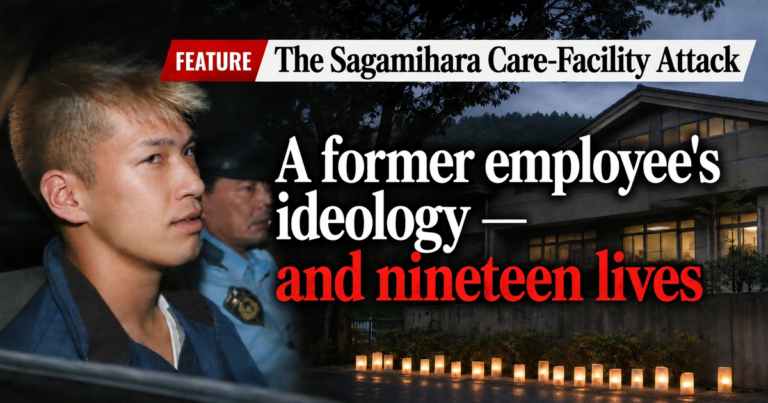
The Sagamihara Care-Facility Attack: The Former Employee Who Killed Nineteen — From a Warning Letter to a Death Sentence and the Following Decade
Case record
The Kyoto Animation Arson Attack: 36 Deaths, Criminal Responsibility and the Disputed Appeal Withdrawal
Case record
The Maebashi Snack Bar Shooting: Four Killed, Including Three Uninvolved Customers
Case record