
The Kyoto Animation Arson Attack: 36 Deaths, Criminal Responsibility and the Disputed Appeal Withdrawal
On July 18, 2019, a fire at Kyoto Animation's Studio 1 killed 36 employees. Shinji Aoba was sentenced to death in 2024 after the court found full criminal responsibility. His 2025 appeal withdrawal was ruled valid in 2026, but defence counsel's objection remains unresolved in the latest reporting reviewed.
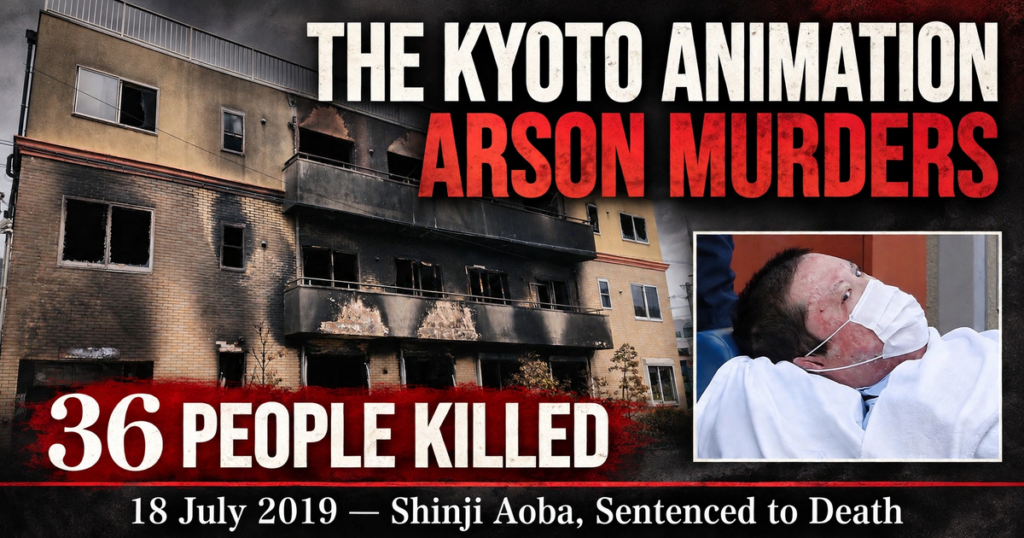
A fire destroyed Kyoto Animation's first studio
At about 10:31 a.m. on July 18, 2019, a fire broke out at Kyoto Animation's Studio 1 in Fushimi Ward, Kyoto. Shinji Aoba entered the building, spread gasoline and set it alight while approximately 70 employees were inside. The building burned extensively. Thirty-six employees died. The criminal court also found attempted murder against 34 other employees; 32 of those people were injured. The remaining two were included in the attempted-murder finding even though they did not sustain physical injuries. The distinction between 34 attempted-murder victims and 32 injured people is therefore not a contradiction. The attack devastated a workplace where artists and production staff were creating animation, and it caused losses that extended beyond the immediate deaths and injuries.
The attack involved preparation, not only the moment the fire started
The court record described Aoba's preparation and movements before he entered the studio. He had developed a grievance based on his belief that Kyoto Animation had taken ideas from his writing. He prepared gasoline and travelled to the studio with weapons, including six yanagiba knives for which he was also charged. The court considered the preparations, the choice of an occupied building and the way he carried out the attack when assessing his responsibility. Describing the event only as a sudden fire would omit the planning that the court found. At the same time, the defendant's belief that his work had been stolen was his own claim; it was not a finding that the company had in fact plagiarised his writing.
The scale and speed of the fire overwhelmed the building
Kyoto City's fire-service review estimated that the fire began at approximately 10:31 a.m. The emergency call was made at 10:33, fire crews were dispatched at 10:35, the fire was brought under control at 3:19 p.m., and extinguishing work was completed at 6:20 a.m. the following day. The three-storey reinforced-concrete building had a spiral staircase connecting the floors through its central area. The review did not identify a major violation of the fire regulations then applicable as the cause of the disaster. Instead, the large quantity of gasoline burning indoors caused flames and high-temperature smoke to spread extremely rapidly. The incident demonstrated how a deliberately initiated fuel fire can create conditions very different from an ordinary accidental building fire.
Aoba was secured at the scene but was not arrested until 2020
Aoba was seriously burned in the fire and was taken into medical care. Although he was secured by police immediately after the incident, his injuries required prolonged treatment and rehabilitation. Kyoto Prefectural Police formally arrested him on suspicion of murder and related offences in May 2020, about ten months after the attack. Prosecutors then arranged a period of detention for psychiatric examination to assess his criminal responsibility. On December 16, 2020, he was indicted. The charges included building trespass, arson of an occupied building, murder, attempted murder and violations of the Swords and Firearms Control Law. Arrest and indictment were separate procedural events; the time between them reflected both his medical condition and the investigation into his mental state.
The trial focused on delusional disorder and criminal responsibility
Aoba maintained that Kyoto Animation had stolen ideas from his writing. The defence argued that his mental condition, including delusional disorder, had impaired his ability to understand or control his conduct. The prosecution argued that he had formed a discriminatory grievance, planned the attack and retained full criminal responsibility. The Kyoto District Court accepted that Aoba had delusional disorder at the time of the offence. It nevertheless found that the disorder influenced the formation of his motive but did not substantially impair his ability to choose the method of attack or control his actions. A psychiatric diagnosis does not automatically establish legal incapacity. The court examined the relationship between the disorder and the actual decisions he made, rather than treating the diagnosis alone as decisive.
The District Court imposed the death penalty in January 2024
On January 25, 2024, the Kyoto District Court sentenced Aoba to death. It emphasised the deliberate attack on a workplace containing many employees, the use of gasoline and the resulting loss of 36 lives, as well as the attempted murders of 34 others. Defence counsel filed an appeal the following day, and Aoba also appealed in February. The ordinary appeal process would have allowed the High Court to review the first-instance judgment, including the finding on criminal responsibility. However, the appeal did not proceed to a full merits hearing because Aoba later submitted a document withdrawing his own appeal. That procedural act created a separate dispute about whether he had the capacity to make the decision.
Aoba withdrew his appeal in January 2025
On January 27, 2025, Aoba submitted a written withdrawal of his appeal while detained at Osaka Detention House. The Osaka High Court later examined what he understood about the consequences. According to the court's decision, he had been told that the withdrawal could make the death sentence final and indicated that he accepted that outcome. He later made statements expressing regret and saying that the decision had been made in a moment of emotion. His lawyers argued that his mental condition meant he could not adequately understand the consequences or protect his legal interests. The dispute was not a second trial about whether he committed the arson. It concerned the legal effectiveness of his withdrawal of the appeal against the death sentence.
The High Court found the withdrawal valid, but counsel objected
On March 17, 2026, the Osaka High Court ruled that Aoba's appeal withdrawal was valid and that the appeal proceedings had ended on January 27, 2025. The court concluded that he understood the consequence of the act and that his ability to make the procedural decision had not been lost. Defence counsel filed an objection on March 23. The objection asks the court to reconsider the ruling on the validity of the withdrawal; it is not an ordinary appeal against the original death sentence. Reporting and the Japanese archive's November 2026 review did not establish a later final ruling on that objection. The death sentence is being treated as final following the valid withdrawal decision, but the separate objection to that decision remains a live procedural issue in the latest information reviewed.
Original Japanese record: 京都アニメーション放火殺人事件|36人死亡と完全責任能力、控訴取り下げをめぐる異議
Last updated:
Related articles
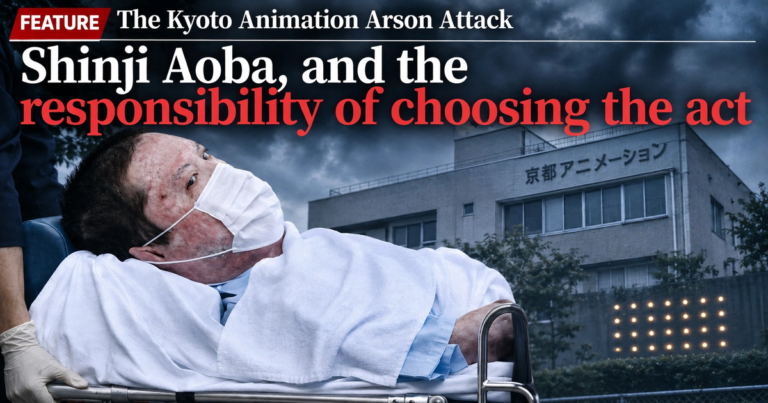
Same case · Feature
The Kyoto Animation Arson Attack: Shinji Aoba Had Abandoned a Mass-Killing Plan at Omiya Station One Month Earlier — The “Plagiarism Delusion” and Responsibility for Choosing the Crime
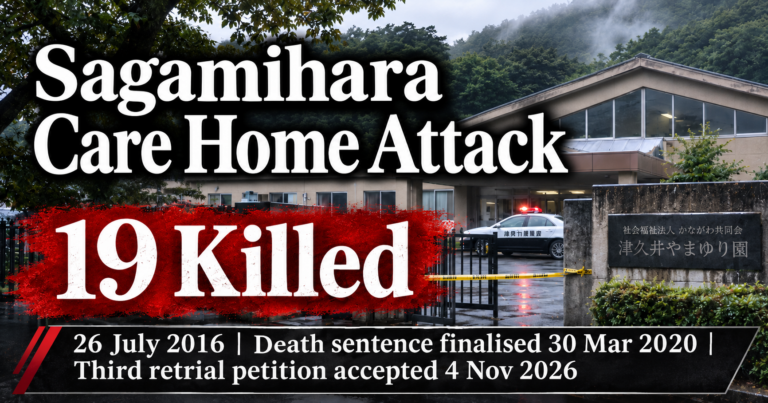
Case record
Sagamihara Care Home Attack: Third Retrial Petition Accepted
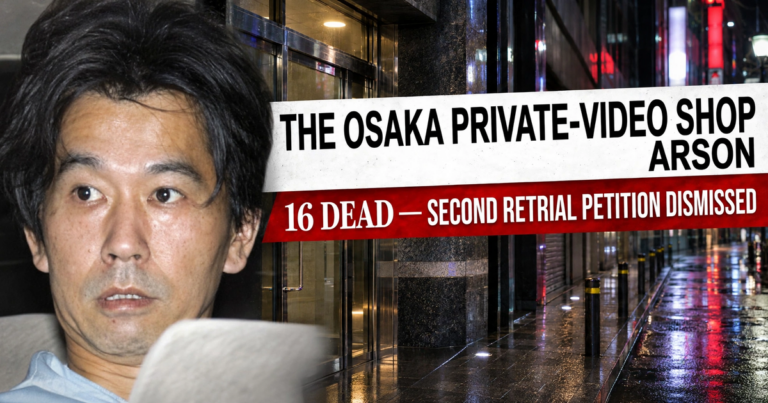
Case record
The Osaka Private Video Booth Fire: Sixteen Deaths, a Final Death Sentence and a Second Retrial Denial
Case record