
The Fukuchiyama Fireworks Stall Explosion: Three Deaths, Fifty-Six Injured and a Five-Year Sentence
On August 15, 2013, a stall at the Fukuchiyama Fireworks Festival in Kyoto Prefecture exploded and caught fire as its operator attempted to refuel a generator. Gasoline sprayed from a hot, pressurised portable can and ignited near the stall. The Fire and Disaster Management Agency recorded three deaths and 56 injured. The stall operator was arrested in October 2013 and admitted the charges at trial. On March 27, 2014, the Kyoto District Court imposed a five-year prison term, the statutory maximum then available for the relevant negligent offence. The disaster prompted new fire-prevention rules for outdoor events.
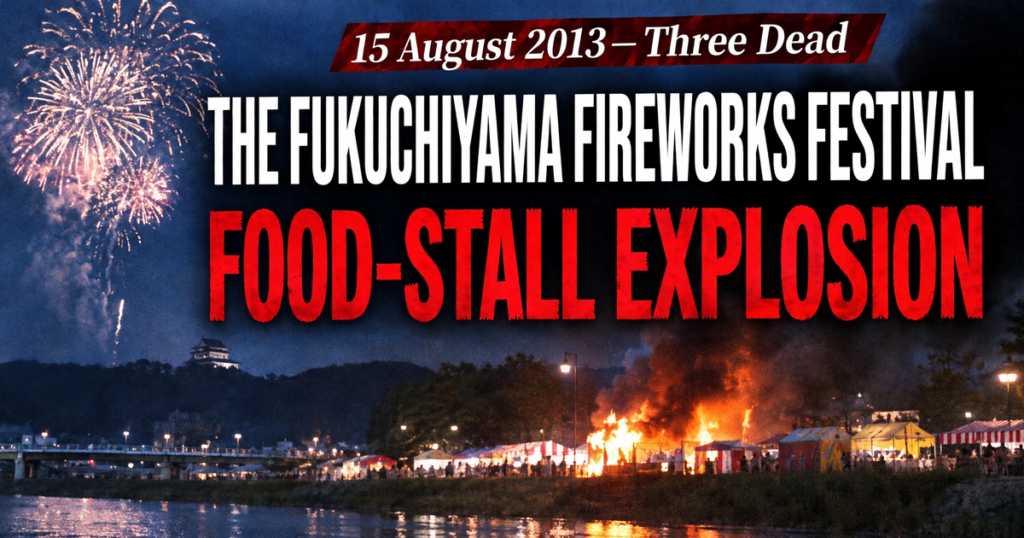
An explosion struck a crowded fireworks festival
At about 7:28 p.m. on August 15, 2013, an explosion and fire occurred at the venue of the Fukuchiyama Fireworks Festival on the bank of the Yura River in Fukuchiyama, Kyoto Prefecture. A stall selling baby castella cakes was using a portable generator for its equipment. The explosion and flames spread into a crowded area where spectators were waiting for the fireworks. Several stalls burned, and people nearby suffered severe burns. The event was taking place in an open riverside area, but the crowd and the stalls left limited room to escape.
A hot gasoline can released fuel when its cap was opened
The stall operator attempted to refuel the generator using gasoline stored in a metal portable can. The can had been heated by direct sunlight and by exhaust heat from the generator. As the temperature inside the container rose, pressure increased. When the operator opened the cap, gasoline was forced out and sprayed into the surrounding area. The fuel ignited after reaching a nearby source of fire. The resulting flames spread among the stalls and spectators. The danger came not only from gasoline itself but from opening a heated, pressurised container near ignition sources.
The official casualty count was three dead and 56 injured
The Fire and Disaster Management Agency's account records three deaths and 56 injured. The three people who later died included a woman in her forties, a fifth-grade boy and a man in his thirties. They died after being transported to hospital, on August 17 and August 19. Some news reports and other medical summaries use different totals for people injured or treated, but the Fire and Disaster Management Agency's figure of 56 injured is the official count used here. The three deaths are recorded separately from the injured figure.
Emergency services faced a large burn incident in a crowded venue
The fire produced a large number of burn casualties in a short period. People were taken to nearby hospitals, and medical teams had to distribute patients among facilities. Emergency services from neighbouring prefectures also assisted. The event showed how a fire at a temporary food stall could create a mass-casualty incident when fuel, generators, cooking equipment and spectators were concentrated in a small space. The problem was not limited to the operator's immediate refuelling action; the wider event plan had to account for how fuel and ignition sources were managed around the public.
The stall operator was arrested in October 2013
Kyoto Prefectural Police arrested the stall operator on October 2, 2013, on suspicion of professional negligence causing death or injury. The National Public Safety Commission's October 3, 2013 explanatory material described the incident as occurring at about 7:29 p.m. on August 15 and recorded three deaths and 54 injured at the time of the arrest. The number of injured people later recorded by the Fire and Disaster Management Agency was 56. The difference reflects the timing and source of the counts; the official final fire-service count is used for the overall casualty total.
The defendant admitted the charges at the first hearing
The first public hearing took place at the Kyoto District Court on December 19, 2013. The stall operator admitted the charged facts and apologised. The case focused on the unsafe handling of the portable gasoline can and the failure to take precautions before opening it and refuelling the generator. The prosecution argued that the operator should have recognised the danger created by the heat and pressure inside the can and should have kept the refuelling process away from nearby flames and spectators.
The Kyoto District Court imposed a five-year prison term
On March 27, 2014, the Kyoto District Court sentenced the stall operator to five years' imprisonment. The sentence was the maximum available under the relevant professional-negligence offence at the time. The court criticised the operator's careless conduct in a crowded festival setting, where many spectators were close to the stall. The judgment brought the criminal proceedings to a conclusion. It should not be confused with a finding that the festival organiser or every nearby stall operator was criminally convicted.
The disaster led to new fire-prevention requirements for outdoor events
The government revised the Order for Enforcement of the Fire Services Act in December 2013 and the model Fire Prevention Ordinance in January 2014. The changes required fire extinguishers when equipment using fire was handled at outdoor events. For large events designated by the fire chief, organisers had to appoint a person responsible for fire prevention and prepare and submit an operational plan addressing fire-safety duties. The reforms were intended to ensure that temporary stalls, generators and cooking equipment were covered by event-wide prevention measures.
A routine refuelling task became a warning about temporary-event safety
The Fukuchiyama explosion demonstrated that a portable fuel can is not safe to open simply because it is designed for transport. Heat can increase internal pressure, and gasoline vapour can ignite when released near a flame or hot surface. The incident also showed that event organisers and public authorities must plan for fuel storage, generator placement, refuelling procedures, fire extinguishers and crowd separation. The final casualty count and the criminal sentence are important, but the wider legacy is the fire-prevention framework introduced after the disaster.
Original Japanese record: 福知山花火大会露店爆発事故|ガソリン携行缶から噴出、3人死亡と禁錮5年・安全規制改正
Last updated:
Related articles
Case record
The Kyoto Gion Runaway Van Crash: Seven Pedestrian Deaths, a Driver's Medical History and Changes to Driving-Licence Rules
Case record
The Kyoto Kameoka Runaway Crash: Three Deaths, Seven Injuries and the Limits of the Former Dangerous-Driving Law
Case record
Fukushima Daiichi and the Criminal Trial of TEPCO's Former Executives: Two Final Acquittals and a Separate Shareholder Lawsuit
Case record