
Fukushima Daiichi and the Criminal Trial of TEPCO's Former Executives: Two Final Acquittals and a Separate Shareholder Lawsuit
The Fukushima Daiichi nuclear accident began after the March 11, 2011 earthquake and tsunami disabled essential power and cooling systems. A separate criminal case examined whether three former TEPCO executives could have foreseen the tsunami and should have taken measures to prevent the resulting deaths and injuries. The Tokyo District Court acquitted all three in 2019, and the Tokyo High Court upheld the acquittals in 2023. Former chair Tsunehisa Katsumata died in 2024, ending proceedings against him by dismissal. The Supreme Court dismissed the appeals concerning former vice presidents Ichiro Takekuro and Sakae Muto on March 5, 2025. A separate shareholder derivative suit remains a civil proceeding.
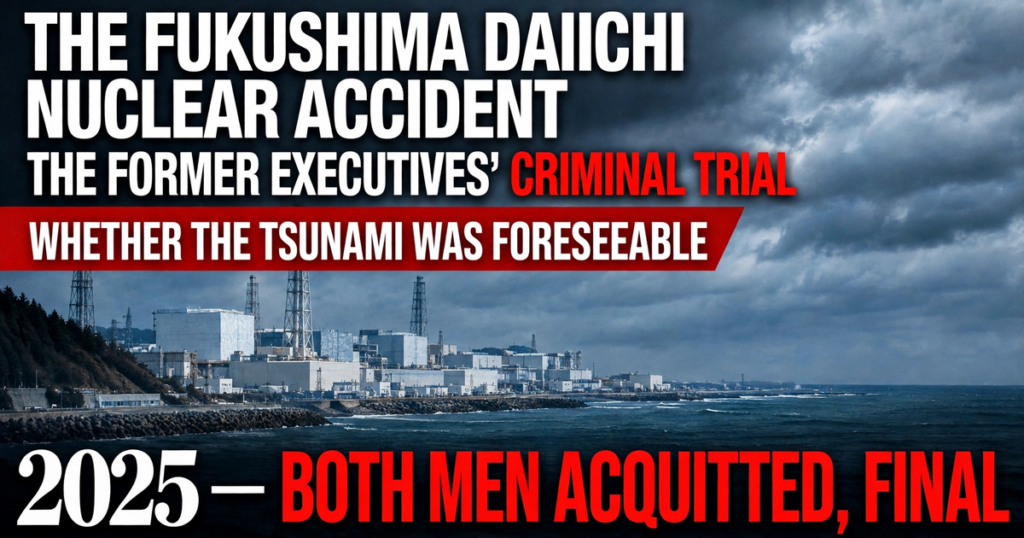
The accident and the criminal trial are related, but not the same event
On March 11, 2011, a major earthquake and tsunami struck northeastern Japan. At Fukushima Daiichi Nuclear Power Station, flooding disabled essential electrical and cooling systems. Three reactor cores melted down, and radioactive material was released. The accident caused large-scale evacuation and long-term disruption for communities in Fukushima. The criminal trial discussed in this record did not determine every cause of the nuclear accident or all responsibility for the disaster. It examined whether three former executives of Tokyo Electric Power Company could be held criminally liable for deaths and injuries connected to the evacuation.
The prosecution concerned professional negligence causing death and injury
After investigating the former executives, prosecutors initially decided not to indict them. The Tokyo Prosecution Review Commission later issued decisions that led to a compulsory prosecution. Court-appointed lawyers acted as prosecutors, and three former TEPCO executives were indicted: former chair Tsunehisa Katsumata and former vice presidents Ichiro Takekuro and Sakae Muto. The charge was professional negligence resulting in death or injury. The prosecution's case concerned the alleged failure to anticipate a major tsunami and take measures that could have prevented the accident and its human consequences.
The alleged victims included patients who died during evacuation
The indictment did not treat the physical damage to the reactors as a standalone criminal offence. It alleged that the executives' failure to take precautions led to the nuclear accident and, through the evacuation that followed, caused deaths and injuries among hospital patients and others. The prosecution identified 44 deaths and 13 injuries in its charged facts. Those figures refer to the victims in the criminal indictment, not to the total number of people who died in the earthquake and tsunami or to the full number of people affected by the nuclear disaster.
A 2008 tsunami assessment became central evidence
The prosecution relied in part on a 2002 long-term assessment by the government's Earthquake Research Committee concerning the possibility of large tsunami earthquakes along the Japan Trench. TEPCO later applied the assessment to Fukushima Daiichi. In 2008, an internal calculation suggested that a tsunami of up to approximately 15.7 metres could reach the plant. The central question was whether the information available to the executives was sufficiently reliable and specific that they should have ordered protective measures or suspended operations before the accident.
The Tokyo District Court acquitted all three defendants in 2019
On September 19, 2019, the Tokyo District Court found all three defendants not guilty. The court concluded that the prosecution had not proved beyond a reasonable doubt that the executives could have foreseen the specific tsunami that caused the accident and had a criminal-law duty to take the measures alleged. The existence of the 2008 calculation was not treated as automatically proving criminal foreseeability. The judgment concerned the legal requirements for a conviction, not whether the earthquake, tsunami, meltdowns or evacuation harm had occurred.
The Tokyo High Court upheld the acquittals in January 2023
The court-appointed prosecutors appealed. On January 18, 2023, the Tokyo High Court dismissed the appeal and maintained the acquittals. The High Court examined the reliability of the long-term assessment, the internal tsunami calculation and whether the executives could reasonably have predicted the specific event in a way that created a criminal duty to act. It did not find grounds to overturn the first-instance judgment. The acquittal of all three defendants therefore remained in place at the appellate level.
Katsumata's case ended differently from the cases of the two former vice presidents
Tsunehisa Katsumata died in October 2024 before the Supreme Court completed its review. The proceedings against him were therefore dismissed because of his death. On March 5, 2025, the Supreme Court dismissed the appeals concerning Takekuro and Muto. Their acquittals became final. It is inaccurate to say that the Supreme Court acquitted all three former executives: the two former vice presidents received final Supreme Court decisions, while Katsumata's proceedings ended through dismissal after death.
The shareholder derivative suit was a separate civil case
TEPCO shareholders separately brought a shareholder derivative suit seeking damages for losses suffered by the company. The Tokyo District Court ordered four former executives to pay approximately 13.321 trillion yen to TEPCO in July 2022. On June 6, 2025, the Tokyo High Court overturned that judgment and dismissed the shareholders' claims. The shareholders appealed to the Supreme Court on June 20, 2025. The case was still listed as pending before the Supreme Court in material updated in June 2026. A shareholder derivative suit is a civil action brought on behalf of the company; it is not the criminal trial and the money, if recovered, is payable to the company rather than directly to individual shareholders.
The different proceedings answer different legal questions
The criminal trial asked whether specific individuals could be convicted of professional negligence causing death or injury. The shareholder derivative suit asked whether former directors breached duties owed to TEPCO and caused losses to the company. The accident itself involved technical, regulatory and public-policy questions beyond either case. The final criminal acquittals do not decide every civil claim or erase the consequences of the nuclear accident. Likewise, the civil High Court's reversal does not change the Supreme Court's final criminal decisions. These proceedings must be described separately, with their own defendants, legal standards and current procedural status.
Original Japanese record: 福島第一原発事故・東電旧経営陣刑事裁判|津波予見可能性を否定、2025年に2人の無罪確定
Last updated:
Related articles
Case record
The Schindler Elevator Death: An Open-Door Movement, a Teenager's Death and Acquittals on Appeal
Case record
The Fukushima Prefectural Ono Hospital Case: A Maternal Death, a Doctor's Prosecution and a Final Acquittal

Case record
The Fukuchiyama Fireworks Stall Explosion: Three Deaths, Fifty-Six Injured and a Five-Year Sentence
Case record