
The Kanuma Crane-Truck Crash: Six Children Killed on Their Way to School and the Limits of the Law
On April 18, 2011, a mobile crane truck crossed into a group of primary-school pupils walking to school in Kanuma, Tochigi Prefecture. Six children died. The driver had a history of epileptic seizures, previous seizure-related crashes and medical advice not to drive. The Utsunomiya District Court imposed the then-maximum seven-year prison term for negligent driving causing death. The case exposed limits in the law and in a licensing system that relied heavily on self-reporting, while also prompting reforms that focused on symptoms affecting safe driving rather than excluding everyone with epilepsy.
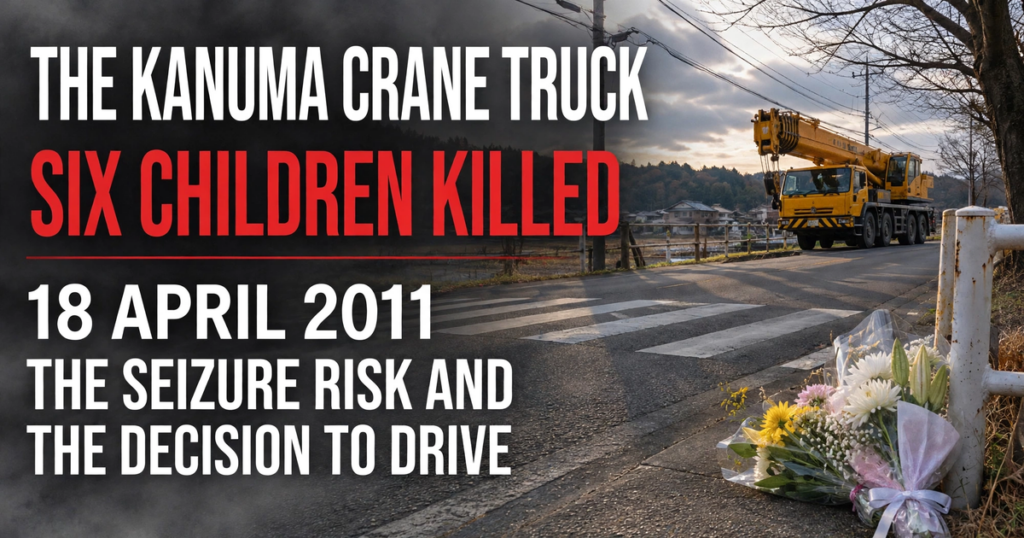
A crane truck entered a line of children walking to school
At about 7:45 a.m. on April 18, 2011, a mobile crane truck crossed the centre line on a national road in Kanuma, Tochigi Prefecture, and struck a group of primary-school children walking to school. Six pupils died. The crash took place during the morning school commute, when children were using the roadside as part of their ordinary route. The scale of the loss immediately raised questions about the driver's fitness to operate a heavy vehicle, the way his medical history had been handled, and whether the existing criminal law could impose a penalty proportionate to the consequences.
The driver had a documented history of seizures and earlier crashes
The driver, Masato Shibata, had been treated for epilepsy and had experienced seizure-related incidents before the Kanuma crash. Records discussed during the proceedings included earlier traffic accidents and episodes in which he lost consciousness. A doctor had advised him not to drive. The prosecution also presented evidence that Shibata had experienced warning symptoms before setting out on the morning of April 18. Despite that history, he drove the mobile crane truck for work. The case was therefore not about epilepsy as a diagnosis in itself; it concerned a driver who knew of a concrete risk that could make him lose control.
The case examined choices made before the truck moved
The investigation reconstructed Shibata's employment and driving history over several years. The record included previous seizures, road incidents and the process through which he obtained and renewed licences. The authorities examined whether he had disclosed relevant medical information and whether the licensing system had the information needed to assess his ability to drive safely. The court's assessment of responsibility focused on his knowledge of the risk, the medical advice he had received and his decision to drive despite that advice. The history mattered because it showed that the danger was not an unforeseeable event without warning.
The prosecution proceeded under the negligent-driving offence then available
Shibata was prosecuted for causing death by negligent driving under the law in force at the time. The older dangerous-driving offence covered specified forms of conduct, including certain kinds of intoxicated or severely impaired driving, but did not clearly cover every instance in which a driver knowingly took the risk of a sudden illness-related loss of consciousness. The six deaths did not automatically allow the prosecution to select a more serious offence. The legal classification depended on the statutory elements that could be proved, not simply on the number of victims or the public's view of the conduct.
The Utsunomiya District Court imposed the statutory maximum
On December 19, 2011, the Utsunomiya District Court sentenced Shibata to seven years in prison. That term was the maximum available under the negligent-driving offence applied to the case. The sentence reflected the deaths of six children and the court's assessment of Shibata's prior knowledge and conduct. Families of the victims had sought severe punishment, and the case drew attention to the gap between the gravity of the outcome and the maximum penalty then available. The judgment did not mean that the court considered the loss of six lives minor; it was constrained by the offence and penalty structure then in force.
The licensing issue was about disclosure and assessment, not a blanket ban
Epilepsy does not automatically make every person unable to drive. Some people with the condition may meet medical and legal standards for obtaining or renewing a licence, depending on seizure control and other circumstances. The Kanuma case highlighted a different problem: whether a person who knows that a seizure may cause sudden loss of consciousness has disclosed that risk and followed medical advice. Before the reforms, licensing authorities relied substantially on information supplied by applicants. The case exposed how an incomplete or inaccurate declaration could prevent the authorities from assessing a serious safety risk.
The 2013 reforms strengthened questions and reporting mechanisms
After the crash, the Road Traffic Act and related systems were revised. The reforms strengthened questions about symptoms that could affect safe driving, introduced penalties for false answers in specified circumstances, and provided a framework through which doctors could report certain dangerous conditions to the public safety commission. The aim was to identify symptoms that could impair driving and to make the assessment more reliable. These changes were not designed to exclude all people with epilepsy. The legal approach continued to distinguish a medical diagnosis from the presence, frequency and control of symptoms that could make driving unsafe.
A new driving-offence framework addressed illness-related impairment
The Kanuma crash was discussed alongside other fatal crashes in which the driver had experienced a medical episode. In 2013, Japan enacted a new statute on punishment for acts causing death or injury while driving motor vehicles. The legislation added provisions addressing driving when a person knew that a disease or other condition could cause an inability to drive safely. The reform did not retroactively change Shibata's conviction. It changed the legal framework for later cases, illustrating how a specific tragedy can expose a gap in the law without allowing courts to apply a later offence to conduct that occurred before it existed.
The six children remain central to the record
The crash is often discussed through the later debates about epilepsy, licensing and criminal penalties. Those issues are important, but they should not displace the immediate fact: six children were killed while walking to school. The case also requires care in describing people who live with epilepsy. The relevant failure was not the existence of a diagnosis; it was the combination of a known risk, prior incidents, medical advice and a decision to drive a heavy vehicle. The lasting lesson is that accurate disclosure, medical assessment and a legal framework that addresses foreseeable impairment must work together.
Original Japanese record: 鹿沼市クレーン車児童6人死亡事故|発作リスク下の運転と免許制度・処罰法改正
Last updated:
Related articles
Case record
The Ikebukuro Runaway-Car Crash: Two Deaths, a Five-Year Sentence and the Driver's Death in Custody
Case record
The Tomei Expressway Road-Rage Deaths: Why Kazuho Ishibashi Was Convicted of Dangerous Driving Causing Death or Injury Without Hitting the Victims

Case record
The Fukuchiyama Fireworks Stall Explosion: Three Deaths, Fifty-Six Injured and a Five-Year Sentence
Case record