
The Akita Child Murders
Two children, nine-year-old Ayaka Hatakeyama and seven-year-old Goken Yoneyama, were killed in Akita Prefecture in April and May 2006. The first death was initially treated as likely accidental; later proceedings established that both children had been murdered by Ayaka's mother, Suzuka Hatakeyama.
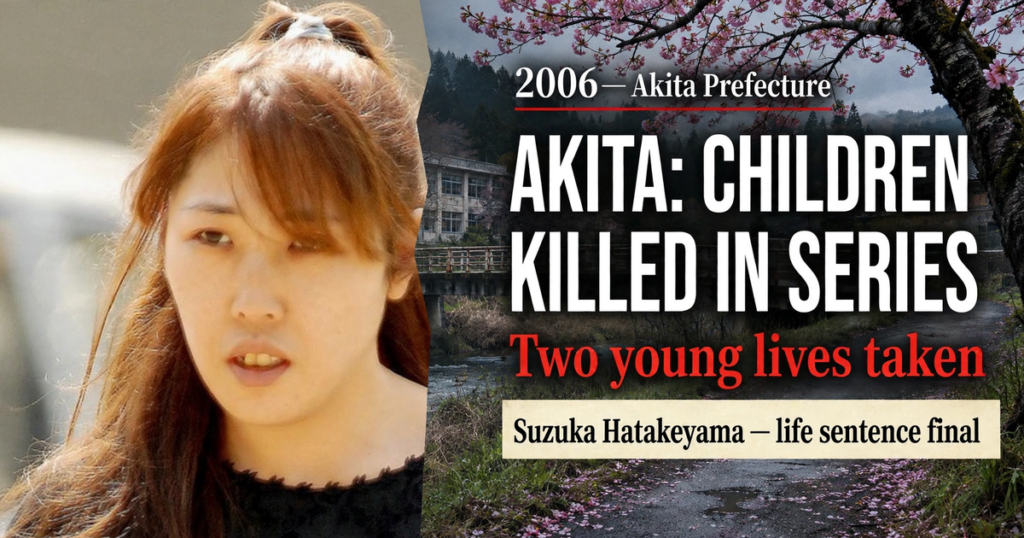
Two children died in separate incidents within about a month
The Akita child murders concerned the deaths of nine-year-old Ayaka Hatakeyama and seven-year-old Goken Yoneyama in Fujisato Town and nearby Noshiro City in Akita Prefecture in 2006. Ayaka was found in a river on 10 April. About a month later, Goken disappeared on 17 May and was found dead the following day. The investigation eventually focused on Ayaka's mother, Suzuka Hatakeyama. The criminal courts found her responsible for both children's murders and imposed life imprisonment. The case is also remembered for the way the first death was initially assessed by police.
Ayaka disappeared on 9 April and was found in the river the next day
Ayaka was last known to be missing on 9 April 2006. Her body was discovered in a river on 10 April. A forensic examination identified drowning as the immediate cause of death. At the time, investigators did not identify injuries that strongly indicated an assault. Police considered the riverbank, traces around the water, the river conditions and the police dog's scent work. They judged that an accidental fall from a riverbank near the family home was more likely than a criminal act. The authorities did not publicly establish that the death was an accident beyond doubt, but the practical direction of the initial inquiry was strongly accident-oriented.
The first investigation did not fully examine the surrounding community
After the later murder of Goken, questions were raised about whether the first investigation had been sufficiently thorough. A formal question was submitted in the House of Representatives concerning the Akita Prefectural Police response. The government's written answer explained why investigators had considered an accident likely, but acknowledged that the assessment was inconsistent with the facts later established in court. It also confirmed that residents in relevant areas had not been interviewed as part of the initial inquiry. The Akita Prefectural Public Safety Commission said the investigation had not necessarily been adequate and that police should learn from the shortcomings. These admissions concern the quality of the initial inquiry; they do not establish that a different approach would certainly have prevented the later murder.
Goken disappeared on 17 May and the investigation changed direction
On 17 May 2006, Goken, who attended the same elementary school as Ayaka and lived nearby, went missing. His body was found beside a river in Noshiro City on 18 May. The police treated his death as a murder and began examining the circumstances around the child. Suzuka Hatakeyama came under investigation. The inquiry into Goken's death then connected with the earlier death of Ayaka, and Hatakeyama was also investigated for the first child's killing. The sequence matters: the first death had initially been treated as likely accidental, while the second was investigated as a homicide from the outset. The later case caused investigators to revisit the first assessment.
The trial considered whether Ayaka's death was intentional
Hatakeyama did not substantially dispute killing Goken, but the defence contested whether she had intended to kill Ayaka. It argued that Ayaka's fall into the river was an accident or, at most, the result of negligence rather than a deliberate act. The Akita District Court rejected that position and found that Hatakeyama had acted with intent to kill Ayaka. The court therefore treated both children's deaths as murders. The distinction was important because the initial police assessment had not identified the first death as a homicide, while the later criminal trial reached a finding of intentional killing based on the evidence presented in court.
Criminal responsibility was also disputed
The defence raised questions about Hatakeyama's mental condition, particularly in relation to Goken's murder. Psychiatric assessments and her conduct before and after the offences were considered. The district court found that she retained criminal responsibility. Under Japanese criminal law, the existence of a mental disorder does not by itself decide whether a defendant is criminally responsible. Courts examine whether the disorder deprived the person of the ability to understand the nature and wrongfulness of the act, or to control their conduct accordingly. In Hatakeyama's case, the court did not find that the legal threshold for insanity or diminished capacity had been met.
The district court imposed life imprisonment, not death
Prosecutors sought the death penalty. On 19 March 2008, the Akita District Court found Hatakeyama guilty of two murders and imposed life imprisonment. In assessing the sentence, the court considered that the two killings were not part of one carefully prepared, integrated serial-murder plan. It also considered the absence of a financial or other clear profit motive and the fact that she had no prior criminal record. Those considerations did not diminish the gravity of the children's deaths, but the court concluded that life imprisonment was the appropriate sentence. Japanese capital sentencing is not determined by a simple numerical rule based only on the number of victims.
Both sides appealed, and the High Court maintained the sentence
Both the prosecution and the defence appealed. Prosecutors argued that life imprisonment was too lenient and sought a death sentence. The defence challenged the finding that Hatakeyama had intended to kill Ayaka and disputed the sentence. On 25 March 2009, the Sendai High Court's Akita branch dismissed both appeals. It maintained the finding of intent in Ayaka's death and left the life sentence unchanged. The appellate court also considered the circumstances of the offences, including the lack of a unified, profit-driven plan. The High Court upheld the result reached at first instance.
The life sentence became final through withdrawal of the Supreme Court appeal
After the High Court decision, the Sendai High Public Prosecutors Office decided not to appeal. Hatakeyama herself filed an appeal to the Supreme Court, but withdrew it on 18 May 2009. As a result, the life sentence became final without the Supreme Court issuing a merits ruling on the questions of intent or sentence. It is not correct to say that the Supreme Court independently imposed or affirmed life imprisonment after reviewing the case. The final judgment was the High Court decision, which became final when the defendant withdrew her appeal.
The investigation and the unresolved background remain part of the record
The case did not end every question about why the children were killed or how the events developed. A local newspaper's investigative series, introduced by the Japan Newspaper Publishers and Editors Association, followed the case through the first trial and appeal in 125 installments. The series reflected on the difficulty of explaining why two young children had lost their lives, even after the criminal proceedings had ended. The final legal finding is clear: Hatakeyama's life sentence for the two murders became final in May 2009. The separate institutional question is also clear: the first investigation into Ayaka's death was later acknowledged to have been inadequate in important respects. Neither point proves that the initial investigative shortcomings caused Goken's later death.
Original Japanese record: 秋田児童連続殺害事件|彩香さん死亡を事故寄りに見た初動と、2人殺害で無期懲役確定
Last updated:
Related articles
Case record
The Schindler Elevator Death: An Open-Door Movement, a Teenager's Death and Acquittals on Appeal
Case record
The Kabukicho Building Fire: Forty-Four Deaths, an Unidentified Fire-Setter and the Failure of Fire Management
Case record
The Koto Apartment Murder: A Disappearance Inside a Building and a Final Life Sentence
Case record