
The Kabukicho Building Fire: Forty-Four Deaths, an Unidentified Fire-Setter and the Failure of Fire Management
A fire broke out in the Meisei 56 Building in Tokyo's Kabukicho district shortly after 1 a.m. on September 1, 2001. Forty-four people died and three were injured. The fire's origin and the person who started it were never established. Separate criminal proceedings examined the fire-safety duties of building and tenant managers, while emergency inspections and legal reforms followed across Japan.
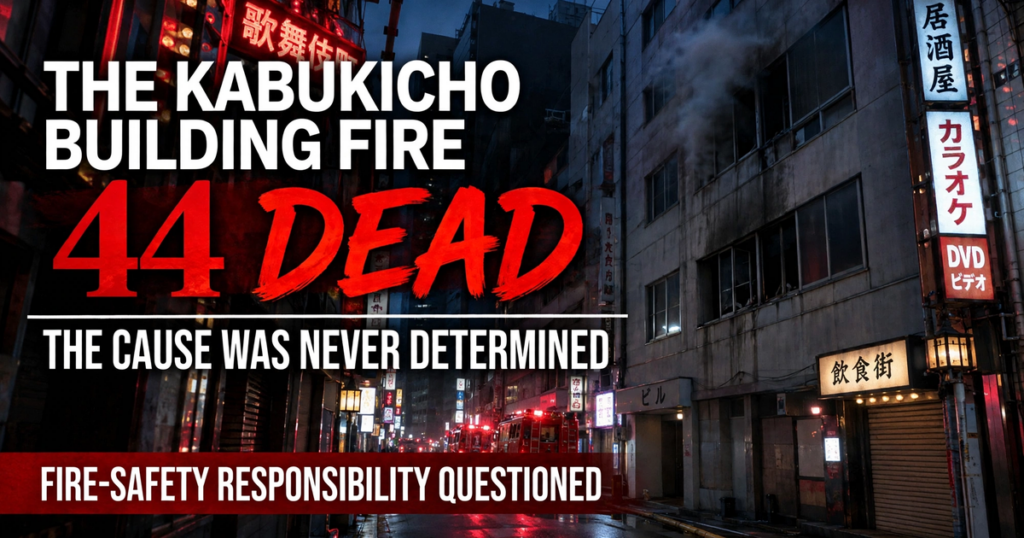
A fire broke out in a small entertainment building in Kabukicho
Shortly after 1 a.m. on September 1, 2001, a fire broke out in the Meisei 56 Building in Kabukicho, Shinjuku, Tokyo. The building was a small mixed-use property with four floors above ground and two basement levels, with a total floor area of approximately 497 square metres. The fire was believed to have started near the elevator lobby on the third floor. It spread through the building and caused 44 deaths and three injuries. The scale of the loss was extraordinary in relation to the size of the building and became a major turning point in discussions of fire safety in small multi-tenant entertainment buildings.
Forty-four people died on the third and fourth floors
The victims were concentrated among customers and employees on the upper floors. The total number killed was 44: 32 men and 12 women. Approximately 160 square metres across the third and fourth floors were burned. The building's size did not provide a reliable indication of the danger because people were inside late at night, when the premises were operating and the opportunity to escape depended on the condition of the internal stairs, fire doors and warning systems. Three other people were injured. The disaster demonstrated how a fire in a relatively small building can produce a catastrophic toll when smoke and evacuation conditions are poorly controlled.
The building had only one main indoor stairway
The building's internal stairway was the principal route connecting the floors. Items had been left in the stair area, creating obstacles to movement. Fire doors that should have limited the spread of smoke did not close effectively. The Fire and Disaster Management Agency's review also identified problems with the maintenance of automatic fire alarms and the absence of adequate evacuation training. A stairway can become unusable very quickly if smoke enters it, and a building with only one effective route has little resilience when that route is compromised. The conditions inside the Meisei 56 Building therefore made escape difficult even though the burned area was not exceptionally large.
Smoke moved through the building's vertical openings
Smoke and hot gases travelled through the stairwell and other vertical openings, including shafts and ducts. These openings can connect floors that appear to be separated by walls and doors. If fire doors fail to close or compartments are not maintained, smoke can reach upper floors before occupants understand where the fire began. In a late-night entertainment building, customers may be unfamiliar with the layout and may not know which exit or stairway is safest. The disaster showed why the condition of common areas and the maintenance of fire compartments are as important as the fire resistance of the structure itself.
The cause of the fire and the identity of the person responsible remain unknown
Investigators considered arson as a possible cause, but the origin of the fire was not conclusively established. The person who may have started it was never identified. The fact that a fire occurred and caused 44 deaths does not prove who set it or establish a criminal conviction for arson. This unresolved question must be kept separate from the fire-safety failures examined in court. The criminal proceedings focused on whether building and tenant managers had fulfilled their duties to maintain safe escape routes, fire equipment and evacuation arrangements, not on a judicial finding that a particular person had ignited the fire.
The criminal cases examined the duties of different managers
The proceedings considered the responsibilities of people who held different roles in the building and its tenants. The issues included the management of common areas, the condition of fire doors, the maintenance of fire-safety equipment and the training of employees to guide customers. Some defendants were convicted, while others were acquitted. Those outcomes did not identify the person who started the fire. They addressed whether the individual defendants had breached duties that applied to their own authority and responsibilities. The distinction is important: the cause of the fire remained unresolved, while the separate question of whether preventable management failures contributed to the deaths was adjudicated.
Emergency inspections found widespread violations in similar buildings
After the disaster, the Tokyo Fire Department conducted emergency inspections of small multi-tenant buildings in entertainment districts. Between September and October 2001, it inspected 4,169 buildings. The national review found that more than 90 percent of similar small mixed-use buildings had at least one violation of fire-safety requirements. The problems were not unique to the Meisei 56 Building. In buildings with multiple tenants, ownership and management responsibilities can be divided, and changes in tenants or interior layouts can gradually obstruct escape routes or undermine fire compartments. The inspections exposed a broader weakness in the way these properties were managed.
The Fire Services Act was strengthened in 2002
The fire led to reforms that strengthened the ability of fire authorities to inspect buildings, require corrections and impose penalties for serious violations. The Fire Services Act was amended in 2002, and greater emphasis was placed on making fire-safety management enforceable rather than relying only on voluntary compliance by owners and tenants. The Fire and Disaster Management Agency's December 2001 advisory also called for clearer responsibility, stronger inspection and more effective evacuation and safety standards. These reforms were intended to address the recurring risks found in small mixed-use buildings, especially those with a single stairway and late-night businesses.
An unresolved fire origin does not erase the lessons of the disaster
The established record is that the Meisei 56 Building fire began on September 1, 2001, killed 44 people and injured three, and exposed serious weaknesses in fire management and evacuation. The fire's origin and the person who started it remain unidentified. Separate criminal proceedings examined the responsibilities of building and tenant managers, and the disaster prompted emergency inspections and statutory changes. A careful account must not present the fire as a proven arson case or treat all defendants as having received the same judgment. The lasting significance lies in the distinction between an unresolved ignition cause and the preventable conditions that made escape so difficult.
Original Japanese record: 歌舞伎町ビル火災|44人死亡、出火原因未特定のまま問われた防火管理責任
Last updated:
Related articles
Case record
The Bibai Beauty Salon Dormitory Fire: Ten Deaths, Smoke-Filled Escape Routes and an Undetermined Cause
Case record
The Schindler Elevator Death: An Open-Door Movement, a Teenager's Death and Acquittals on Appeal
Case record
The 1999 Tomei Expressway Drunk-Driving Crash: Two Young Sisters Killed and a Four-Year Sentence
Case record