
The Koto Apartment Murder: A Disappearance Inside a Building and a Final Life Sentence
A woman disappeared from her apartment building in Tokyo in April 2008. The investigation led to neighbor Takanori Hoshijima and a life sentence.
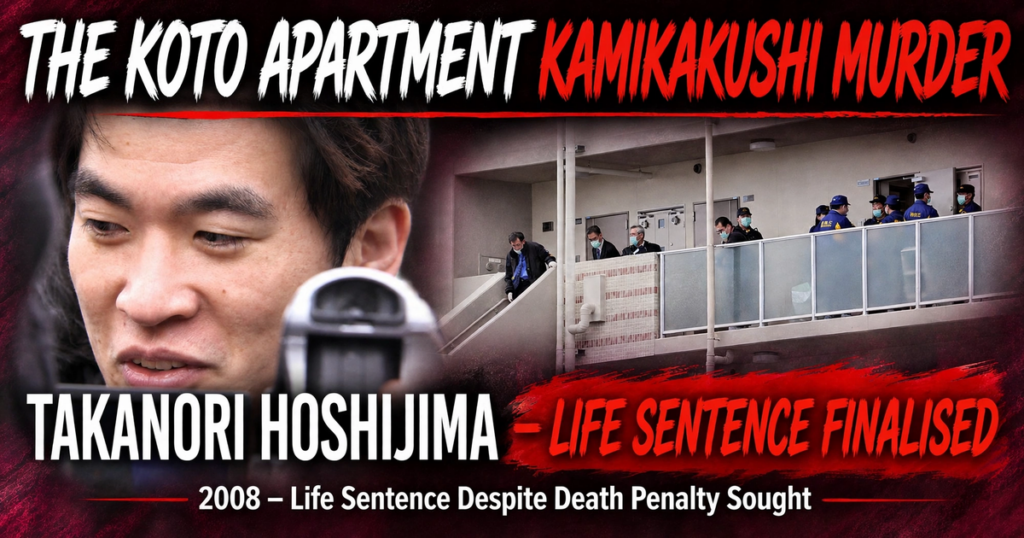
A resident disappeared after returning to her apartment
On April 18, 2008, 23-year-old Rurika Tojo disappeared from the apartment building in Koto Ward, Tokyo, where she lived with her sister. Security-camera footage recorded her entering the building after returning home, but there was no corresponding record of her leaving. When her sister returned, Tojo was missing and there were blood traces and other signs near the entrance. The circumstances did not fit an ordinary decision to go out. Police began examining the building itself, including its residents and shared spaces, rather than assuming that the woman had left voluntarily or been taken away from outside.
The missing exit footage focused attention inside the building
The building had an auto-lock entrance and security cameras. The absence of footage showing Tojo leaving after she returned was an important clue. Investigators compared the movements of residents and examined whether someone inside the building could have approached her. The blood traces near her entrance and the lack of belongings associated with a planned trip also raised concern. The police did not immediately announce that a murder had occurred. They developed the case through interviews, camera footage and physical evidence. The investigation showed why a person disappearing inside a secured building cannot be treated in the same way as a person last seen outdoors.
A neighbour two doors away was arrested for trespass
On May 25, 2008, police arrested Takanori Hoshijima, who lived on the same ninth floor, two doors away from Tojo's apartment. The first arrest was on suspicion of unlawful entry. After his arrest, Hoshijima admitted that he had taken Tojo into his own apartment and killed her on the day she disappeared. The initial arrest charge reflected the evidence that police could establish at that stage. As the investigation progressed, the authorities added the more serious offences. It would be inaccurate to say that police arrested him for murder from the outset or that the first arrest already included every charge later brought.
Physical evidence corroborated parts of the confession
Hoshijima said that he had damaged Tojo's body and disposed of the remains in stages. Police searched the surrounding sewer system and recovered bone fragments, skin tissue and other material that was identified as belonging to her. The discoveries provided physical evidence supporting parts of his account. The case was therefore not based solely on a confession. Investigators compared his statements with the material recovered, the security-camera record and the circumstances inside the building. The handling of the remains was a separate part of the criminal case from the killing itself, and the courts considered the legal elements of each offence individually.
The indictment covered five separate offences
Prosecutors charged Hoshijima with unlawful entry, kidnapping for an indecent purpose, murder, damage to a corpse and abandonment of a corpse. These offences described different stages of the conduct: entering the victim's residence, taking her into his own apartment, killing her and concealing the remains. The prosecution sought the death penalty, emphasising the seriousness of the crime and the subsequent concealment. Hoshijima admitted the charges. As a result, the trial was not primarily a dispute about whether he was the offender. The central issue was the appropriate sentence, especially how to weigh the murder against the acts committed after death.
The District Court imposed life imprisonment in February 2009
On February 18, 2009, the Tokyo District Court sentenced Hoshijima to life imprisonment. The court regarded the crime and the treatment of the remains as extremely serious. It nevertheless considered that the killing itself had not been planned in detail before the encounter, that there was one victim, that Hoshijima had no prior serious criminal record and that he had admitted the offences and expressed remorse. The court did not say that a murder with one victim can never result in a death sentence. It assessed the circumstances of this particular case and concluded that the death penalty was not the only possible punishment.
The Tokyo High Court rejected the prosecution's appeal
The prosecution appealed the life sentence, arguing that it was too lenient. Hoshijima did not appeal the conviction or sentence. On September 10, 2009, the Tokyo High Court dismissed the prosecution's appeal and maintained life imprisonment. The High Court emphasised the absence of a carefully prepared plan to kill Tojo before the encounter, the lack of a serious prior record and the defendant's conduct in court. It did not excuse the murder or treat the concealment as insignificant. It concluded that the District Court's overall sentencing assessment was not unreasonable.
The life sentence became final without a Supreme Court judgment
The prosecution did not file a further appeal to the Supreme Court, and Hoshijima also did not appeal. The Tokyo High Court judgment therefore became final in September 2009. There was no Supreme Court merits judgment deciding whether death or life imprisonment was appropriate in this case. The final legal outcome is life imprisonment for unlawful entry, kidnapping for an indecent purpose, murder, damage to a corpse and abandonment of a corpse. As of the Japanese archive's November 14, 2026 update, no public retrial or other proceeding had overturned that judgment. The case is best understood as a final life sentence following a prosecution-only appeal, not as a Supreme Court decision that set a general rule for all one-victim murders. The victim's disappearance inside a secure building, the initial trespass arrest and the later murder charges were distinct stages of the investigation.
Original Japanese record: 江東マンション神隠し殺人事件|星島貴徳の無期懲役確定と死刑が回避された理由
Last updated:
Related articles
Case record
The Murder of Diet Member Koki Ishii: A Political Career, a Fatal Attack and an Unresolved Motive
Case record
The Matsudo Female University Student Murder-Arson: A Death Sentence Replaced by Life Imprisonment
Case record
The Murder of Lindsay Ann Hawker: Police Encounter and Flight on Foot, Arrest 961 Days Later
Case record