
The Oguchi Hospital Infusion Poisonings: Three Patients Killed and a Life Sentence Upheld
Three patients at the former Oguchi Hospital in Yokohama died in September 2016 after the disinfectant DiaMitol was introduced into their intravenous drips. Former nurse Ayumi Kuboki was convicted of three murders and five counts of preparation for murder. The Yokohama District Court imposed life imprisonment in 2021, and the Tokyo High Court dismissed both appeals on 19 June 2024, leaving the life sentence in place.
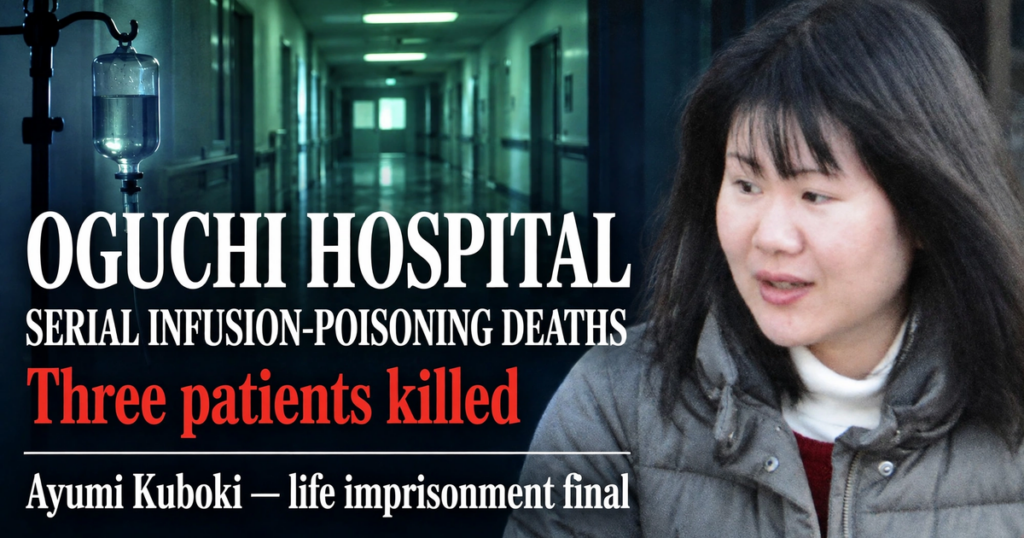
An abnormal infusion bag exposed a poisoning at a Yokohama hospital
In September 2016, patients at the former Oguchi Hospital in Yokohama's Kanagawa Ward died after receiving intravenous infusions contaminated with DiaMitol, a disinfectant used in the hospital. The first death that brought the pattern to attention was that of an 88-year-old patient on 20 September. A nurse noticed unusual foaming in an infusion bag and reported the concern. Testing detected benzalkonium chloride, a component of the disinfectant. The investigation then examined two earlier deaths on the same ward: a 78-year-old patient who died on 16 September and an 88-year-old patient who died on 18 September.
The three deaths occurred on separate days and through different infusion routes
The Tokyo High Court's judgment sets out the three killings as separate counts. In Okitsu's case, DiaMitol was mixed into a bag intended for later administration, and another nurse unknowingly administered it. Nishikawa's infusion was contaminated through a three-way stopcock while it was being given. In Yamaki's case, the disinfectant was mixed into an infusion bag before it was administered. All three patients died from benzalkonium poisoning. The different routes matter because the court considered the evidence for each death individually; the fact that the same chemical was involved did not mean that every infusion had been altered in the same way.
The former nurse used a hospital disinfectant to contaminate the drips
Ayumi Kuboki, a former nurse on the ward, was later arrested and prosecuted. The disinfectant was stored in the hospital and was colourless and odourless, making it difficult to notice once mixed into an infusion. The prosecution presented evidence that Kuboki had introduced the substance into the patients' infusions and that the deaths were not accidental medication errors. The court examined the timing of the contamination, the administration by other nurses who did not know what had been added, and the toxicological findings. The case was not about a mistaken dosage or a clinical decision; the courts found intentional contamination designed to cause death.
The court identified a motive linked to avoiding difficult patient situations
The Tokyo High Court's judgment examined Kuboki's working conditions and her fear of being blamed by patients' families when a patient deteriorated or died during her shift. She had felt unable to discuss the pressure with colleagues or supervisors. The judgment described how she came to think that if a patient died when she was not on duty, she might avoid the family response and the burden of dealing with the death. The court did not treat this as an excuse. It explained the motivation found from the evidence while emphasizing that the patients were not responsible for her workplace anxiety and had no reason to expect that a nurse would deliberately poison them.
The indictment covered three murders and five preparations for murder
Kuboki was arrested in July 2018, nearly two years after the deaths. The prosecution charged her with three murders and five counts of preparation for murder. The preparation counts concerned other patients and a saline solution that had been contaminated or prepared for contamination but did not result in additional deaths. The distinction between a completed murder and preparation for murder is important. The court did not convict her of killing every patient whose death had raised suspicion in the hospital. The proven criminal case was limited to the three deaths and five preparatory acts included in the indictment.
The district court imposed life imprisonment in 2021
On 9 November 2021, the Yokohama District Court sentenced Kuboki to life imprisonment. The prosecution had sought the death penalty, pointing to three intentional killings of vulnerable patients in a place where they should have been safe. The court considered the number of victims and the serious breach of trust inherent in a nurse poisoning people under her care. It nevertheless selected life imprisonment. The judgment treated the three murders and five preparations as the offences proved in court, rather than expanding the case to include other suspected deaths that had not been charged.
The Tokyo High Court rejected both appeals in June 2024
On 19 June 2024, the Tokyo High Court dismissed both the prosecution's and the defence's appeals. The appellate judgment left the life sentence in place. One important issue was the prosecution's attempt to rely on Kuboki's statements about similar conduct that had not been included in the indictment. The High Court was cautious about using uncharged acts to increase the sentence, because doing so could effectively punish a defendant for conduct that had not been tried through the ordinary criminal process. The court emphasized that the proven case remained three murders and five preparations for murder.
The hospital's safety failures were examined separately from Kuboki's guilt
The criminal case was only one part of the aftermath. Yokohama City reviewed how earlier concerns about unusual events and patient safety had been handled by the hospital and local authorities. The review identified problems in the sharing of medical-safety information and in the response to warning signs. That administrative examination was not a finding that hospital staff other than Kuboki had committed murder. It addressed whether systems for reporting and responding to risks were adequate. The distinction matters: a criminal judgment determines the defendant's responsibility for offences proved beyond the required standard, while an administrative review looks for failures that may be corrected to protect future patients.
The final record is three murders, five preparations and a life sentence
The case is often described as a serial poisoning of hospital patients, but the number of deaths judicially established is three. The court also convicted Kuboki of five preparatory offences. The High Court's 2024 decision left the life sentence in place and refused to expand the sentencing analysis to uncharged allegations. The separate medical-safety review addressed the hospital's reporting and oversight systems. A responsible account must not inflate the victim count by including every unexplained death at the hospital, and it must not confuse administrative findings with criminal convictions. The central facts are the three patients, the disinfectant-contaminated infusions and the life sentence.
Original Japanese record: 大口病院連続点滴中毒死事件|患者3人殺害、院内の異常と死刑を回避した量刑判断
Last updated:
Related articles
Case record
The Kumagaya Serial Murders: Six Victims, Diminished Responsibility, and a Life Sentence
Case record
The Sumoto Five-Person Murders: From a Death Sentence to Life Imprisonment
Case record
The Mazda Headquarters Factory Vehicle Attack
Case record