
The Kumagaya Serial Murders: Six Victims, Diminished Responsibility, and a Life Sentence
Between 14 and 16 September 2015, six people were killed in three homes in Kumagaya, Saitama Prefecture. The Peruvian defendant Nakada was first sentenced to death, but the Tokyo High Court found that schizophrenia had substantially impaired his criminal responsibility and replaced the sentence with life imprisonment. The criminal judgment became final after the Supreme Court rejected his appeal; a separate civil claim against Saitama Prefecture also failed.
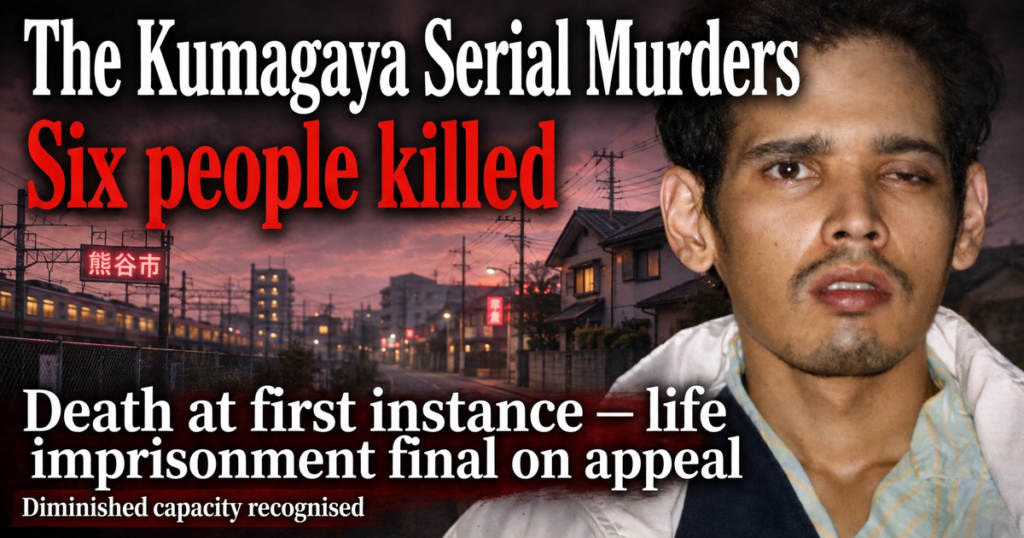
A man left the police station during voluntary questioning
The events began on 13 September 2015, when a Peruvian national identified as Nakada was taken to Kumagaya Police Station in Saitama Prefecture after residents reported suspicious behaviour near a home. He was not under arrest; officers were questioning him on a voluntary basis. During a break, he left the station and escaped. The next day, residents reported intrusions at houses in Kumagaya. Between 14 and 16 September, three homes were attacked and six people were killed. The escape became a major issue in the later investigation because it preceded the killings and raised questions about how police handled a person who had been brought in for questioning.
Six people were killed in three homes over several days
The victims were members of three households. On 14 September, a married couple, aged 55 and 53, were killed in their home. On 15 September, an 84-year-old woman was killed at another residence. Later that day, a 41-year-old mother and her two daughters, aged 10 and 7, were killed in a third home. The attacks involved forced entry, theft and the use of a knife. The bodies were found in circumstances that indicated attempts to conceal what had happened. Police located Nakada at the third house and took him into custody after he fell from the building. Six people had died, including two young girls.
The prosecution and defence disputed the defendant's mental state
Nakada was charged with offences including robbery-murder, murder, residential burglary and concealment of bodies. His mental condition became the central issue at trial. Psychiatric examinations identified schizophrenia and delusions that he was being pursued by people who intended to harm him and his relatives. The prosecution argued that he retained sufficient ability to understand the nature and wrongfulness of his actions. The defence argued that the illness had substantially impaired his ability to distinguish right from wrong and control his behaviour. The dispute was not whether six people had died; it concerned the extent to which the defendant could be held criminally responsible for the acts.
The district court imposed the death penalty in March 2018
On 9 March 2018, the Saitama District Court sentenced Nakada to death. It accepted that he had schizophrenia and that delusions had affected him to some degree, but it considered the influence limited in the circumstances of the crimes. The court found that he had acted with sufficient awareness and purpose to bear full criminal responsibility. The defence appealed. Under Japanese criminal law, a person who is in a state of mental incapacity may be exempt from punishment, while a person with diminished capacity must receive a reduced sentence. The distinction can determine whether the death penalty is legally available.
The Tokyo High Court found diminished capacity and replaced the sentence
On 5 December 2019, the Tokyo High Court set aside the death sentence and imposed life imprisonment. It concluded that the effects of schizophrenia were much greater than the district court had recognized. The appellate court considered the delusions that Nakada believed he was being pursued and that the people in the homes might be connected to that imagined threat. It found that his ability to understand the situation and control his conduct had been substantially impaired. The court did not find him not guilty. It found him criminally responsible in a diminished-capacity state, which required mitigation under Japanese law. The result was life imprisonment rather than death.
The Supreme Court left the life sentence in place
The prosecution decided not to appeal the Tokyo High Court's reduction of the sentence. The defence continued to argue that Nakada should be acquitted because he had been in a state of complete mental incapacity. The Supreme Court rejected the defence appeal in September 2020, and an objection was also dismissed later that month. The life sentence therefore became final. The procedural outcome is important: the first-instance death sentence was overturned by the appellate court, and the final criminal judgment was life imprisonment. It would be inaccurate to describe the defendant as a death-row prisoner or to say that the death sentence was carried out.
A separate lawsuit asked whether the police should have warned residents
The case continued in civil court after the criminal judgment. A family member who lost his wife and two daughters argued that Saitama Prefectural Police should have shared information about the earlier incidents with residents, and that the failure to do so contributed to the later deaths. On 15 April 2022, the Saitama District Court dismissed the claim. The Tokyo High Court rejected the appeal in June 2023, and the Supreme Court dismissed the family's further appeal in November 2024. This was a civil claim about the prefecture's alleged liability, not another criminal trial of Nakada. The courts' decisions did not reduce the seriousness of the murders; they addressed a different legal question.
The case prompted changes in local information sharing
The killings led to debate about how police and local authorities should communicate when a dangerous person or a series of suspicious incidents may threaten residents. Kumagaya and police authorities developed an information-sharing arrangement that later became known as the 'Kumagaya Model' and influenced similar coordination elsewhere in Saitama. The policy issue is distinct from the criminal responsibility question. The criminal court determined the defendant's guilt and mental capacity; the civil courts examined whether police had breached a legal duty to provide information. A careful account keeps those proceedings separate and avoids implying that the civil judgments overturned or modified the criminal conviction.
The six victims must remain distinct from the legal debate
The case is often discussed through the unusual change from a death sentence to life imprisonment. That legal issue is important, but it should not eclipse the six people who were killed: two members of a couple, an elderly woman, and a mother with her two daughters. The appellate judgment did not deny the deaths or excuse the violence. It applied the legal rule for diminished capacity to the defendant's mental state at the time of the offences. The later civil case considered police information-sharing duties. The final record is therefore a six-victim murder case with a final life sentence and a separate, unsuccessful claim against the prefecture.
Original Japanese record: 熊谷連続殺人事件|6人殺害の死刑を無期へ変えた心神耗弱判断と県警訴訟
Last updated:
Related articles

Case record
The Greater Tokyo Suspicious Deaths: How Circumstantial Evidence Established Three Murders
Case record
The Tokyo–Saitama Child Abduction and Murder Case: Four Victims and a Long Trial Over Criminal Responsibility
Case record
The Sumoto Five-Person Murders: From a Death Sentence to Life Imprisonment
Case record