
The Genzō Kurita Murders: The Osenkorogashi Family Killings and Two Death Sentences
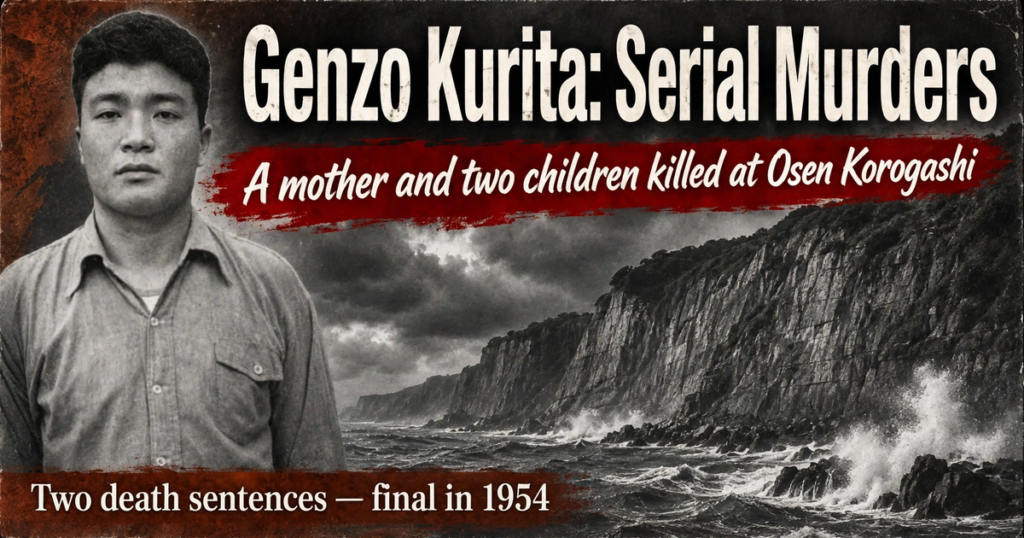
Genzō Kurita's crimes between 1948 and January 1952 involved seven deaths dealt with in criminal proceedings across Shizuoka, Tochigi and Chiba. The Osenkorogashi attack killed a mother and two children, while the eldest daughter survived. A further killing was described in Kurita's statements but was not prosecuted. Two separate death sentences were imposed, and Kurita withdrew an appeal in October 1954, making the sentence final.
The crimes covered several prefectures and more than three years
The criminal cases involving Genzō Kurita concerned offences committed between 1948 and January 1952 in Shizuoka, Tochigi and Chiba Prefectures. The record is sometimes summarized as a series of murders involving eight victims, but that total combines different levels of proof. Seven deaths were dealt with in criminal proceedings. Kurita also made a statement about killing another woman in 1948, but that allegation was not prosecuted and was not established by a court. A careful account must therefore distinguish the seven deaths addressed by the courts from the additional statement, rather than presenting every allegation as a judicially proven murder.
Earlier attacks preceded the Osenkorogashi killings
The series included a woman killed in Shizuoka in 1948 and another woman killed in Tochigi in 1951. The crimes involved sexual violence, robbery and the exploitation of women who were travelling or in vulnerable circumstances. Kurita's movements across prefectural boundaries complicated the investigation, because local police initially handled separate incidents without knowing that the same man might be responsible. The later cases showed how a series of offences could be connected through the defendant's movements, statements and the circumstances of the victims. The record should not imply that every incident was discovered at the time or that police immediately understood the full pattern.
The Osenkorogashi attack killed a mother and two children
In October 1951, a mother travelling with her children was attacked at Osenkorogashi, a steep coastal area in Chiba Prefecture. Kurita pushed the family down the slope. The mother and two of her children died; the eldest daughter survived despite her injuries. The surviving child became an important witness to what had happened. Contemporary newspapers reported the discovery and the search for the missing family, but the incident did not immediately lead to Kurita's arrest. The name Osenkorogashi later became closely associated with the case, and the deaths of the mother and two children remain its most widely remembered part.
A later double murder led investigators to Kurita
In January 1952, two women were killed in Kemigawa, Chiba Prefecture. This case became the breakthrough that connected Kurita to the earlier offences. The investigation examined the circumstances of the killings, the property taken and the information that could identify the offender. Kurita was arrested in connection with the Kemigawa murders. His statements and the evidence gathered by police led to prosecutions covering other killings in different prefectures. The case therefore developed from a local investigation into a broader series, with separate courts dealing with offences that had occurred in different places and at different times.
Seven deaths were handled by the courts; an eighth remained an allegation
The seven deaths addressed in the criminal proceedings can be grouped as one woman in Shizuoka in 1948, one woman in Tochigi in 1951, three victims at Osenkorogashi and two women in Kemigawa in January 1952. Kurita also reportedly said that he had killed another woman in 1948. That additional allegation was not prosecuted. It is therefore not equivalent to the seven deaths considered in court. The difference matters because a confession or statement is not itself a judicial finding. The number eight may appear in some accounts of the broader series, but the number seven is the appropriate figure for the deaths dealt with in the criminal cases.
Two separate courts imposed death sentences
Kurita received two death sentences in separate proceedings. In August 1952, the Chiba District Court sentenced him to death in connection with the Kemigawa murders. On 21 December 1953, the Utsunomiya District Court also imposed the death penalty for other offences in the series. These were not two stages of one appeal; they were separate judgments arising from different prosecutions. The existence of two death sentences is part of the unusual legal history of the case. It also explains why a simple statement that 'the Supreme Court sentenced Kurita to death' would be inaccurate.
Kurita withdrew an appeal and the death sentence became final
In October 1954, Kurita withdrew an appeal, and the death sentence became final through that procedural step. The National Diet Library's reference record cites a Chiba newspaper dated 23 October 1954 reporting that the sentence had become final. The finality should not be described as a Supreme Court ruling if the sentence became final because an appeal was withdrawn. Kurita was executed on 14 October 1959. The legal history therefore involves two separate death sentences, an appeal withdrawal in 1954 and an execution in 1959.
The survivor and the contemporary press shaped the public record
The Osenkorogashi case was reported widely because a child survived an attack that killed her mother and two siblings. Contemporary newspapers documented the family's movements, the discovery of the bodies and the police search. Later books and magazine articles revisited Kurita's crimes, including a 1970 issue of Shūkan Sankei that carried a prison account attributed to him. Such material helps explain how the case entered public memory, but later retellings should not blur allegations and convictions. The National Diet Library's reference service points researchers to newspaper collections and other historical sources, providing a way to compare the later narrative with records from the period.
The case requires a clear separation of fact, confession and judgment
Kurita's crimes are often described through the Osenkorogashi killings, but the wider record is more complicated. Some offences were tried in separate courts, two death sentences were imposed, one additional killing remained an unprosecuted statement, and the final sentence became effective after an appeal was withdrawn. The surviving child, the families of the victims and the communities affected should not be reduced to a sensational total. The most accurate summary is seven deaths handled in criminal proceedings, an additional unprosecuted allegation, two death sentences, finality in October 1954 and execution in October 1959.
Original Japanese record: 栗田源蔵連続殺人|おせんころがし母子3人殺害と、二つの死刑判決に至るまで
Last updated:
Related articles
Case record
The Akira Nishiguchi Case: Five Murders, a Nationwide Manhunt and a Child's Crucial Observation
Case record
The Tokyo–Saitama Child Abduction and Murder Case: Four Victims and a Long Trial Over Criminal Responsibility
Case record
The Tateyama Family Arson Murders
Case record