
The Tateyama Family Arson Murders
A fire in Tateyama, Chiba Prefecture, on 18 December 2003 destroyed seven buildings and killed four members of one family. The case was part of a longer series of arson incidents by Koji Takao, including a separate 1998 fire in which one employee died. Takao's death sentence became final in September 2010.
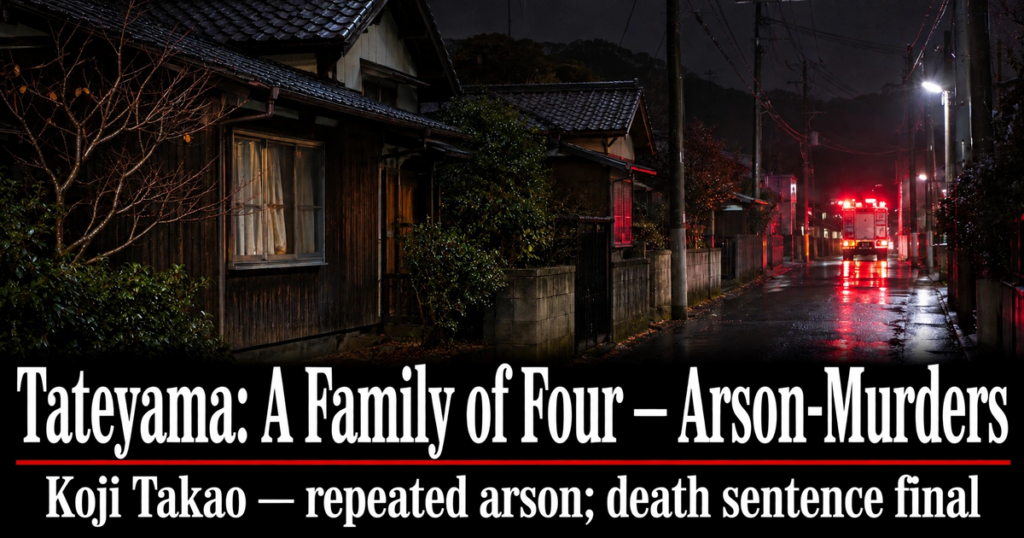
A December 2003 fire killed four members of one family
At approximately 3:15 a.m. on 18 December 2003, a fire was deliberately set at a residence in Tateyama City, Chiba Prefecture. The fire spread to neighbouring buildings, and seven structures in total were destroyed. Four members of one family died: a 56-year-old man, his 52-year-old wife, their 27-year-old son and their 25-year-old son. The deaths were the central homicide component of the case against Koji Takao, but the trial also considered earlier and later arson incidents.
The case had a history reaching back to 1998
The December 2003 fire was not the first serious fire linked to Takao. On 11 February 1998, he set fire to newspapers piled between a restaurant building and a storage structure in a Tateyama commercial area. An employee was sleeping on the second floor and died after being unable to escape. Takao had believed that the building was unoccupied, and the offence was treated in the judgment as arson of a non-inhabited building rather than as a murder charge.
Takao learned that someone had died in the 1998 fire
After the 1998 fire, Takao heard other customers discussing the incident at a restaurant and learned that a person had died in the building he had set alight. He temporarily stopped drinking and setting fires because of guilt and fear. That pause did not last. When time passed without him being identified as the offender, he resumed arson. The 1998 death is therefore a separate fatal incident in the history of the case, not one of the four family members killed in December 2003.
Economic frustration and resentment formed part of the background
The court's account described a pattern of destructive behaviour that developed after Takao became frustrated with work and financial circumstances. He had damaged other people's property, including vehicle tyres, and later began setting fire to rubbish. The article identifies dissatisfaction with his workplace and problems involving income, debt and unpaid taxes as part of the background. Those circumstances were not treated as a justification or an excuse. They helped explain the history of his conduct but did not lessen the seriousness of the offences.
A further arson incident occurred in September 2003
The chronology also includes an arson incident on 18 September 2003, three months before the fatal family fire. The September incident involved two inhabited buildings that were completely destroyed by fire. It was treated as part of the series of property offences considered at trial. It must not be confused with the 1998 fire or with the December 2003 fire that killed four family members. The court considered the repeated conduct over time, including the fact that Takao had already learned of a death caused by one of his earlier fires.
The four family members died in the December fire
The fatal fire began in the early hours of 18 December 2003 and spread through the residential area. The four victims were members of the same household, and the fire destroyed seven buildings. The court considered Takao's decision to set fire to a residence at night, the danger to people inside and the surrounding structures, and his awareness of the consequences of earlier fires. The charge of murder concerned the four deaths in this incident; it did not convert the 1998 employee's death into a fifth murder conviction.
Takao set additional fires after the fatal blaze
The article records that Takao continued setting fires after the residential fire. At approximately 3:25 a.m., he ignited a towel in the circulation room of a hotel bath, charring part of an insulation tube. At around 3:45 a.m., he set fire to New Year decorations near the entrance of a supermarket, damaging the exterior wall. These later incidents were part of the same night's sequence and show why the case was prosecuted as a series of arson offences as well as the four murders.
The trial considered whether Takao understood the risk to human life
The case involved different legal classifications for different fires. The 1998 building was treated as non-inhabited in the charge, although an employee died inside. The December 2003 residence fire involved murder as well as arson of an inhabited building. The court considered Takao's knowledge of the earlier death, the circumstances of the later fires and the risk to people inside the residence. The judgment treated his conduct as demonstrating an acceptance of the grave danger to human life, rather than as an accidental fire.
The Chiba District Court imposed death in February 2005
On 21 February 2005, the Chiba District Court found Takao guilty of murder, arson of inhabited buildings, arson of non-inhabited buildings, attempted arson and property damage, and sentenced him to death. The sentence reflected the four deaths in the December 2003 fire and the broader course of repeated arson. The judgment also considered the earlier fatal fire and the fact that Takao had resumed setting fires after learning that someone had died in 1998.
The High Court and Supreme Court upheld the sentence
The Tokyo High Court dismissed Takao's appeal on 28 September 2006. On 16 September 2010, the Supreme Court's First Petty Bench dismissed his further appeal, leaving the death sentence final. The case should be described with three distinct dates: the 1998 fire in which one employee died, the 2003 December fire in which four family members died, and the 2010 Supreme Court decision that made the death sentence final. The earlier death and the four later deaths are separate factual and legal matters.
Original Japanese record: 館山市一家4人放火殺人事件|5年前の死亡火災を知りながら放火を再開、未必の殺意で死刑確定
Last updated:
Related articles
Case record
The Osaka Private Video Booth Fire: Sixteen Deaths, a Final Death Sentence and a Second Retrial Denial
Case record
The Oita Insurance-Fraud Substitute-Body Murders
Case record
The Ichikawa Family Murders: Four Victims and Capital Punishment for a Nineteen-Year-Old
Case record