
The Ichikawa Family Murders: Four Victims and Capital Punishment for a Nineteen-Year-Old
Four members of a family were murdered in Ichikawa in 1992. Mitsuhiko Seki, nineteen at the time, received a final death sentence.
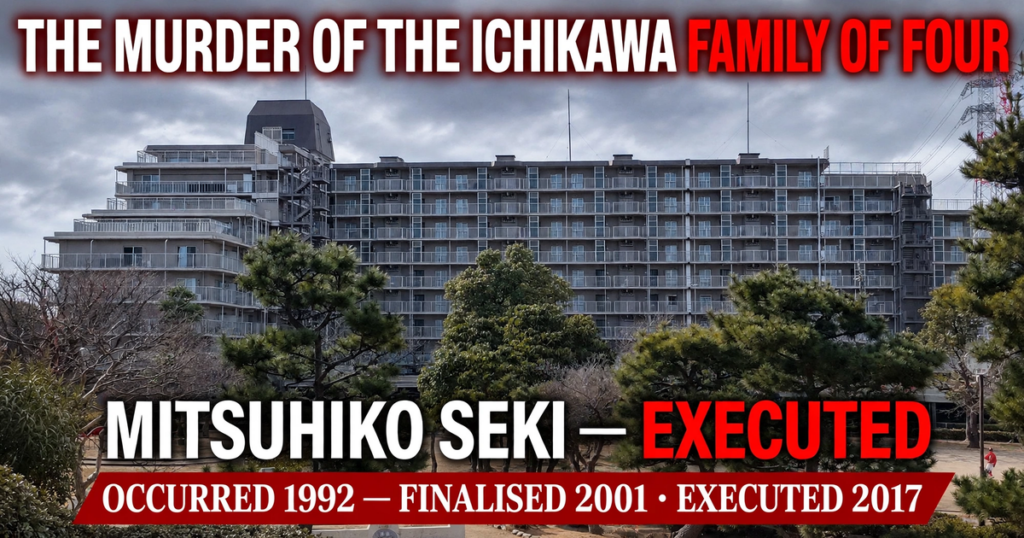
A family of four was killed in Ichikawa in March 1992
During the night of March 5–6, 1992, four members of a family were killed in their home in Ichikawa, Chiba Prefecture. The victims were an 83-year-old grandmother, a 36-year-old mother, a 42-year-old father and their four-year-old daughter. The offender, Mitsuhiko Seki, was 19 at the time of the family murders. The family's 15-year-old eldest daughter survived, but she was also subjected to serious criminal violence. The Supreme Court judgment anonymised her as a letter rather than publishing her name. This translation follows that approach and does not attempt to identify her or describe her later life.
The offender had previously sexually assaulted the surviving daughter
Before the family murders, Seki had sexually assaulted and injured the eldest daughter. They were not a couple. She was a victim of his earlier violence. Through that earlier offence, Seki had learned information about her and her family's home. When he later needed money after a dispute with a gang-related person, he chose the same residence as a place to obtain cash and valuables. This earlier crime was part of the broader case considered by the courts, not a separate relationship between the two. It also explains why the surviving girl was targeted again and why the case involved serious offences beyond the four murders.
A theft plan escalated after Seki encountered the grandmother
The Supreme Court's findings described the initial purpose of entering the home as theft rather than a plan to kill every member of the family. Seki needed money to meet a demand made by a gang-related person. When the grandmother discovered him, the offence escalated into robbery. He killed her, and later killed family members who returned to the house. The sequence matters because the court examined how a property crime became a series of killings. The victims were not all present at the same time. As family members came home, the number of people harmed increased, and Seki also committed serious offences against the surviving daughter.
Four family members died; the eldest daughter survived
The grandmother was killed first. The mother and father were killed after returning home, and the four-year-old younger sister was also killed when Seki feared that the crime would be discovered. The eldest daughter survived but suffered further sexual violence and injury. The court treated the four deaths and the harm to the surviving girl as part of the full criminal course. The four-year-old child was not a participant in the dispute or a threat to Seki. The judgment regarded the killing of the child to conceal the crime as one of the particularly serious circumstances relevant to sentencing.
The case involved several offences beyond the four murders
The Supreme Court case record included assault, rape, rape causing injury, robbery-murder, murder, robbery-rape, extortion and theft. The four family deaths were the most serious part of the case, but they were not the only conduct considered. The court also examined Seki's earlier offences against the surviving daughter and other crimes committed in the same period. This explains why the Supreme Court described his age as ranging from 18 to 19 across the overall case, even though he was 19 when the four family members were killed. The distinction between his age during the family murders and his age during earlier offences is important.
The Juvenile Act did not prohibit a death sentence at age nineteen
In 1992, people under 20 were juveniles under Japan's Juvenile Act. Seki was therefore a juvenile in the legal sense when he committed the family murders. However, the Act prohibited a death sentence only for an offender who was under 18 at the time of the offence. Seki was 19 when the four family members were killed, so the law did not categorically bar capital punishment. The courts still had to weigh his youth, upbringing and prospects for rehabilitation against the seriousness of the crimes. The case was not one in which death was legally impossible because the defendant was a juvenile.
The death sentence was upheld through three levels of court
On August 8, 1994, the Chiba District Court sentenced Seki to death. The Tokyo High Court dismissed his appeal on July 2, 1996. On December 3, 2001, the Supreme Court's Second Petty Bench dismissed his final appeal. It considered the four deaths, the motive, the sequence of killings, the serious offences against the surviving daughter and Seki's age. The Court concluded that the death sentence was unavoidable even after taking his youth into account. The sentence became final in 2001, approximately nine years and nine months after the family murders.
Seki was executed in December 2017 while a retrial request was pending
The Ministry of Justice announced that Seki was executed at Tokyo Detention House on December 19, 2017, aged 44. At the time, he had a third retrial request pending. A retrial request does not automatically suspend the execution of a final death sentence. The execution was the first in twenty years of a person who had been under 20 when committing the crime, following the 1997 execution of Norio Nagayama. The case remains a major example in debates about capital punishment for juvenile offenders. Its record must preserve both facts: Seki was 19 at the time of the family murders, and the final sentence was carried out in 2017. The execution did not change the surviving victim's anonymity; her identity remains outside this record.
Original Japanese record: 市川一家4人殺害事件|19歳の関光彦に死刑、2001年確定から2017年執行まで
Last updated:
Related articles
Case record
The Komatsugawa Case: Two Murders, Ri Chin-u's Death Sentence and the Debate That Continued After His Execution
Case record
The Murder of 18-Year-Old Manae Noguchi
Case record
The Tateyama Family Arson Murders
Case record