
The Akira Nishiguchi Case: Five Murders, a Nationwide Manhunt and a Child's Crucial Observation
Five people were murdered in 1963 during Akira Nishiguchi's flight across Japan. A family's recognition of a wanted man led to his arrest.
Two men were killed in Fukuoka in October 1963
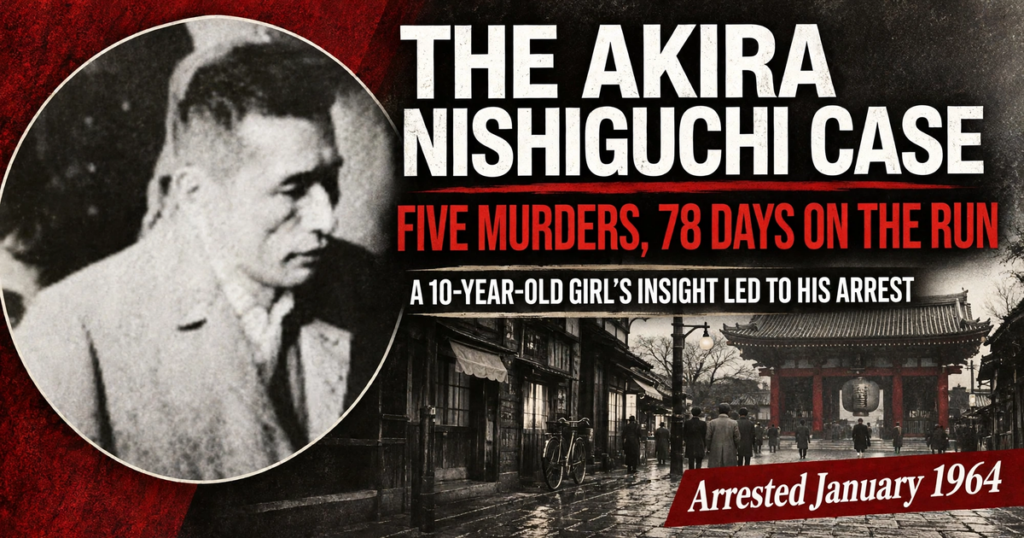
The Akira Nishiguchi case involved five murders committed between October and December 1963 in Fukuoka, Shizuoka and Tokyo. The first two victims were Ikuo Murata, aged 58, and Goro Mori, aged 38. Their bodies were found in Fukuoka Prefecture on October 18, 1963. Both were connected with work for the Japan Monopoly Corporation. The killings drew attention to a suspect who moved between prefectures and used false identities. Police issued a nationwide wanted notice, but Nishiguchi continued to evade arrest and committed further crimes while on the run. The sequence quickly became a national investigation rather than a local case confined to the first scene.
Nishiguchi used false identities to gain trust and keep moving
Nishiguchi relied on false identities rather than simply staying out of sight. He introduced himself as a university professor, lawyer or other person of standing, choosing a title that would make strangers more willing to trust him. He used false names and professional roles to gain access to lodging, money and personal relationships. During the escape, he also left belongings on a boat to create the impression that he had gone into the sea and died. The staged disappearance misled the search for a time, while he continued travelling. His conduct showed that impersonation was not incidental to the crimes: it helped him approach people and obtain the resources he needed to keep moving.
Two women were killed in Hamamatsu
On November 18, 1963, Nishiguchi travelled to Hamamatsu, Shizuoka Prefecture, and approached a woman who operated a small private lodging business and her mother. He presented himself as a university professor. The women, aged 41 and 61, were killed, and jewellery and other property were taken. He also disposed of the telephone line and converted it into money. Their deaths brought the victim count to four. The incident showed how Nishiguchi used a fabricated professional identity to enter a setting where he could be welcomed as a guest. It also widened the investigation beyond Fukuoka and increased the urgency of the nationwide search.
A Tokyo lawyer became the fifth victim
On December 29, 1963, Nishiguchi entered the home of an elderly lawyer in Tokyo under the pretext of seeking legal advice. He killed the lawyer and took cash and other property. The killing brought the number of victims to five. By this stage, the investigation involved murders in three prefectures and a suspect who repeatedly changed his name and claimed different occupations. The Tokyo killing was the last murder before Nishiguchi was recognized in Kumamoto, but the search still depended on information moving between local police forces.
A ten-year-old girl recognised Nishiguchi at a temple in Tamana
On January 2, 1964, Nishiguchi arrived at a temple in Tamana, Kumamoto Prefecture, and presented himself as a lawyer from Tokyo. The temple's head, Furukawa Tairyu, was involved in prison chaplaincy and social work; Nishiguchi approached him as someone sympathetic to his activities. Furukawa's ten-year-old daughter recognized the visitor's face from a wanted poster she had seen. She told her mother, and the family contacted police. The recognition was a crucial lead, but it did not itself complete the arrest: officers still had to confirm the man's identity and decide how to approach a potentially dangerous suspect inside a family home.
The delay in protecting the family was examined by the Diet
The family's call reached police at about 11:30 p.m. on January 2. Kumamoto Prefectural Police headquarters ordered an internal watch, with officers entering the building to protect the family while confirming the visitor's identity. At the scene, officers instead watched from outside. Furukawa was not told that police had surrounded the building until about 4 a.m., leaving the family in the same house as the man they suspected. The delay was examined at the House of Councillors Justice Committee on February 4, 1964. The questioning focused on why the family had not been protected sooner and how police should balance confirmation, arrest and the safety of people who provide information.
Nishiguchi was arrested in January 1964 and executed in 1970
Police arrested Nishiguchi in Tamana on January 3, 1964. After arrest, he was tried for the five murders and related offences. The Fukuoka District Court's Kokura Branch sentenced him to death on December 23, 1964. The Fukuoka High Court dismissed his appeal on August 28, 1965. Nishiguchi filed a final appeal but withdrew it on August 15, 1966. The death sentence therefore became final because he withdrew the appeal, not because the Supreme Court issued a merits judgment. He was executed on December 11, 1970. The final legal outcome was a death sentence for the five killings and related property offences.
The escape exposed gaps in nationwide police information sharing
During the escape, Nishiguchi crossed prefectural boundaries while wanted information was still being distributed through local police stations and police boxes. On November 21, the day he was specially designated as wanted, he reportedly took a handbag containing cash to a police box as lost property. The officer who dealt with him did not recognize him. The National Police Agency later explained to the Diet that the special-notice measures had not yet been completed across all prefectures and the police box did not have his photograph displayed at that time. Nishiguchi also stayed at a Nagoya inn under an assumed name on the night of December 29. A later police review found that no inquiry had been made at that inn that night. These episodes were examined as part of the wider review of the investigation and police coordination.
Original Japanese record: 西口彰事件|5人殺害と偽装逃走、10歳少女の気づきが終わらせた広域逃亡
Last updated:
Related articles
Case record
The Norio Nagayama Case: Four Murders and the Origins of Japan's Death Penalty Sentencing Standard
Case record
The Tokyo–Saitama Child Abduction and Murder Case: Four Victims and a Long Trial Over Criminal Responsibility

Case record
The Zama Nine Murders: Why the Court Rejected Claims of Consent

Case record