
The Yamagata–Tokyo Serial Arson Murders
Katsumi Asayama was convicted of killing three people in two attacks about a year apart. In Yamagata, he set fire to the home of a former partner's parents; in Tokyo, he confined and killed another former partner's mother before setting fire to her home. His death sentence became final in June 2016.
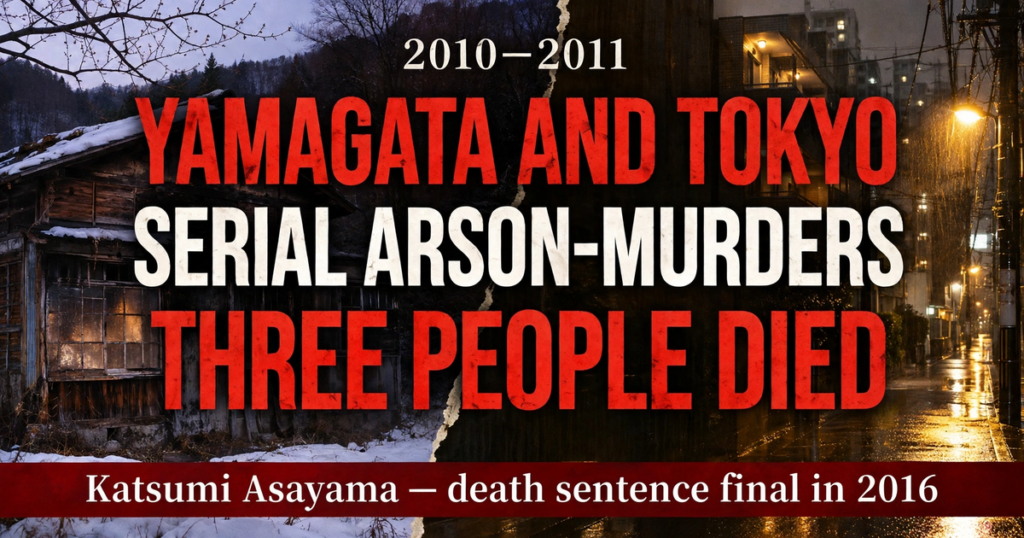
Three people died in two attacks about a year apart
The Yamagata–Tokyo serial arson murders involved two separate incidents in 2010 and 2011. On 2 October 2010, a fire at a home in Yamagata City killed an elderly married couple, Takeyoshi Yamaga, aged 71, and his wife Kazuko, aged 69. On 24 November 2011, a woman named Tatsuko Otsuka, aged 76, died in a residence in Koto Ward, Tokyo, after carbon-monoxide poisoning; the house was then set on fire. Katsumi Asayama was convicted of all three deaths. The cases were connected through his relationships with two different men.
The Yamagata fire targeted the parents of a former partner
Asayama had been in a relationship with a man identified in the judgment as A. A returned to his family home in Yamagata to help care for his parents, who had physical disabilities, and to assist with the family business. Asayama did not accept the separation. He came to regard A's parents as obstacles to bringing A back to him. On 2 October 2010, Asayama entered the parents' home in Yamagata City, spread kerosene and set the building on fire. Both parents died.
The first case involved an eventual intent to kill
The Supreme Court distinguished the mental element in the Yamagata incident from the Tokyo murder. In Yamagata, the court described Asayama's intent as eventual or indirect intent: he set fire to an occupied home while accepting the possibility that the people inside would die. The court did not treat this as a case in which he necessarily had a fully formed, direct purpose to kill both parents in the same way as the later attack. This distinction did not mean the deaths were accidental or that the arson was legally harmless. The Supreme Court still treated the conduct as murder-related and upheld the death sentence when considering the two cases together.
The Tokyo incident arose from a separate relationship
After the Yamagata incident, Asayama became involved with another man, identified in the judgment as B. When that relationship ended, Asayama continued trying to locate B. He pursued information about B's whereabouts and became angry when B's mother, Otsuka, would not disclose where her son was. The Tokyo incident therefore did not involve the same family as the Yamagata fire. It concerned a second former partner and his mother, who was targeted because she would not reveal her son's location.
Asayama and his wife entered Otsuka's home and confined her
On 24 November 2011, Asayama and his wife conspired to enter Otsuka's home in Koto Ward. They restrained her hands and feet and confined her for approximately four and a half hours while demanding information about B's whereabouts. The prolonged confinement was not incidental to the later killing. It formed part of the plan to obtain information and control the victim. The court treated the sequence of entry, restraint, questioning and death as a connected course of conduct, rather than as an isolated fire that happened after an unrelated argument.
Otsuka died from carbon-monoxide poisoning before the house was set alight
The Supreme Court found that Asayama placed Otsuka inside a large container and put burning charcoal inside it, causing carbon-monoxide poisoning. After her death, kerosene was spread and the residence was set on fire. The distinction between the cause of death and the subsequent arson matters. Otsuka died from carbon-monoxide poisoning; the fire was then used as part of the offender's actions at the scene. The Japanese article identifies her as 76 years old and records her death on 24 November 2011.
The investigation linked the Tokyo case to the earlier Yamagata fire
The investigation did not initially resolve the Yamagata fire as a murder case. Although kerosene-related evidence raised questions, the earlier deaths were not immediately attributed to Asayama. In January 2012, Asayama and his wife came under investigation over alleged stalking and document offences connected with attempts to obtain B's address and residence information. Investigators examined the forgery and use of documents, stalking-related conduct and the Tokyo death. Asayama also admitted involvement in the Yamagata fire, connecting the two separate scenes and bringing both incidents into the same criminal proceedings.
The victims were family members, not the former partners themselves
A feature common to the two incidents was that Asayama attacked the families of the men with whom he had been involved, rather than the men themselves. In Yamagata, the parents were treated as obstacles to the return of A. In Tokyo, Otsuka was targeted because she would not reveal B's location. The Supreme Court expressly considered that the victims had done nothing that warranted being killed. The relationship disputes explain the background to the crimes, but they do not make the victims responsible for the violence. The court characterized Asayama's conduct as driven by one-sided attachment and resentment.
The Tokyo District Court imposed death in 2013
On 11 June 2013, the Tokyo District Court sentenced Asayama to death. It found that three people had died in the two cases and accepted the murder allegations, including the intent issue in the Yamagata arson. The court considered the selfish motives, the fact that the victims had no fault, and the planning and leadership shown in the Tokyo offence. Asayama appealed. The death sentence at this stage was a first-instance judgment and had not yet become final.
The High Court and Supreme Court upheld the death sentence
On 1 October 2014, the Tokyo High Court dismissed Asayama's appeal and maintained the death sentence. The defence continued to contest the finding of intent in the Yamagata case and the severity of the sentence. On 13 June 2016, the Supreme Court's Second Petty Bench dismissed the final appeal. It acknowledged that the Yamagata killing involved eventual intent and considered other circumstances favourable to Asayama, including that he had admitted some facts and expressed remorse. It nevertheless concluded that the three deaths, the relationship-driven motives, the planning and leadership in the Tokyo case, and the victims' lack of fault made the death penalty unavoidable.
The death sentence became final in June 2016
The Supreme Court's dismissal on 13 June 2016 left the death sentence final. The legal chronology should be kept separate from the dates of the fires: the Yamagata incident occurred on 2 October 2010, the Tokyo incident on 24 November 2011, the Tokyo District Court sentenced Asayama on 11 June 2013, the High Court dismissed his appeal on 1 October 2014, and the Supreme Court dismissed the final appeal on 13 June 2016. The Japanese article identifies the final sentence as death. The translation does not add an execution date that is not stated in the source article.
Original Japanese record: 山形・東京連続放火殺人事件|3人死亡、未必の殺意と主導性を認定し死刑確定
Last updated:
Related articles
Case record
The Hitachi Murder of Dohi's Wife and Five Children
Case record
The Kyoto Animation Arson Attack: 36 Deaths, Criminal Responsibility and the Disputed Appeal Withdrawal
Case record
The Hino City Two-Child Arson Murders: Yukie Kitamura, Intent and the Life Sentence
Case record