
The Hitachi Murder of Dohi's Wife and Five Children
On 6 October 2017, Dohi, then using the surname Komatsu, appeared at Hitachi Police Station with burns on his legs and reported that he had stabbed his wife and five children at their home and set the house on fire. All six family members died. After a severe medical crisis, Dohi suffered hypoxic brain injury and lost his memory of the incident. The courts nevertheless found him capable of standing trial, and his death sentence became final in February 2025.
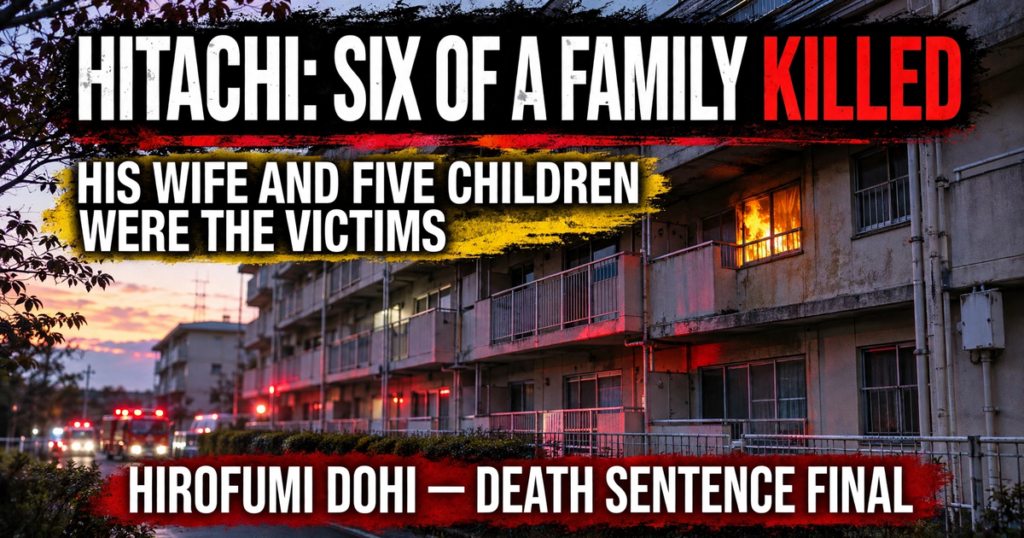
Dohi appeared at a police station with burns and reported the deaths
At about 5:10 a.m. on 6 October 2017, a man with burns on both legs appeared at Hitachi Police Station in Ibaraki Prefecture. He told officers, in substance, that he had stabbed his wife and five children at their home in Hitachi City, poured gasoline and set the house on fire. The man was Dohi, who was using the surname Komatsu at the time of the incident. His arrival at the police station brought the deaths to the attention of authorities before the full scene had been investigated.
Six members of the family died in the house
The victims were Dohi's wife, his wife, aged 33, and their five children: an adopted daughter aged 11 and four boys aged 7, 5, 3 and 3. The six family members died in the incident. The case was treated as a multiple murder and arson. The family relationship and the number of victims are important to the legal and factual description: this was not a single-victim domestic homicide, but the killing of a wife and five children in the family home.
The reported sequence involved stabbing and a deliberately set fire
Dohi's initial account to police was that he had stabbed his wife and children with a knife and then spread gasoline before setting the house alight. Investigators examined the scene and the evidence relating to both the stabbing and the fire. The fire was not treated as an independent accident. The public account describes it as part of the same episode in which the six family members were killed. The precise details of every movement inside the home should be limited to what the criminal proceedings established.
Dohi's medical condition left him without a memory of the incident
After the incident, Dohi suffered a serious medical crisis that included cardiopulmonary arrest. He sustained hypoxic brain injury and later lost his memory of the events. The memory loss became a major issue in the criminal proceedings because he could not recall the acts that formed the charges. The loss of memory did not mean that the deaths or the physical evidence disappeared; it raised the separate legal question of whether he could understand the proceedings and participate in his defence.
The trial focused on whether he had the capacity to stand trial
The court had to consider whether Dohi's memory loss and brain injury made him incapable of participating in a criminal trial. The issue was not simply whether he could remember the incident. Trial capacity concerns whether a defendant can understand the nature of the proceedings, communicate with counsel and take part in the process. The courts recognised that Dohi had lost his memory of the events but concluded that he retained the capacity required for the trial to proceed. This distinction was central to the case.
The Mito District Court imposed the death penalty in 2021
On 30 June 2021, the Mito District Court sentenced Dohi to death. The judgment followed a trial in which the killings of all six family members and the defendant's capacity to stand trial were major issues. The fact that he could not remember the incident did not prevent the court from examining the evidence and reaching a verdict. The sentence was the first-instance judgment and was then subject to an appeal by the defence.
The Tokyo High Court rejected the appeal in April 2023
On 21 April 2023, the Tokyo High Court dismissed Dohi's appeal and upheld the death sentence. The appellate proceedings did not overturn the district court's conclusion that he could stand trial despite his memory loss. The case therefore continued to the Supreme Court. The appellate ruling maintained the first-instance sentence, but the death penalty did not become final until the Supreme Court completed its review.
The Supreme Court made the death sentence final in February 2025
On 21 February 2025, the Supreme Court dismissed Dohi's appeal. The death sentence consequently became final. The finality date is important because it marks the end of the ordinary appeal process. The legal outcome is a final death sentence for the murders and arson. The case should not be described as a pending appeal after that date, and the fact that Dohi had no memory of the incident should not be confused with an acquittal or a finding that he lacked trial capacity.
The case is also a significant example of memory loss and trial capacity
The case drew attention to the difference between remembering an offence and being legally capable of standing trial. Dohi's memory of the events had been lost after a serious medical condition, but the courts assessed his ability to understand and participate in the proceedings separately. The courts allowed the trial to proceed and the death sentence became final. The six deaths, the fire, the defendant's medical condition and the procedural rulings must all be described accurately without implying that memory loss automatically removes criminal responsibility or prevents a trial.
Original Japanese record: 日立妻子6人殺害事件|事件記憶を失った土肥博文に訴訟能力を認め、死刑が確定
Last updated:
Related articles
Case record
The Yamagata–Tokyo Serial Arson Murders
Case record
The Kyoto Animation Arson Attack: 36 Deaths, Criminal Responsibility and the Disputed Appeal Withdrawal

Case record
The Katsuta Kiyotaka Serial Murders: The Reported 22-Victim Confession, Eight Judicially Established Deaths and the Nationwide No. 113 Investigation
Case record