
The Shibamata Student Murder and Arson: The 1996 Killing of Junko Kobayashi
Twenty-one-year-old Sophia University student Junko Kobayashi was murdered at her family home in Tokyo on September 9, 1996, and the house was set on fire. The offender has not been identified.
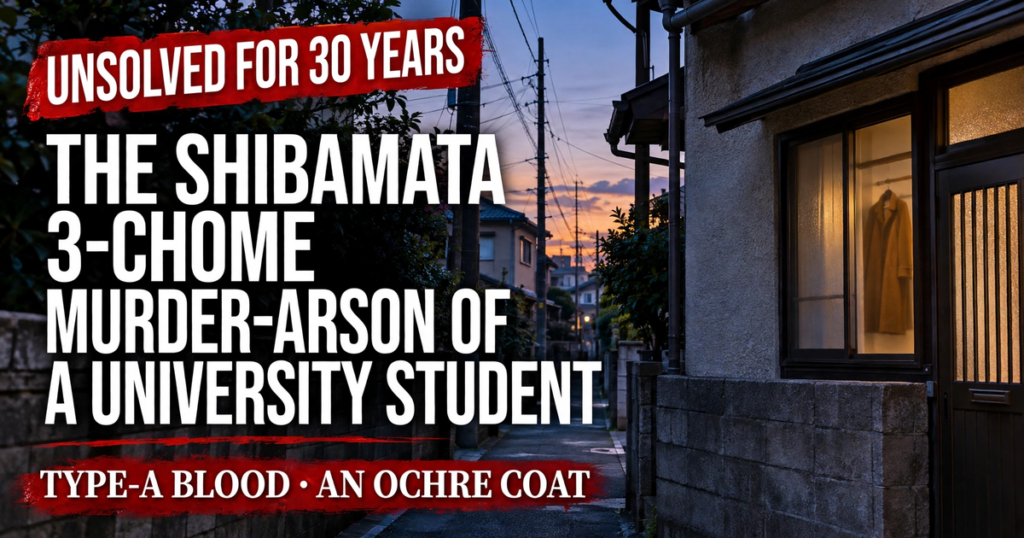
The killing of a university student in Shibamata
On the afternoon of September 9, 1996, Junko Kobayashi, a twenty-one-year-old fourth-year student in the English Department at Sophia University, was murdered at her family home in Shibamata 3-chome, Katsushika Ward, Tokyo. The house was then set on fire. The Metropolitan Police Department places the possible period of the crime between approximately 3:50 p.m., when Kobayashi's mother left the house, and 4:39 p.m., when a fire was reported to emergency services. The victim was killed with a bladed weapon. The fire destroyed the residence and became part of the investigation into the killing.
The narrow time window and the witnesses who saw a man
The Metropolitan Police Department says it has received two sightings close to the time of the crime and considers that the men may have been the same person because of the timing, location and clothing. The first sighting was at about 3:30 p.m. at an intersection south of the house. A cyclist saw a thin man, approximately 150 to 160 centimetres tall, holding a black umbrella and wearing an oversized ochre-coloured collared coat without a hood and dark, sweatshirt-like trousers. The second sighting was at about 3:55 p.m. in front of the house. A passer-by saw a man without an umbrella standing near the entrance and looking intently at the nameplate or the second-floor area. He was about 160 centimetres tall, of medium or slightly slim build, and wore an ochre or brick-brown coat or raincoat without a hood and dark trousers. The weather was rainy and unusually chilly. The police assessment that the two sightings may concern one man is an investigative view, not an identification.
The estimated weapon and the restraints
Investigators believe the attacker used a small, single-edged knife with a pointed tip. The police description gives an estimated blade length of at least eight centimetres and a width of approximately three centimetres. Fruit knives and paring knives have been shown as examples of the general type, not as an identification of a particular product. The weapon has not been publicly identified as a specific make or model. Reports based on investigative material describe Kobayashi's mouth and hands as having been bound with adhesive tape and her ankles as having been tied with a stocking. The knot used on the ankles has been described as a karage-musubi, a knot used in more than one practical setting. It is not sufficient evidence to identify a particular occupation.
The tape offered clues but was widely distributed
The cloth-backed adhesive tape used in the incident was traced to a factory in Shizuoka Prefecture and was manufactured from January 1994 onward. Police described a roll approximately fifty millimetres wide and twenty-five metres long, then priced at roughly 700 to 800 yen. It was more expensive than ordinary household tape and was sold mainly for packaging, including through direct supply to businesses as well as shops such as home-improvement and stationery stores. The adhesive surface contained small plant fragments, wood fragments and dog hair. Investigators considered that these materials might have been carried into the house on the offender's clothing. The trace evidence could help narrow possible environments or routes, but the tape was not a unique item that identified one purchaser.
Blood evidence and the matchbox
The Metropolitan Police Department has stated that the offender was male, suffered an injury and bled during the incident, and had blood type A. Blood evidence recovered at the scene, including material associated with a matchbox, has been treated as an important investigative lead. In September 2025, TV Asahi reported that a trace resembling the pattern of a work glove had been found on the bloodstained matchbox. The report also stated that the offender's fingerprints had not been found. The glove-like pattern does not identify a particular glove or the person who left it. The evidence remains a basis for seeking information rather than a public identification.
Old evidence and later witness information were reviewed again
The investigation did not remain limited to the information available in 1996. In 2020, police received and publicized a further account from a person who said that he had seen a man near the southern side of the house at approximately 3:30 p.m. on the day of the crime. In 2025, a life-size panel based on witness descriptions was reported as part of renewed public appeals. Police have also continued to examine physical traces using methods available after the original investigation. The passage of time can make recollections less precise, but a later statement may still be useful when it can be compared with the original scene, known movements and other evidence. None of these later developments has publicly resolved the identity of the offender.
The renewed reward and the continuing investigation
The National Police Agency renewed the case's special reward advertisement on September 9, 2026. The public reward has a maximum of three million yen, and a separate private reward offered by a support group has a maximum of five million yen. The combined maximum is therefore eight million yen, subject to the separate rules and to the degree to which information contributes to an arrest or resolution. The current public application period runs from September 9, 2026, through September 8, 2027. A maximum reward is not an automatic payment, and anonymous information may not qualify. The Metropolitan Police Department continues to request information about the crime, the man seen nearby, anyone who had an unexplained injury, and people who suddenly moved or stopped appearing around the relevant period.
The legal status and the facts that remain unknown
No person has been arrested, indicted or convicted for Kobayashi's murder. There has been no criminal trial in which the evidence, witness accounts or possible motive were tested before a court. Because the 1996 murder had not reached its former limitation deadline when Japan abolished the prosecution limitation period for murder in 2010, the case did not become time-barred under the old fifteen-year rule. That legal change does not itself identify an offender or establish guilt. The exact motive, the identity of the man seen near the home and the relationship, if any, between the blood evidence and the witness accounts remain unresolved. The case is an active unsolved murder and arson investigation, not a case in which a suspect's guilt has been judicially established.
Original Japanese record: 柴又三丁目女子大生殺人放火事件|A型の血液・黄土色コートの男、30年続く未解決捜査
Last updated:
Related articles

Case record
The Nagasakiya Amagasaki Store Fire: Fifteen Deaths from Smoke on the Fifth Floor
Case record
The Toyoake Mother-and-Three-Children Murders: Four Deaths in a House Fire and an Investigation Still Open
Case record
The Tama City Manhole Murder: A Missing Woman Found in a Roadway Chamber Ten Months Later

Case record