
The Mazda Headquarters Factory Vehicle Attack
On 22 June 2010, a former Mazda temporary worker drove into the company's factory grounds in Hiroshima and struck employees during the morning shift change. One man died and eleven people were injured. The defendant had worked for Mazda for only eight actual days. Although a psychiatric assessment identified a delusional disorder, the courts found that he retained criminal responsibility and upheld a life sentence in 2013.
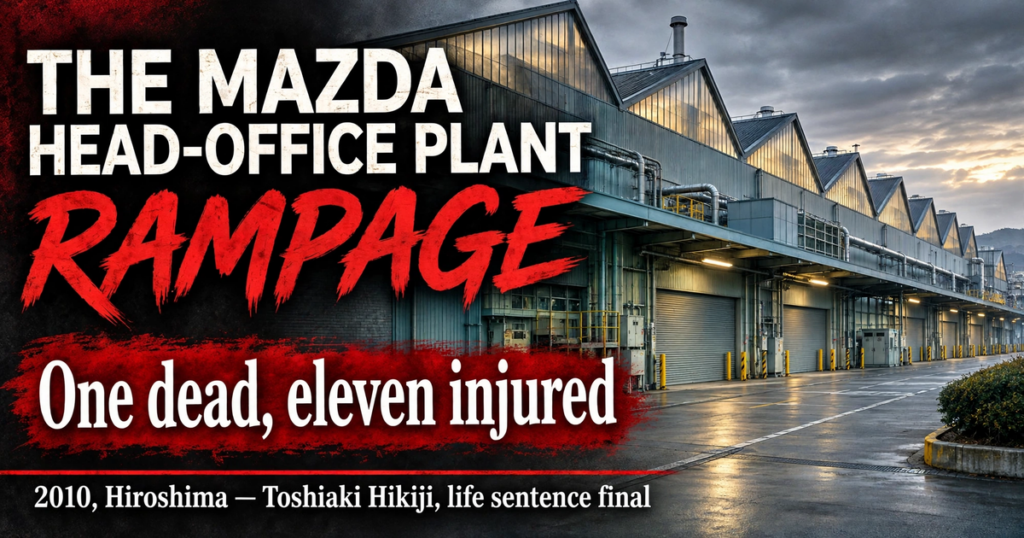
A car struck employees inside the Mazda factory grounds
At about 7:35 a.m. on 22 June 2010, a passenger car entered Mazda's factory grounds in Hiroshima and struck employees arriving for work. The site extended across Hiroshima's Minami Ward and Fuchu Town. Twelve people were hit. Hiroshi Hamada, aged 39, died, and eleven others suffered injuries ranging from minor to serious. The vehicle was driven by Toshiaki Hikiji (引寺利明), a former temporary employee. The attacks occurred during the morning shift change, when employees were moving on foot and by bicycle around the factory.
Hikiji had worked for Mazda for only eight actual days
Hikiji had not spent years working at the factory. Contemporary reporting and the later detailed employment account state that he was hired on 25 March 2010 under a six-month temporary contract, began work in the Ujina plant on 1 April and resigned on 14 April at his own request. Excluding paid leave, his actual work amounted to eight days. This detail matters because the attack was not the result of a long period of employment at the plant. It followed a brief placement and a later period in which Hikiji developed grievances about the company.
A claimed grievance became directed at employees as a group
After leaving Mazda, Hikiji came to believe that he had been bullied at work and that the company was using personal information to harass him. The article distinguishes those beliefs from evidence that organised harassment had actually occurred. His resentment widened beyond any specific former colleague. He planned to retaliate against the factory by harming employees who happened to be present. The people struck were not selected because of personal disputes with him; they became targets because they worked for the company he blamed.
The attack involved preparation and movement through several areas
Before the incident, Hikiji examined entrances and internal roads and chose a time when employees would be moving between shifts. He obtained a vehicle and drove through the grounds at speed. The car continued for approximately eight minutes, passing through more than one area and striking employees at separate locations. Security-camera images, the vehicle's damage and the positions of the injured people were used to reconstruct the route. The evidence indicated that the vehicle changed direction toward people at different points rather than being involved in one accidental collision.
One employee died and eleven others were treated as attempted-murder victims
Hamada died after being struck. Eleven other employees survived but suffered injuries. The fact that those eleven people did not die did not automatically mean that the driver lacked an intent to kill them. The court examined the vehicle's direction, the repeated impacts and the circumstances of each encounter. The prosecution included murder in relation to Hamada and attempted murder in relation to the other victims, along with related offences. The legal assessment distinguished the one death from the eleven attempted killings, rather than treating all twelve as victims of a traffic accident.
Hikiji left the factory and then contacted the police
After driving out of the factory grounds, Hikiji contacted the police and surrendered. Officers secured the vehicle and examined its damage, possible traces and the route it had taken. Investigators compared his account with camera footage, witness observations and the locations where people had been struck. His decision to contact police after leaving the site did not erase the conduct inside the factory. The investigation also considered the preparations made before entry, his knowledge of the roads and the timing of the shift change.
A delusional disorder was identified, but criminal responsibility remained separate
A psychiatric assessment identified a delusional disorder and considered its influence on Hikiji's resentment and the formation of his motive. The defence argued that the disorder impaired his criminal responsibility. The prosecution relied on his preparations, his choice of time and place, and his purposeful driving toward people. Under Japanese law, a diagnosis does not by itself establish insanity or diminished responsibility. The court must assess whether the person's ability to understand the nature and wrongfulness of the conduct, or to control it in accordance with that understanding, was lost or substantially impaired.
The district court imposed life imprisonment and the appellate courts upheld it
On 9 March 2012, the Hiroshima District Court sentenced Hikiji to life imprisonment. The prosecution sought life imprisonment, not death. The court accepted that the delusional disorder had influenced his thinking but found that he retained full criminal responsibility. Hikiji appealed, and on 11 March 2013 the Hiroshima High Court dismissed the appeal. On 24 September 2013, the Supreme Court's Second Petty Bench dismissed his final appeal. The life sentence became final. The courts did not treat the diagnosis as a legal basis for diminished responsibility.
An internal date inconsistency in the source article is recorded
One paragraph in the live Japanese article states that Hikiji was hired in 2008, but the incident chronology and the detailed employment record place his Mazda temporary employment in 2010. Contemporary reporting and the company's account corroborate 25 March 2010 as the hiring date and 14 April 2010 as the resignation date, with eight actual working days. This translation uses the corroborated 2010 chronology and does not repeat the isolated 2008 statement. The discrepancy is recorded for editorial review rather than silently treated as a verified fact.
Original Japanese record: マツダ本社工場連続殺傷事件|実働8日の元期間社員が12人を死傷、無期懲役確定
Last updated:
Related articles
Case record
The Kumagaya Serial Murders: Six Victims, Diminished Responsibility, and a Life Sentence
Case record
The Sumoto Five-Person Murders: From a Death Sentence to Life Imprisonment
Case record
The Oguchi Hospital Infusion Poisonings: Three Patients Killed and a Life Sentence Upheld
Case record