
The Sakai Father-and-Brother Murders
In Sakai, Osaka Prefecture, a father and his son died in separate incidents in early 2018. The father suffered repeated severe hypoglycaemic episodes after excessive insulin administration and died months later; the son was found dead in a room where charcoal had been burned, in circumstances staged to resemble suicide. The daughter and sister, Akemi Adachi, was convicted of both murders and received a final life sentence.
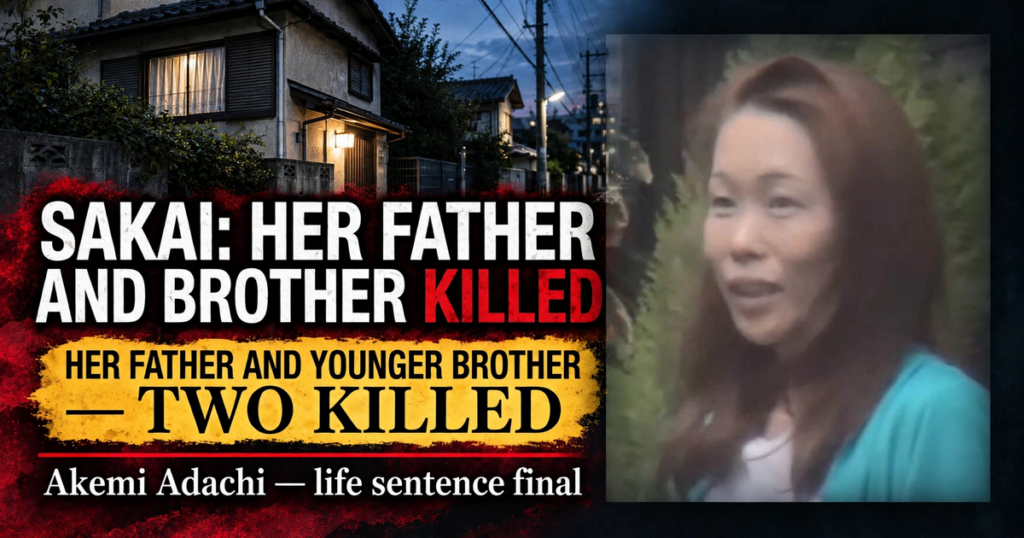
Two members of a family died in separate incidents
In 2018, two men in the same family died at their home in Sakai City, Osaka Prefecture. The father, Tomio Adachi, was 67. He suffered a severe hypoglycaemic episode in January and was left with serious brain impairment. He died on 28 June. His son, Seiko Adachi, aged 40, was found dead on 27 March in a second-floor toilet. Charcoal had been burned in the enclosed room, creating the appearance of death by carbon-monoxide poisoning in a suicide. The two deaths occurred at different times and by different means, and the investigation eventually connected them to the daughter and sister, Akemi Adachi.
The father had two severe hypoglycaemic episodes
Tomio had diabetes and regularly used insulin. He had managed his blood-glucose levels himself for many years. In January 2018, he experienced two severe episodes of hypoglycaemia within a short period. The first occurred after the night of 19 January and into the early hours of 20 January; he recovered after treatment. A second episode occurred between 25 and 26 January and left him with significant brain injury. He could no longer communicate or take nutrition independently in the way he had before. The prosecution alleged that excessive insulin had been administered on both occasions.
The cause of the father's later death was contested
Tomio also had advanced cancer. The defence argued that he died in June from the progression of his illness and that the insulin episodes in January were not legally connected to his death. The Osaka District Court found that the excessive insulin administration had caused hypoglycaemic brain injury, which made it difficult for him to receive appropriate cancer treatment and adequate nutrition. His condition deteriorated, including through complications such as pneumonia, and he died. The court concluded that the causal connection between the insulin administration and the death had not been broken simply because several months had passed.
The second death was staged to resemble suicide
On 27 March 2018, Seiko was found dead in the toilet on the second floor of the family home. Charcoal had been burned in the room, and the circumstances initially suggested suicide by carbon-monoxide poisoning. Investigators later found that Seiko had taken a sleeping medication that contained the same substance as a drug prescribed to Akemi. The prosecution argued that she had made him sleep and then burned the charcoal in the enclosed room so that he would be unable to respond to the danger. The court found that the use of medication, the preparation of charcoal and the choice of the small room formed part of a planned killing.
A false note attempted to shift responsibility for the father's condition
A document found at the scene of Seiko's death appeared to say that he had injected insulin into their father. If genuine, it could have suggested that Seiko had caused the father's hypoglycaemic episodes. The court found, however, that the document had been created using a computer connected with Akemi and was not a genuine note written by Seiko. It treated the document as an attempt to make the brother appear responsible for the father's condition and to support the false appearance that he had taken his own life. The document helped connect the two deaths, which otherwise occurred in different months and involved different apparent causes.
Digital searches and other circumstantial evidence were examined
The prosecution also relied on searches found on Akemi's smartphone, including searches linking hypoglycaemia with death and inquiries about insulin injections. A search history alone cannot establish murder. The court considered it together with the timing of the father's episodes, the opportunities to administer insulin, the medication found in the brother's body, the charcoal and the false note. The evidence concerning the mother, who reported drowsiness after drinking something prepared by Akemi on the day of Seiko's death, was also examined as part of the circumstances. The court did not treat that account alone as proof of either murder.
The defendant remained silent and the defence sought acquittal
The lay-judge trial began on 22 August 2022. When asked to respond to the charges, Akemi said that she had nothing to say and in substance maintained silence. The defence sought a full acquittal. It argued that the father had died from terminal cancer, that he might have administered the insulin himself and that the evidence did not prove Akemi had killed her brother. The Osaka District Court assessed the circumstantial evidence individually and together. It found that the father's history of managing diabetes, the unusual hypoglycaemic episodes, the searches, the medication in the brother's body, the preparation of charcoal and the false note were difficult to explain as unrelated coincidences.
The district court imposed life imprisonment rather than death
On 29 November 2022, the Osaka District Court found Akemi guilty of both murders and imposed life imprisonment. The prosecution had sought the death penalty, arguing that she had planned both killings and staged the brother's death to shift blame for the father's condition. The court regarded the brother's murder and the false evidence as particularly serious. It nevertheless found that the motive for killing the father had not been fully clarified and considered the balance with previous death-penalty cases. It concluded that the death penalty was not the only legally appropriate sentence and selected life imprisonment.
Both appeals were dismissed and the life sentence became final
The defence appealed against the convictions, while the prosecution appealed on the ground that life imprisonment was too lenient. On 26 April 2024, the Osaka High Court dismissed both appeals and maintained the first-instance outcome. The court upheld the findings that Akemi had killed both her father and her brother, and it found that the unresolved motive for the father's murder and comparison with earlier capital cases left room for a sentence other than death. The Supreme Court's Third Petty Bench dismissed Akemi's appeal on 9 December 2024. Her life sentence is final; the case is not awaiting a trial or an appellate ruling.
Original Japanese record: 堺・父弟殺害事件|インスリン投与と練炭自殺偽装、足立朱美の無期懲役確定
Last updated:
Related articles

Case record
The Osaka Minami Double Murder: A Death Sentence Overturned and Life Imprisonment Upheld
Case record
The Osaka Two-Child Starvation Case: Sakurako and Kaede Left Alone for About 50 Days, and Three Reports Failed to Protect Them
Case record
The Toyota Shoji Chairman Murder: A Consumer Fraud Scandal and a Killing in Front of Television Cameras
Case record