
The Toyota Shoji Chairman Murder: A Consumer Fraud Scandal and a Killing in Front of Television Cameras
Toyota Shoji chairman Kazuo Nagano was stabbed to death in his Osaka apartment on June 18, 1985, while reporters were gathered outside. Two men were convicted and received prison terms of ten and eight years. The killing did not resolve the losses suffered by thousands of investors.
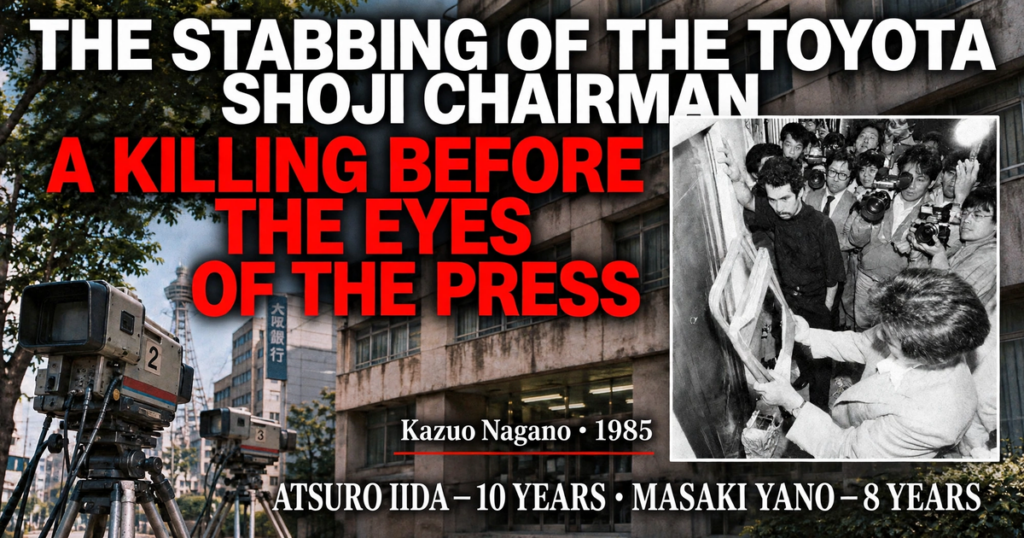
Toyota Shoji was a gold-investment business, not the automobile manufacturer
Toyota Shoji was a Japanese sales-deposit company that marketed gold bullion and similar assets. Customers were told that they were buying gold, but the company generally did not deliver the physical metal. Instead, it retained the supposed asset and issued documents representing the transaction, while promising returns or later repurchase. The scheme became known as a form of 'phantom commodity' or paper-gold trading. Many customers were older people who had been persuaded to invest their savings. The company name can be confused with Toyota Motor Corporation, but the two businesses were unrelated. The distinction matters because the murder occurred against the background of a major consumer-fraud scandal, not a dispute involving the automobile industry.
The scale of the consumer losses was enormous, although figures vary by definition
Later public discussions commonly described the Toyota Shoji losses as affecting approximately 29,000 people and involving about ¥200 billion. Figures from the 1986 bankruptcy proceedings were lower: approximately 27,800 claims totaling a little over ¥110 billion were reported. These figures do not necessarily contradict one another. One set describes the broader estimated scale of the scheme, while the other counts claims actually filed in the bankruptcy process. The number changes depending on whether withdrawn contracts, people who did not file claims and related companies are included. By 1985, the company's finances were collapsing, customers were demanding repayment and lawyers representing victims were pursuing recovery. The chairman, Kazuo Nagano, became the focus of intense media attention.
Reporters gathered outside Nagano's apartment on June 18, 1985
On June 18, 1985, a large group of journalists and television crews assembled outside Nagano's apartment in Osaka's Kita Ward. The company's financial failure and the possibility of Nagano's arrest had become major news. At approximately 4:30 p.m., two men arrived and announced their hostility toward the chairman. They entered the apartment through a window beside the entrance after damaging its metal frame and glass. One of the men was Atsuro Iida, a metalworks operator; the other was Masakazu Yano, a construction worker. The attack took place while reporters were still in the corridor outside. The television cameras recorded the events before and after the men entered, making the killing one of the most widely remembered crimes of the period.
Nagano was fatally stabbed and the two attackers were arrested at the scene
The two men attacked Nagano inside the apartment with a bayonet. He suffered fatal injuries and died after being taken to hospital. The attackers did not make a sustained attempt to escape. Police officers arrived and arrested them at the scene. Their actions were later examined separately in court, including which man had inflicted the fatal wounds and whether the two had acted together. Both defendants disputed aspects of their responsibility, but the courts rejected their attempts to avoid conviction. The fact that the attack was filmed and witnessed by reporters did not itself settle every question about the defendants' respective acts; the criminal proceedings still had to determine their roles and legal responsibility.
The court imposed different prison terms on the two men
The two defendants were convicted of the murder. The first-instance sentences were ten years' imprisonment for Iida and eight years for Yano. At the Osaka High Court appeal hearing on March 8, 1989, the court dismissed the appeals by both defendants and the prosecution, leaving the two sentences in place. The defendants had argued that the other man was responsible for the fatal attack, while the prosecution considered the sentences too lenient. The appellate court acknowledged the brutality and social impact of the crime but also considered the defendants' stated anger at the fraudulent business. That context was relevant to sentencing, but it did not turn the killing into a lawful act or remove their criminal responsibility.
Anger at the fraud did not make the killing an act on behalf of all victims
The men described their actions as driven by anger at the harm caused by Toyota Shoji. One of them claimed to have been asked by victims to kill Nagano. Such statements should not be treated as proof that the thousands of customers supported the attack. The interests of people seeking repayment were not identical, and many wanted their money returned through legal proceedings. A private killing could not substitute for a criminal investigation, asset recovery or compensation. It also removed the possibility of questioning Nagano in court about the company's transactions and the movement of its funds. The legal proceedings therefore treated the murder and the underlying consumer-fraud scandal as related background but separate matters.
The killing did not restore the money lost by Toyota Shoji customers
After Nagano's death, the company's bankruptcy process and the pursuit of responsibility against other officers continued separately. The bankruptcy estate contained only a small fraction of the money that had been collected. Parliamentary discussions in 1986 referred to filed claims exceeding ¥110 billion, while the bankruptcy estate was reported to contain only a little over ¥4 billion. The exact amount returned to each claimant depended on the proceedings, but the overall recovery was far below the estimated losses. Nagano's death ended the possibility of obtaining his testimony in a criminal trial about the company's financial structure. It did not make the victims whole, and it did not bring the wider consumer-fraud matter to an end.
The scandal contributed to regulation of sales-and-deposit transactions
In 1986, Japan enacted the Act on Specified Commodities, etc. Deposit Transactions, creating rules for transactions in which a business sells a product but retains it and promises benefits or repurchase. Toyota Shoji became a major example in later discussions of the risks of such schemes. The murder also raised enduring questions about television coverage of violence. Reporters had been present outside the apartment, and footage of the attack was broadcast widely. Later criticism asked whether journalists could have intervened or warned police sooner. The answer cannot be determined simply by replaying the footage, but the case remains an important reference point for discussions about public safety, reporting ethics and the treatment of violent images.
Original Japanese record: 豊田商事会長刺殺事件|報道陣の目前で永野一男が殺害された1985年、2人の実刑と預託商法規制
Last updated:
Related articles
Case record
The Tochigi Lynching Murder: Two Months of Captivity, a Failed Rescue and the Police Negligence Ruling
Case record
The Sasaguri Five-Year-Old Child Death Case: Coercive Control, Neglect, and Two Final Prison Sentences
Case record
The Cosmo Research Case: Two Abductions, One Hundred Million Yen and Litigation After the Executions
Case record