
The Higashisumiyoshi Case: A Life Sentence Overturned by Retrial Acquittals and a Finding of Unlawful Police Interrogation
After an 11-year-old girl died in a house fire in Osaka in 1995, her mother and her mother's partner were convicted of arson and murder and sentenced to life imprisonment. A retrial acquitted both in 2016 after fire experiments undermined the confession-based case; a later civil judgment found part of the police interrogation unlawful.
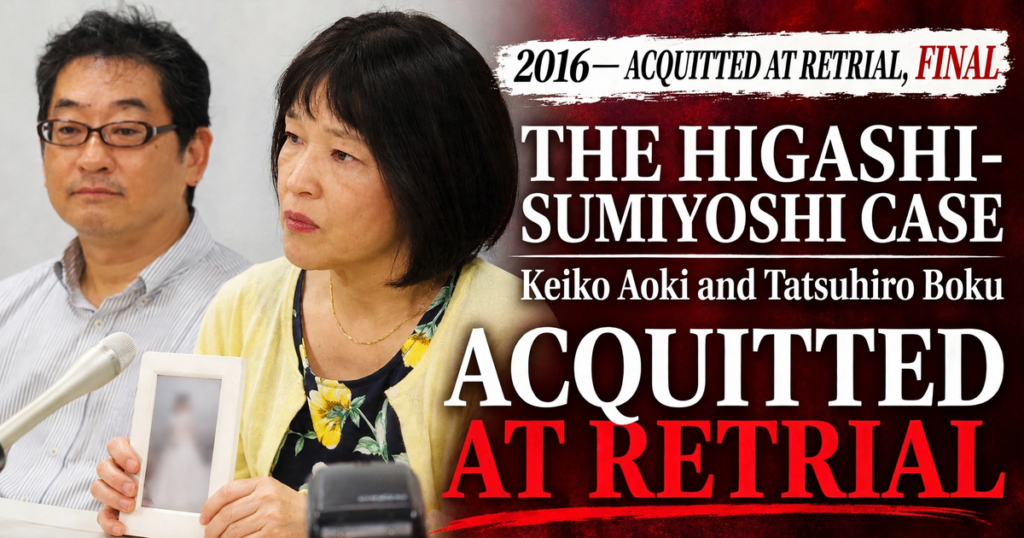
An 11-year-old girl died in a house fire in July 1995
On the evening of 22 July 1995, a fire broke out at a residence in Higashisumiyoshi Ward, Osaka City. Megumi, an 11-year-old sixth-grade pupil, was unable to escape from the bathroom where she had been bathing and died. Her mother, Keiko Aoki, and Aoki's partner, Yong-ho Park, were later accused of deliberately setting the fire to obtain insurance money. The death of a child in her own home was followed by a criminal investigation that would eventually result in life sentences, two decades of imprisonment, a retrial, and acquittals. The later proceedings established that the original convictions could not stand.
Investigators alleged that gasoline had been used to start the fire
The prosecution theory was that Park had removed gasoline from a vehicle's fuel tank, spread it across the garage floor, and ignited it, acting in concert with Aoki. The case also involved a student insurance policy with a death benefit of 15 million yen, and the two were charged with murder, arson of an inhabited building, and attempted fraud. The theory depended heavily on statements made during police questioning. There was no video recording or eyewitness account directly showing the two setting the fire. The reliability of the confessions and whether the described method was physically possible later became central issues in the retrial.
Aoki and Park were arrested and later convicted
Osaka Prefectural Police arrested Aoki and Park in September 1995, approximately six weeks after the fire. Aoki was then 31. Both made statements during the investigation that were used to construct the prosecution's account, but they denied the charges in court. In 1999, the Osaka District Court accepted the confessions and sentenced each defendant to life imprisonment. The convictions were upheld on appeal and became final by 2006. Aoki and Park continued to maintain their innocence while serving their sentences. The original judgment therefore remained legally effective for years, even as the defence sought to challenge the scientific basis of the alleged fire-setting method.
The defence requested retrials and tested the alleged fire mechanism
Park filed a retrial request in July 2009, and Aoki followed in August. Their defence team did not rely only on re-reading the interrogation statements. It examined the slope of the garage floor, the position of the vehicle and the bath heater, and the characteristics of a comparable vehicle. Experiments were conducted to determine whether gasoline could leak from an overfilled fuel tank, spread across the floor, and ignite from the pilot flame of the bath heater. The purpose was to test the central factual premise of the original conviction: whether the fire could have occurred in the manner described in the confessions.
Experiments showed that an accidental ignition remained possible
The retrial evidence indicated that gasoline could leak from the vehicle and flow toward the bath heater. If vapour or spilled fuel reached the heater's pilot flame, ignition could occur without anyone deliberately lighting the fire. The defence experiments also raised serious doubts about whether the sequence described in the confessions could actually be carried out under the conditions at the house. The issue was not simply whether another explanation was imaginable. It was whether the prosecution's account could be reconciled with the physical conditions and experimental results. The new evidence undermined the assumption that deliberate arson was the only reasonable explanation for the fire.
The Osaka District Court ordered a retrial in 2012
In March 2012, the Osaka District Court granted a retrial, finding that the new evidence created reasonable doubt about the original convictions. The prosecution challenged that decision, so the retrial did not begin immediately and the two were not yet acquitted. On 23 October 2015, the Osaka High Court rejected the prosecution's immediate appeal and upheld the decision to reopen the case. That ruling became final on 29 October 2015. The suspension of their sentences allowed Aoki and Park to leave prison on 26 October, before the retrial itself had concluded. At that point, the original convictions still existed, but the sentences were no longer being enforced while the retrial proceeded.
Both defendants were acquitted at retrial on 10 August 2016
The retrial began in 2016. The prosecution did not present evidence or maintain an affirmative case seeking to prove that Aoki and Park had committed the arson and murder. On 10 August 2016, the Osaka District Court acquitted both defendants. It found that the possibility of accidental ignition from leaked gasoline could not be excluded and that the prosecution's account did not prove deliberate arson beyond reasonable doubt. The prosecution did not appeal, and the acquittals became final. The legal position is therefore that Aoki and Park are not guilty of the arson and murder. The former life sentences are historical facts, not their current legal status.
Aoki later brought a civil damages action against the state and Osaka Prefecture
After the retrial acquittal, Aoki sought compensation from the national government and Osaka Prefecture, arguing that unlawful interrogation and prosecution had deprived her of approximately twenty years of freedom. This civil action was not a second trial about who started the fire. It concerned whether police officers and prosecutors had acted unlawfully under the State Redress Act. The civil court had to assess the conduct of investigators and prosecutors under the rules governing government liability, a different question from whether the criminal charges had been proved beyond reasonable doubt.
The court found part of the police interrogation unlawful, but not the prosecution decision
In March 2022, the Osaka District Court found part of the police interrogation of Aoki unlawful and ordered Osaka Prefecture to pay approximately 12.2 million yen. Reporting on the judgment described findings that investigators had used false statements and otherwise induced a confession. The court did not, however, find the prosecutors' decision to indict and conduct the original trial unlawful for purposes of state compensation. The Osaka High Court upheld that division of responsibility in February 2023. Osaka Prefecture did not appeal the part concerning the police, so the finding of unlawful interrogation and the prefecture's liability became final.
The Supreme Court ended the remaining state-liability dispute in March 2024
Aoki continued to challenge the rejection of the claim against the national government. On 28 March 2024, the Supreme Court dismissed her appeal, leaving the decision that denied national-government liability in place. The civil litigation therefore ended with different conclusions for the police and prosecutors: part of the police interrogation was held unlawful and Osaka Prefecture was liable, while the claim concerning the prosecutors' conduct was rejected. That result does not undo the retrial acquittals. The criminal case established that Aoki and Park were not guilty; the civil case separately determined which government actors had incurred compensation liability.
Original Japanese record: 東住吉事件|めぐみさん死亡火災、無期懲役から再審無罪と警察取調べ違法認定まで
Last updated:
Related articles
Case record
The Sennichi Department Store Fire: 118 Deaths and the Supreme Court's Ruling on Fire-Management Duties
Case record
The JR Fukuchiyama Line Derailment: 107 Dead, 562 Injured and the Questions of Speed, Safety Systems and Corporate Oversight
Case record
The Sakai Couple Murder: A Planned Robbery, Two Deaths and a Final Death Sentence
Case record