
The Osaka Two-Child Starvation Case: Sakurako and Kaede Left Alone for About 50 Days, and Three Reports Failed to Protect Them
In July 2010, police found the bodies of two young children in a one-room apartment in Osaka's Nishi Ward. The children were a three-year-old girl, Sakurako, and her one-year-old brother, Kaede. Their mother had left them alone for about 50 days. The Osaka City review later documented three reports from a neighbour and five home visits, none of which confirmed the children's safety. The mother was convicted of murder and sentenced to 30 years in prison in 2012; the judgment became final after appeals. The case exposed serious failures in child-protection assessment and inter-agency coordination.
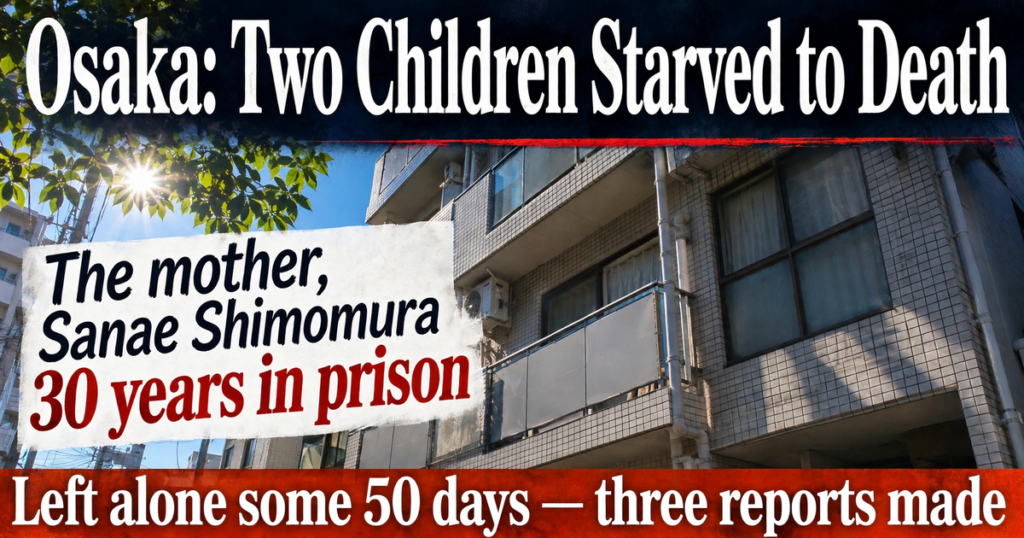
Two young children were found dead in a Nishi Ward apartment
At about 1:15 a.m. on 30 July 2010, police received a report of a foul smell coming from a one-room apartment in Osaka City's Nishi Ward. Officers entered and found the bodies of two children. The girl was three years old and her younger brother was one. Their mother, aged 23, was not at the apartment and was later arrested. The case became known as the Osaka two-child starvation case. The children's names are often reported as Sakurako and Kaede, but their ages and the circumstances of their deaths are the central facts. Their deaths were the result of prolonged neglect and the absence of food and care.
The mother and children had moved to Osaka in January
The family had moved to Osaka in January 2010. The mother and the two children lived together in a one-room apartment, but the family had no resident registration at that address. That made it harder for local services to connect the household with ordinary support and child-welfare information. The official review later noted that the family had been isolated from neighbours and local services. The mother's circumstances did not remove her responsibility for the children, but the administrative record is important because it shows how the warning signs were received and handled before the children died.
A neighbour made three reports about the children's crying
A neighbour contacted the child-abuse hotline three times. The first report was made on 30 March 2010 and described children crying late at night. The second report, on 8 April, said that the crying continued and that no adult voice could be heard. The third report came early on 18 May, after a period when the crying had temporarily stopped. The neighbour said that crying had resumed. The three reports concerned the same apartment. A separate 110 call made at the same time on 18 May referred to a different, unidentified apartment and must not be counted as a fourth report about this family.
Five visits did not establish that the children were safe
The child consultation centre and ward staff made five visits to the building. On the first three visits, staff could not get beyond the building's automatic-lock entrance. On two later visits, they entered the building but received no response at the apartment door. They rang the intercom, knocked and called out, but did not confirm whether the children were inside or safe. The official review noted that the first and second visits took place the day after the reports. After the third report, staff visited about ten hours later, but still did not verify the children's safety.
The official review identified failures in the response
The Osaka City review report, issued in December 2010, stated that three reports had been received and five visits had been made. It criticised the lack of an effective escalation after repeated unsuccessful visits. The centre did not bring the case together for a sufficiently urgent organisational review, and information from earlier visits was not adequately fed back to hotline staff. The report also identified weaknesses in coordination between the child consultation centre, the ward office, local child-welfare volunteers and police. The failures were not simply that a door had gone unanswered; the system did not respond appropriately to the repeated inability to confirm the children's safety.
The review also documented missed opportunities before the move
The official report described an earlier incident in Nagoya in August 2009, when the older child had been found alone and police had notified the child consultation centre. The centre made calls and visits but did not complete an effective follow-up. The family then moved to Osaka, where the lack of resident registration and limited neighbourhood contact made it harder to identify the children and provide support. The report emphasised that a household's lack of registration should not prevent child-protection agencies from investigating. It also recommended stronger outreach and better use of local networks, rather than relying only on a parent's response to a doorbell or telephone call.
The mother was arrested first for abandoning bodies and then for murder
Police arrested the mother on 30 July 2010 on suspicion of abandoning the bodies. On 10 August, she was re-arrested on suspicion of murder. These were separate procedural steps. The initial arrest concerned the handling of the children's bodies after death; the later arrest concerned responsibility for their deaths. The Osaka City review report was written before the criminal trial had begun and expressly warned that the precise circumstances of the deaths had not yet been established through court proceedings. Its findings about administrative response should therefore be distinguished from the later criminal judgment against the mother.
A 30-year sentence was imposed and became final
On 16 March 2012, the Osaka District Court sentenced the mother to 30 years' imprisonment for murder. The court found that she had left the children alone for an extended period, without the food and care they needed, and that the children died as a result. The sentence was later upheld through the appellate process: the Osaka High Court dismissed the appeal in December 2012, and the Supreme Court rejected the further appeal in March 2013. The judgment became final. The mother was not convicted merely of abandoning the bodies; the final judgment was for the murders of the two children.
The case changed how child-protection failures were discussed
The case became a major reference point in discussions of child protection, particularly the need to treat repeated reports and unsuccessful visits as a reason to escalate, not as a reason to close a case. The official review recommended stronger organisational decision-making, improved coordination with police and local agencies, better use of home-entry powers where legally justified, and outreach to isolated families. The review did not claim that every recommendation could have guaranteed a different outcome. It documented specific missed opportunities and institutional weaknesses. A responsible account must preserve both the criminal responsibility of the mother and the system failures identified by the city's own investigation.
Original Japanese record: 大阪2児餓死事件|桜子ちゃんと楓君を約50日残した母親と、3回の通告が届かなかった経緯
Last updated:
Related articles

Case record
The Eniwa Office Worker Murder: A Circumstantial-Evidence Conviction and Two Rejected Retrial Requests

Case record
The Asahikawa High School Student Murder
Case record
The Shibuya Junior-College Student Dismemberment Case: A Brother's Conviction and the Shift from Seven to Twelve Years

Case record