
The Hokkaido Government Office Bombing: Two Deaths, 95 Injuries and a Fourth Retrial Request
At about 9:00 a.m. on March 2, 1976, a timed bomb concealed in a fire extinguisher exploded near an elevator on the first floor of the Hokkaido Government Office in Sapporo. Two government employees died and 95 people were injured. Katsuhisa Omori was arrested in August 1976 and prosecuted for murder and explosives-related offences. He consistently denied placing the bomb. His death sentence became final in 1994. A fourth retrial request was filed in July 2025. In August 2026, prosecutors disclosed that 89 evidence items were unaccounted for, a development that did not itself overturn the conviction.
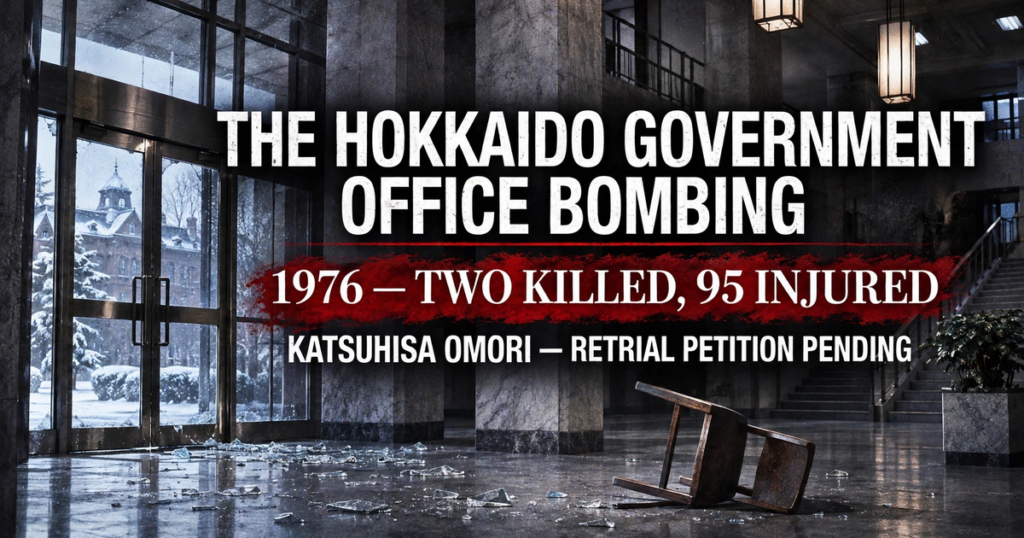
A timed bomb exploded at the prefectural government building
At about 9:00 a.m. on March 2, 1976, a timed bomb exploded near an elevator on the first floor of the Hokkaido Government Office's main building in Chuo Ward, Sapporo. The device had been concealed in a fire extinguisher. Two Hokkaido government employees, a man and a woman, died, and 95 people suffered injuries ranging from minor to serious. Part of the ceiling collapsed and glass was scattered by the blast. The explosion occurred during the morning work period, when many people were present in the building.
The attack affected a public building and many people who were not the target of a personal dispute
The bombing took place at the administrative centre of Hokkaido, not at a private home or an isolated site. The people killed and injured were employees and others who happened to be in the building. The Japanese article places the incident in the context of the 1970s, when bomb attacks against companies and public facilities had become a serious social issue. The Police White Paper later listed the incident among bombings associated with radical theories or ideologies. The translation does not infer a detailed political motive beyond what the source establishes.
Omori was arrested and consistently denied placing the bomb
Hokkaido police arrested Katsuhisa Omori in August 1976. He was prosecuted for offences including violations of the Explosives Control Punishment Law, murder and attempted murder. Omori denied involvement from the investigation through the trial and continued to assert his innocence after the death sentence became final. The conviction was not based on a confession in which he admitted planting the device. The courts relied on eyewitness testimony, seized materials and other circumstances that they considered connected him to the bombing.
The first-instance court imposed death in 1983
The Sapporo District Court found Omori guilty and sentenced him to death on March 29, 1983. Omori appealed, continuing to dispute that he was the person who had planted the bomb. The Sapporo High Court dismissed the appeal on January 21, 1988. He then appealed to the Supreme Court. The central issue throughout the proceedings was not simply the severity of the punishment, but whether the evidence established that Omori was the perpetrator.
The Supreme Court finalized the death sentence in 1994
On July 15, 1994, the Supreme Court dismissed Omori's final appeal. The death sentence became final. By then approximately eighteen years had passed since the bombing. Omori continued to deny the offence and sought to have the case retried. The legal status of a person with a final death sentence is not changed merely because a retrial request is filed. Unless a court orders a retrial or otherwise changes the judgment, the final conviction and sentence remain in force.
Earlier retrial requests did not result in a new trial
Omori filed a second retrial request in 2013 and a third in 2019. The third request was rejected by the Sapporo District Court and Sapporo High Court, and the Supreme Court dismissed a special appeal in January 2024. None of those proceedings resulted in a retrial being opened. The legal result therefore remained the 1994 final death sentence. A retrial request is an extraordinary procedure based on new evidence or other grounds; it is not simply another ordinary appeal and does not automatically cancel the original judgment.
The fourth request focused on the conditions under which an eyewitness could have seen a person
On July 1, 2025, Omori's defence team filed a fourth retrial request at the Sapporo District Court. The new material included a psychological expert assessment that reconstructed the conditions under which an eyewitness had said that they saw a person resembling Omori. The assessment examined the relative positions of the witness and the person observed and argued that the witness could not have perceived the person's face, or that any perception was unlikely to have remained in memory until the first police interview. The defence argued that the assessment undermined a key part of the final conviction.
The fourth retrial request remained separate from the final death sentence
The Japanese article's August 2026 update described the fourth retrial request as under review at the Sapporo District Court. The filing did not itself reopen the criminal trial or suspend the final death sentence. The question before the court was whether the new expert material and other evidence created grounds to begin a retrial. The article also explained that the earlier retrial requests had challenged physical evidence and forensic evaluations, while the fourth request placed greater emphasis on eyewitness perception and memory.
A later evidence-management problem was reported on 31 August 2026
After the Japanese article's August 28 update, news reports on August 31, 2026 disclosed that the Sapporo District Public Prosecutors Office could not locate 89 evidence items connected with the case. A Kyodo report broke the total down as 70 items for which originals remained but copies were missing, 17 for which copies remained but originals were missing, and two for which neither original nor copy could be found. This was a report about the custody and location of evidence, not a court decision that the conviction was invalid. The fourth retrial request and the final death sentence must therefore be described separately from the evidence-management issue.
The current legal status remains a final sentence with a retrial request pending in the source record
The case has two distinct legal facts: Omori's death sentence became final on July 15, 1994, and his fourth retrial request was filed on July 1, 2025. The reported loss or absence of evidence items in August 2026 may become relevant to future proceedings, but it does not itself amount to an acquittal or a retrial order. The English record therefore states the final conviction, the ongoing fourth retrial process as last reported, and the separate evidence-location disclosure without treating any of them as a final resolution of the others.
Original Japanese record: 北海道庁爆破事件|2人死亡・95人負傷、大森勝久の死刑確定と第4次再審請求
Last updated:
Related articles
Case record
The 1995 Tokyo Subway Sarin Attack: Victims, Criminal Trials and a Continuing Legacy
Case record
The Mitsubishi Heavy Industries Bombing and the East Asia Anti-Japan Armed Front's Corporate Bombing Campaign
Case record
The Mishima Incident: A Balcony Appeal for Constitutional Change and the Trial of Three Tatenokai Members
Case record