
The Yodo-go Hijacking: Red Army Faction Seizes Japan Airlines Flight 351 and Diverts It to North Korea
On March 31, 1970, nine members of the Japanese Communist League's Red Army Faction hijacked Japan Airlines Flight 351, known as the Yodo-go, while it was travelling from Tokyo to Fukuoka. The group demanded that the aircraft fly to North Korea. The plane stopped at Fukuoka and then Gimpo Airport in South Korea, where passengers were released in stages and Japanese transport official Shinjiro Yamamura volunteered to take the place of hostages. The aircraft reached North Korea on April 3. The hijackers' later lives and legal status differed, and international wanted notices continued for some members.
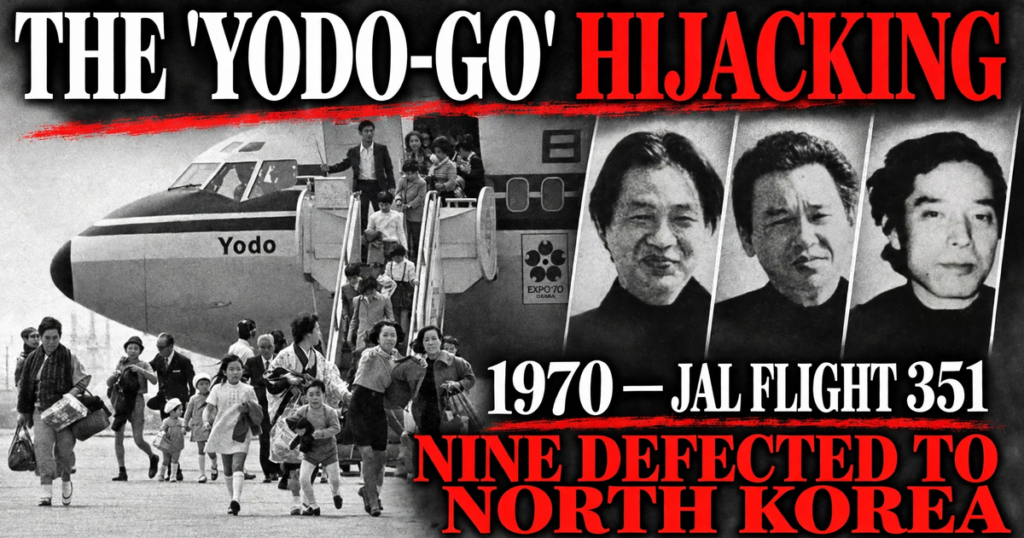
A domestic flight became an international hostage crisis
On the morning of March 31, 1970, Japan Airlines Flight 351, nicknamed the Yodo-go, departed Tokyo's Haneda Airport for Fukuoka. While the aircraft was in flight, nine members of the Japanese Communist League's Red Army Faction took control. The group was armed with Japanese swords and other weapons and demanded that the aircraft be flown to North Korea. A domestic passenger service had suddenly become an international security crisis involving hostages, aviation authorities and the governments of Japan and South Korea.
The hijackers chose a route that the aircraft could not fly directly
The aircraft could not simply continue to North Korea without dealing with its fuel and operational limitations. It first landed at Fukuoka Airport. Some passengers were released there, including women, children and older people. The stop allowed the authorities to begin negotiations while the hijackers continued to insist that the plane should be taken to North Korea. The staged release of hostages did not end the crisis, because the armed group still controlled the aircraft and the people who remained aboard.
The plane moved to Gimpo Airport for negotiations
The aircraft then flew to Gimpo Airport in South Korea. Negotiations continued there over the release of the remaining passengers and crew. Shinjiro Yamamura, a Japanese parliamentary vice-minister for transport, volunteered to enter the aircraft in place of hostages. His decision allowed the remaining passengers to be released while the plane could continue toward North Korea. The exchange was a highly unusual act of personal substitution in a hijacking negotiation and became one of the most remembered episodes of the case.
The aircraft reached North Korea on April 3
After the hostages were released in stages, the Yodo-go flew onward and landed at an airfield near Pyongyang on April 3, 1970. Yamamura and the flight crew later returned to Japan. The nine hijackers remained in North Korea. The Japanese source article's figure of 131 counts the passenger group including the nine hijackers. The official security-agency figure of 129 counts the people held as hostages: the 122 other passengers and seven crew members. The two totals therefore use different counting bases; the 129 hostages do not include the hijackers, while the 131 figure does.
The group belonged to the Red Army Faction, not the later Japanese Red Army
The hijacking was carried out by members of the Red Army Faction, a radical group that had emerged within the Japanese New Left. The Red Army Faction and the later Japanese Red Army are related in the wider history of radical political movements, but they were not the same organisation. The distinction matters because accounts sometimes use the terms interchangeably. The Yodo-go hijackers who remained in North Korea later became known as the Yodo-go group, a separate group from the overseas organisation called the Japanese Red Army.
The members' later lives did not follow one common path
After arriving in North Korea, the nine members did not all experience the same legal or personal outcome. Some later returned to Japan and faced arrest and prosecution; others died or remained abroad. Their spouses and associates also became part of the history of the group. Because the status of each person changed over time, a careful account should not say that all nine remained in North Korea indefinitely or that they were all prosecuted in the same way. Their later histories must be checked individually.
Arrest warrants were later issued over the abductions of three Japanese citizens
Japanese police later obtained arrest warrants in connection with the abductions of three Japanese citizens in Europe. Uomoto Kimihiro (魚本公博), one of the hijackers, was wanted on suspicion of abducting Keiko Arimoto (有本恵子) for the purpose of marriage. Yoriko Mori (森順子) and Sakiko Wakabayashi (若林佐喜子), wives of members of the hijacking group, were wanted in connection with the abductions of Toru Ishioka (石岡亨) and Kaoru Matsuki (松木薫). Police obtained warrants and placed the three on international wanted lists. These allegations concern separate incidents in Europe years after the hijacking; they are not additional convictions arising from the seizure of Flight 351. The individuals and the group have denied involvement.
The hijacking should not be merged with every later political crime
The Yodo-go incident is often discussed alongside later acts of international terrorism and the activities of the Japanese Red Army. That wider context is relevant, but it should not erase the specific facts of March 31 to April 3, 1970. The aircraft was seized by nine Red Army Faction members, hostages were released in stages, Yamamura substituted himself for those still aboard, and the plane reached North Korea. Later allegations, arrests and wanted notices concern distinct people and legal proceedings.
The case changed how Japan viewed aviation security and political violence
The hijacking exposed the vulnerability of domestic air services to politically motivated violence and the difficulty of negotiating when an armed group controlled an aircraft. It required cooperation among Japanese authorities, South Korean officials and aviation personnel. The event also left a long investigative legacy because the members' movement to North Korea placed some suspects beyond the immediate reach of Japanese law enforcement. More than half a century later, the Yodo-go hijacking remains both a historical aviation crisis and a case with continuing questions about the legal status of individuals connected to the group.
Original Japanese record: よど号ハイジャック事件|日航351便から北朝鮮へ、国際手配と拉致容疑が今も続く
Last updated:
Related articles

Case record
The Mitsubishi Heavy Industries Bombing and the East Asia Anti-Japan Armed Front's Corporate Bombing Campaign
Case record
The Matsumoto Sarin Attack: A Chemical Strike on a Residential Area and the First Reporter Who Came Under Suspicion

Case record
The Roppongi Nightclub Attack: Ryosuke Fujimoto's Death and the Search for Shinichi Mitate

Case record