
The Mitsubishi Heavy Industries Bombing and the East Asia Anti-Japan Armed Front's Corporate Bombing Campaign
Two timed bombs exploded outside Mitsubishi Heavy Industries' headquarters in Tokyo on August 30, 1974, killing eight people and injuring 380. The bombing was the starting point of an eleven-incident corporate bombing campaign; the later legal outcomes differed among the participants.
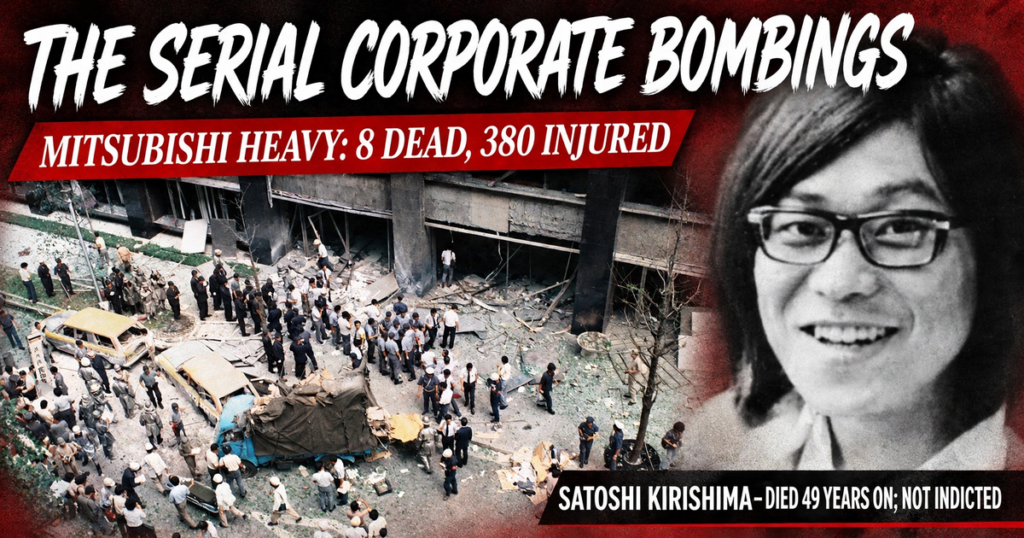
The Mitsubishi Heavy Industries bombing killed eight and injured 380
At around noon on August 30, 1974, two timed bombs exploded outside the headquarters of Mitsubishi Heavy Industries in Marunouchi, central Tokyo. The blast destroyed the entrance area and caused extensive damage to the building and surrounding streets. Police records give the toll as eight people killed and 380 injured. Office workers, passers-by and other members of the public were caught in the explosion. The bombing was not an attack confined to company property: the devices were placed in a busy urban area where large numbers of people were moving through the district. It became the most lethal incident in the corporate bombing campaign carried out by the East Asia Anti-Japan Armed Front.
A warning call did not prevent the casualties
The perpetrators reportedly made a telephone warning before the explosion. The warning did not result in the area being cleared in time to protect the people nearby. The two timed devices detonated in front of the building, and the blast affected the entrance, surrounding pavement and nearby structures. The police count of eight deaths and 380 injuries refers to the Mitsubishi Heavy Industries bombing itself. It should not be confused with the broader figures for all explosive incidents recorded in Japan during 1974, or with the toll from the entire corporate bombing campaign. Different official statistics use different scopes, and the distinction is essential when comparing the scale of the attack.
The East Asia Anti-Japan Armed Front operated through several groups
The bombing was carried out by the 'Wolf' group, one part of the East Asia Anti-Japan Armed Front. The broader organization also included groups known as 'The Fangs of the Earth' and 'Scorpion'. Their actions were linked by a political ideology directed against Japanese corporations and overseas business activity. The campaign did not consist of one isolated explosion. Police records describe eleven corporate bombing incidents through 1975, carried out by the groups and associated participants. The perpetrators' political statements and claimed objectives were part of the investigation, but they did not change the criminal character of placing explosive devices in public places and exposing people to lethal danger.
An earlier plan to attack a special train was abandoned
About two weeks before the Mitsubishi Heavy Industries bombing, members of the organization prepared what police records call the Arakawa Bridge bombing-preparation case, also known as the Rainbow Operation. On August 14, 1974, they laid materials intended to cause an explosion on the Arakawa railway bridge as a special train carrying members of the Imperial Family passed. The plan was abandoned before it was carried out. The National Police Agency's historical account states that explosives prepared for this operation were later used in the August 30 Mitsubishi bombing. The aborted plan is part of the context for the campaign, but it did not cause the eight deaths or 380 injuries recorded in the later attack.
Investigators traced the campaign through statements and organizational links
The corporate bombings continued after August 1974. In 1975, explosions targeted sites associated with Hazama Corporation, the Korea Industrial and Economic Research Institute, Oriental Metal and other locations. The police investigation examined the statements issued after attacks, the underground publication of the bomb-making manual 'Hara Hara Tokei' in March 1974 and the relationships among the people involved in its production and distribution. On May 19, 1975, police arrested eight members of the three groups and placed two others on a wanted list. The investigation linked the eleven corporate bombings to four earlier unresolved explosions from 1971 onward, which police counted as fifteen cases solved. The police count of eleven corporate bombings must still be distinguished from the broader number of explosive incidents that occurred in Japan during the same period.
Major defendants received different sentences and some participants left Japan
A number of leading members were arrested in May 1975, but the later legal history was not uniform. In November 1979, the Tokyo District Court sentenced Masashi Daidoji and Toshiaki Kataoka, later known as Toshiaki Masunaga, to death. The Tokyo High Court dismissed their appeals in 1982, and the Supreme Court dismissed their appeals on March 24, 1987, making both death sentences final. Other participants received different sentences. The 1975 Kuala Lumpur hostage crisis and the 1977 hijacking of a Japan Airlines aircraft in Dhaka led the Japanese government to release people held in custody as part of measures to protect hostages. Some members left Japan and joined the Japanese Red Army. The campaign therefore produced a mixture of final convictions, long-term imprisonment, release and escape.
Satoshi Kirishima was identified after almost five decades
Satoshi Kirishima remained at large for approximately forty-nine years. In January 2024, a man staying in a hospital in Kamakura, Kanagawa Prefecture, said that he was Kirishima. He died on January 29, 2024. Police compared DNA with relatives and examined his life history before identifying him as Kirishima. On February 27, 2024, the Metropolitan Police Department sent papers to prosecutors concerning five bombing cases, including the Korea Industrial and Economic Research Institute bombing. The submission occurred after his death. Kirishima was not arrested alive, indicted and tried in a criminal court. His identification and the police decision to refer the cases must not be described as a conviction.
The legal outcomes of the convicted defendants and Kirishima are not the same
The Tokyo District Court and Supreme Court judgments established criminal responsibility for the defendants who were tried, including Daidoji and Masunaga. Daidoji died in custody in May 2017 before his death sentence was carried out. Kirishima's legal position was different. Prosecutors declined to indict him on March 21, 2024, because he had died. A non-prosecution decision because a suspect is dead is not an acquittal after trial, but it is also not a conviction. The Mitsubishi Heavy Industries bombing should therefore be understood as the deadliest incident in the wider corporate bombing campaign, with eight deaths and 380 injuries, while the judicial outcomes of the various participants must be recorded individually.
Original Japanese record: 連続企業爆破事件|三菱重工8人死亡・380人負傷、桐島聡は49年後に死亡不起訴
Last updated:
Related articles
Case record
The 1995 Tokyo Subway Sarin Attack: Victims, Criminal Trials and a Continuing Legacy
Case record
The Yodo-go Hijacking: Red Army Faction Seizes Japan Airlines Flight 351 and Diverts It to North Korea
Case record
The Mishima Incident: A Balcony Appeal for Constitutional Change and the Trial of Three Tatenokai Members
Case record